Crossing 50 Tonnes? CBAM Country of Origin Rules for Importers
Crossing 50 Tonnes? CBAM Country of Origin Rules for Importers
Country of origin is not optional metadata on a CBAM declaration. It determines whether a shipment is exempt entirely under Annex III, whether you can deduct a carbon price already paid abroad, and how default emissions values get calculated when a supplier hands you nothing usable. Importers moving more than the threshold tonnage of covered goods a year must register as authorized CBAM declarants, and origin sits at the center of nearly every calculation and audit question that follows.
TL;DR:
- Accurate determination of country of origin depends on the last substantial transformation, not where the product was shipped from or produced.
- Only a small group of countries, including Iceland, Liechtenstein, Norway, and Switzerland, are exempt under Annex III if they have comparable carbon pricing systems.
- Proper documentation, such as certificates of origin and supplier records, is essential for verification, especially for complex multi-country supply chains.
- The 50-tonne annual import threshold combines all CBAM-covered goods, requiring early tracking and registration to avoid mid-year compliance surprises.
- Supplier data quality and timely recordkeeping are critical; automated tools like CarbonOps streamline declaration preparation and reduce verification risks.
Table of Contents
- What “country of origin” means under CBAM (and why it isn’t the same as country of production)
- Which countries and territories are exempt under Annex III
- How to determine country of origin for CBAM goods
- Reporting requirements: what your declaration actually needs
- How country of origin drives the CBAM charge and certificate deduction
- Documentation, verification, and recordkeeping tied to origin
- Thresholds, timing, and the compliance calendar
- Your origin compliance checklist before the next filing deadline
- How CarbonOps turns origin data into a filing-ready declaration
- Where origin declarations actually go wrong
- Get your origin data filing-ready without the manual cleanup
- Where to verify the rules yourself
- Sources
What “country of origin” means under CBAM (and why it isn’t the same as country of production)
Customs officials already know this distinction cold, but it trips up a surprising number of import teams: the country of origin for CBAM purposes follows the Union Customs Code’s non-preferential origin rules, not a marketing label or a shipping address. Origin attaches to where a product underwent its “last substantial transformation,” a legal test with decades of customs case law behind it, not to wherever a container happened to leave from.
Country of production, by contrast, is an installation-level concept. The CBAM Regulation requires importers to identify country of origin on every declaration, but where the installation is known, that plant-level detail feeds the emissions calculation separately from the origin field itself. You can have a single country of origin covering steel that was smelted in one facility and finished in another, both inside the same country, and the origin declaration stays the same while the emissions attribution gets more granular underneath it.
The gap between the two concepts widens fast once processing enters the picture:
- Inward processing: raw material enters a country, gets substantially transformed, then re-exports. Origin follows the transformation, not the raw material’s source.
- Assembly operations: if final assembly does not meet the “substantial transformation” threshold, origin can revert to the component’s original country, which is a common trap for goods assembled in a third country from EU-adjacent inputs.
- Multi-stage supply chains: aluminum billets cast in one country and extruded in another require you to trace which stage triggered origin under the applicable rule for that CN heading, since origin rules vary by product category.
- Repackaging or minor finishing: does not change origin, no matter how many customs paperwork trails suggest otherwise.
Get this wrong and the consequences compound. A misdeclared origin can void an Annex III exemption claim, misapply default values calculated for the wrong grid, or trigger a verifier flag that stalls your declaration during a filing window that does not pause for disputes.
Which countries and territories are exempt under Annex III
Goods originating in a handful of jurisdictions skip CBAM obligations entirely, because those countries already run an emissions trading system linked to or aligned with the EU’s own. Iceland, Liechtenstein, Norway, and Switzerland, along with a small number of listed territories, fall under this Annex III carve-out. The logic is straightforward: charging CBAM on top of an equivalent carbon price already baked into the product would double the penalty for the same ton of carbon, and the regulation exists to level a playing field, not to punish countries that already price carbon comparably.
Pro Tip: Don’t treat an Annex III exemption as a free pass on paperwork. You still need to declare the correct country of origin on every line so customs systems can apply the exclusion automatically. Skip the origin field, or get it wrong, and the shipment defaults into standard CBAM treatment.
A few practical points matter here:
- The exemption applies at the country level, not the product level, so a Swiss-origin steel coil is excluded regardless of the specific CN code.
- You still need documentation proving the declared origin holds up, because customs and verifiers can and do request evidence even on exempt shipments.
- If a good passes through Annex III territory but originates elsewhere, the exemption does not travel with the shipment. Transit is not origin.
A small number of countries plus a short list of territories carry this exemption today, a small fraction of the EU’s total trading partners, which means the overwhelming majority of covered imports still face full CBAM treatment regardless of how the goods are routed.
How to determine country of origin for CBAM goods
Establishing origin correctly starts before the shipment ever reaches a port. Here’s the sequence that holds up under verification:
- Identify the CN code first. Origin rules differ by product category, so you cannot apply a generic test. An 8-digit CN classification tells you which specific origin rule set applies.
- Trace the last substantial transformation. Ask your supplier where the product underwent its final significant processing step, not just where it shipped from. This is the legal origin, full stop.
- Request a certificate of origin or supplier attestation. A commercial invoice alone rarely satisfies a verifier. You want a document that names the country, the production facility if known, and ideally an installation identifier.
- Flag multi-country production chains. If raw material, intermediate processing, and final transformation happened in three different countries, document each stage and identify which one legally determines origin under the applicable rule.
- Cross-check inward processing arrangements. Goods that entered a country under an inward processing regime and re-exported after transformation carry the origin of the transformation, not the raw material’s source country. Confirm this with customs procedure codes on the supplier’s side.
- Retain everything. Certificates, supplier correspondence, and installation identifiers all become part of your audit trail the moment you file.
The hardest cases involve goods assembled from components sourced across several countries. A general guide on emission factors and defaults can help you understand which values apply once origin is settled, but the origin determination itself has to happen first. Get the sequence backward, and you risk applying the wrong default emissions dataset to an entire shipment.
Reporting requirements: what your declaration actually needs
Every CBAM import declaration carries a fixed set of mandatory data fields, and country of origin is one of the non-negotiable ones. The CBAM Regulation specifies exactly what customs must capture and pass along to the Commission’s surveillance mechanism:
- The 8-digit CN code for the imported good
- Quantity, expressed in the appropriate unit for that CN heading
- Country of origin, using standard country codes
- Customs procedure applied to the import
- Date of the declaration itself
Customs authorities feed this data into the CBAM Registry, which is the Commission’s central system for tracking covered imports across all member states. Origin is not a static field you fill in once. It flows through the entire chain from your commercial documents, to the customs declaration, to the Registry entry that eventually links to your emissions reporting.
Where the production installation is known, Commission guidance expects you to report it alongside country of origin, not instead of it. This matters because two shipments with identical origin declarations can carry very different emissions profiles depending on which specific plant produced them. A verifier reviewing your file wants to see that installation-level granularity whenever it’s available, because it’s what allows supplier-specific emissions values to replace the more conservative EU defaults.
If your supplier cannot name the installation, that’s not automatically a problem, but it does mean your declaration falls back to origin-based default values rather than facility-specific ones. Templates for structuring these fields consistently across shipments, like the ones in CarbonOps’s declaration guide, reduce the odds of a mismatched field tripping up a Registry submission.
How country of origin drives the CBAM charge and certificate deduction
This is where origin stops being a compliance checkbox and starts affecting what you actually pay. Authorized declarants can deduct a carbon price “effectively paid” in the country of origin from the number of CBAM certificates they owe. Commission guidance is specific about what counts: the price has to have actually been paid, and any rebates, free allowances, or export compensations that reduced the real cost to the producer must be netted out before you claim the deduction.
The mechanics work like this:
- Calculate embedded emissions for the shipment, using supplier data or EU defaults where supplier data is missing.
- Determine the carbon price genuinely paid in the country of origin for those emissions, adjusted for any rebate or compensation scheme.
- Convert that price into an equivalent certificate reduction.
- Subtract it from the gross certificate obligation to arrive at the net number of CBAM certificates to surrender.
A simplified worked example shows why this matters financially. Say an importer brings in steel with 100 tonnes of embedded CO2, and the origin country’s domestic carbon price, net of any rebate, works out to €40 per tonne on emissions that were actually taxed. If the full 100 tonnes was subject to that price, the deduction could offset a meaningful share of the CBAM certificate cost, since the certificate price tracks EU ETS auction levels.
| Component | Value |
|---|---|
| Embedded emissions | 100 tonnes CO2 |
| Origin carbon price (net of rebates) | €40/tonne |
| Deduction basis | Emissions actually subject to that price |
| Result | Reduced net certificates owed, not eliminated |
The deduction never zeroes out the obligation unless the origin price matches or exceeds the EU certificate price, and it never applies to emissions that weren’t actually priced at origin, even if the country has a carbon tax on paper. CarbonOps’s guidance on indirect emissions walks through how this interacts with electricity-related emissions specifically, which follow a separate default calculation track.
Documentation, verification, and recordkeeping tied to origin
Verifiers do not take a declared country of origin at face value. They want a traceable line from the customs entry back to the installation that made the good, and the CBAM Q&A guidance sets recordkeeping at a minimum of four years. That’s longer than most companies retain routine commercial paperwork, so it usually requires a deliberate filing decision rather than relying on default document retention policies.
An audit-ready bundle for a single shipment typically includes:
- The certificate of origin or supplier attestation naming the country and, where available, the installation
- Commercial invoices matching the declared quantity and CN code
- Supplier correspondence establishing the production process, particularly for multi-country supply chains
- Any evidence of a carbon price paid at origin, including rebate or compensation documentation if a deduction was claimed
- The customs declaration itself, cross-referenced against the CBAM Registry entry
The single largest verification failure area is weak traceability from the installation to the customs declaration. A supplier attestation that names a country but not a facility, or a facility that doesn’t match the emissions data submitted, is exactly the kind of gap that turns a routine verification into a drawn-out back-and-forth.
Pro Tip: Build your supplier evidence request into the purchase order process, not after the shipment lands. Chasing a certificate of origin retroactively, three months after a container clears customs, is where most origin disputes start.
Thresholds, timing, and the compliance calendar
The 50-tonne-per-year rule is an aggregation test, not a per-shipment one. Commission guidance sets the threshold at total CBAM-covered goods imported across the calendar year, which means five separate 12-tonne shipments from different suppliers can push you over the line just as easily as one large order.
- Track cumulative tonnage across all CBAM CN codes, not just per supplier or per product line, since the threshold applies to the importer’s total covered volume.
- Register as an authorized CBAM declarant once you cross 50 tonnes, and expect this to carry retrospective obligations if you realize the threshold was crossed mid-year rather than caught in advance.
- Track the certificate pricing basis shift. Certificate pricing is calculated on a quarterly average basis for 2026, moving to a weekly auction-based average from 2027 onward, which changes how predictable your certificate costs are quarter to quarter.
Small importers are the ones most likely to cross this threshold without noticing, because fragmented purchase orders across several suppliers rarely get aggregated automatically unless someone builds a system to track it. A transitional reporting guide is worth reviewing if you’re still working out how the shift from the reporting-only transitional period into the definitive regime affects your filing cadence.
Your origin compliance checklist before the next filing deadline
Turn everything above into a routine, and origin stops being a recurring source of last-minute scrambling:
- Map CN codes to origin risk before you order. Know which product lines fall under CBAM and which origin countries carry Annex III exemptions or higher default emissions values.
- Request installation-level data from every supplier, not just a country name, using a standard evidence template so nothing falls through on a rushed order.
- Build a tonnage aggregation system that links every customs entry to a running annual total, so the 50-tonne threshold never surprises you mid-quarter.
- Connect customs procedure codes to emissions records, so verifiers can trace a straight line from declaration to installation without a manual reconciliation exercise.
- Appoint an accredited verifier early and schedule an internal audit dry run before your actual filing window opens, using the same evidence bundle a real verifier would request.
Teams that build CN-to-origin mapping into procurement rather than bolting it on after the fact tend to cut verification back-and-forth substantially, according to CarbonOps’s automation guide, simply because the evidence exists before the question gets asked.
How CarbonOps turns origin data into a filing-ready declaration
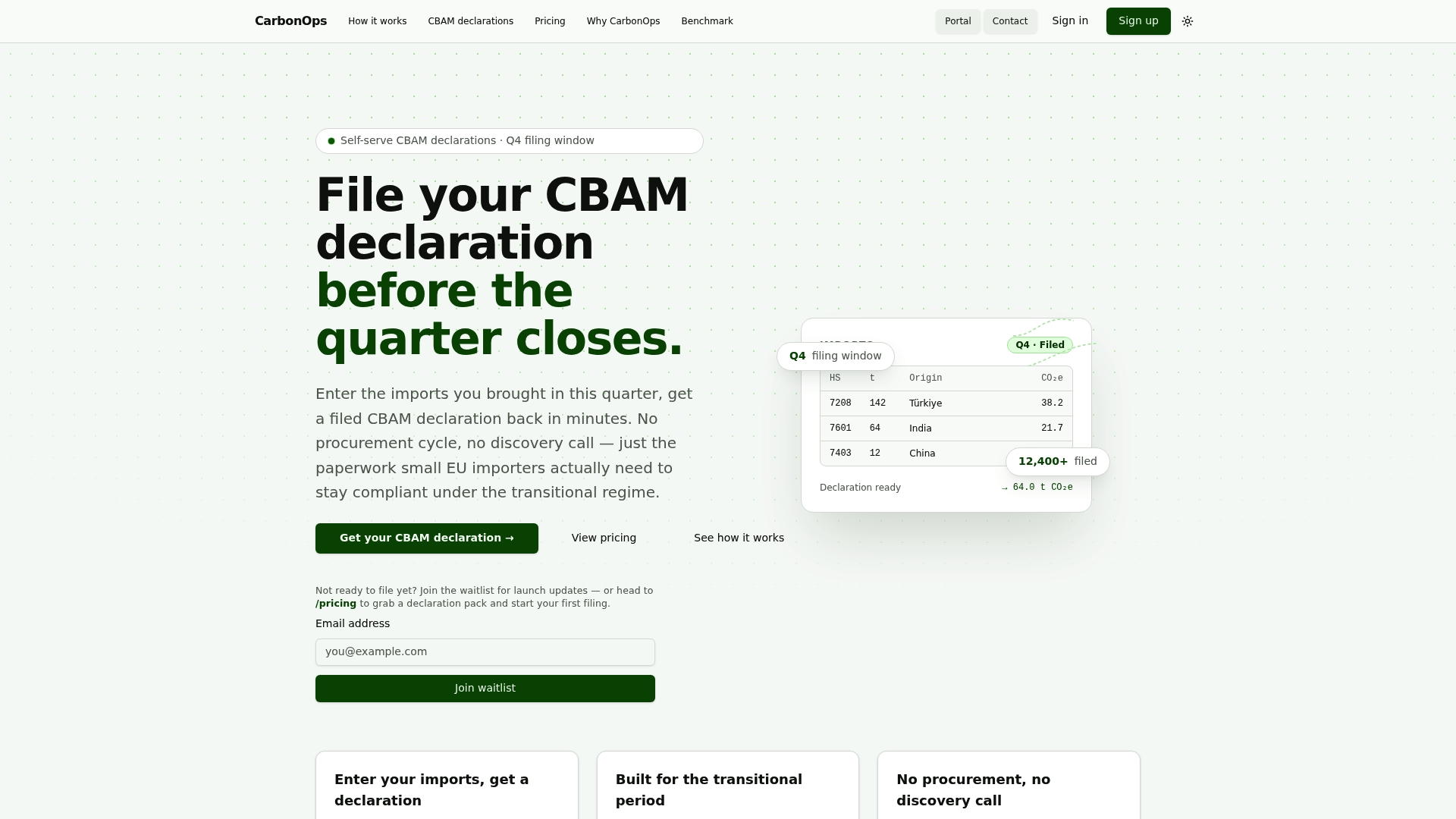
Origin errors usually come from the same root cause: supplier data arrives incomplete, inconsistent, or too late to fix before a filing deadline. CarbonOps handles this with a four-step process built around exactly that problem. You enter each shipment with its HS/CN code, mass, and country of origin, and the platform validates that data against the CBAM CN code list to confirm scope.
From there, every line gets matched to its CBAM sector so you can see instantly which imports need supplier emissions data and which don’t. Where supplier-specific figures are missing, CarbonOps applies the Commission’s published default values by CN code and country of origin automatically, so no line sits incomplete waiting on a supplier that never responds. The result exports directly in the format the CBAM Registry expects, with the origin and emissions trail retained for your filing history.
That structure matters most for import teams juggling multiple suppliers across different origin countries, where manually tracking which lines have real data versus defaults is the exact gap that produces verification headaches later.
Where origin declarations actually go wrong
The mistake I see most often isn’t a fabricated origin claim. It’s a country field filled in with wherever the invoice was issued rather than wherever the last substantial transformation happened. Nobody’s lying; they’re just using the wrong test. The fix is cheap: ask suppliers the origin question directly, in writing, before the shipment ships, not after a verifier asks why the declared country doesn’t match the production evidence.
Escalate to customs or legal the moment a supplier’s documentation contradicts itself, rather than trying to paper over the gap. A shortcut that preserves audit defensibility beats a shortcut that just saves time this quarter. When in doubt on a deduction claim, assume no rebate-adjusted carbon price applies until you can prove otherwise. That conservative default costs you a little now and saves you a penalty conversation later.
— Jake Stevens
Get your origin data filing-ready without the manual cleanup
Chasing supplier attestations, reconciling CN codes against origin countries, and manually applying default values line by line is the part of CBAM compliance that eats the most time for the least reward. CarbonOps turns that grind into a four-step intake: enter your shipments, get CN codes matched to sector, let default values fill the gaps supplier data leaves open, and export a Registry-ready declaration with the origin trail intact.
There’s no subscription to commit to and no platform rollout to schedule. You pay per declaration, with multi-pack options if you’re filing across several quarters, and the audit trail carries forward automatically. If your next filing deadline is approaching and your supplier origin data is still scattered across emails and invoices, check current pricing or start your declaration and see exactly where your origin data stands before you submit.
Where to verify the rules yourself
For the primary legal text, consult the CBAM Regulation on EUR-Lex and the Commission’s CBAM guidance and Q&A. For broader economic context, the OECD’s CBAM analysis is worth a read.
Sources
- Carbon Border Adjustment Mechanism (CBAM) — Taxation and Customs Union
- Regulation (EU) 2023/956 (CBAM) — EUR-Lex