De Minimis CBAM: The 50-Tonne Exemption Explained

De Minimis CBAM: The 50-Tonne Exemption Explained
If your total annual imports of CBAM-covered goods fall at or below 50 tonnes of net mass, Regulation (EU) 2025/2083 exempts you from CBAM reporting, declaration, and certificate-surrender obligations entirely. That is the de minimis CBAM rule in one sentence. The single action you should take right now: build or verify a year-to-date (YTD) mass tracking process at the CN/HS code level so you know exactly where you stand before you cross that line.
A few things worth knowing immediately:
- The 50-tonne threshold is cumulative across your entire calendar year, aggregated across all CBAM CN codes and all supplier channels—not per shipment or per product code.
- The covered sectors are iron and steel, aluminium, fertilisers, and cement. Electricity and hydrogen are excluded.
- Slaughter and May’s analysis estimates the 50-tonne threshold will exempt most importers by count while keeping nearly all embedded emissions in scope.
- CarbonOps automates the mass tracking and declaration steps described throughout this article.
Table of Contents
- What the 50-tonne de minimis exemption actually covers (and what it does not)
- How to calculate the 50-tonne threshold: aggregation rules and worked examples
- How the de minimis exemption fits into CBAM’s reporting phases and key deadlines
- What happens when you exceed 50 tonnes: retroactive obligations and penalties
- Step-by-step compliance checklist for US importers
- Research-backed insights: common mistakes, audit costs, and the leniency nuance
- Key Takeaways
- Why US importers consistently underestimate this rule
- CarbonOps makes CBAM threshold monitoring straightforward
- Useful sources for verifying the primary rules
What the 50-tonne de minimis exemption actually covers (and what it does not)
Regulation (EU) 2025/2083 introduced the single mass-based de minimis threshold through Article 2a and Annex VII. It replaced the previous value-based consignment exemption (the old EUR 150 threshold) with a cleaner, volume-based rule designed to reduce administrative burden on small importers, particularly SMEs.
The regulation’s stated intent: the threshold is calibrated so that the de minimis exemption applies to no more than 1% of total embedded emissions covered by CBAM. The European Commission reviews this annually by April 30 and can adjust the threshold by delegated act if coverage slips below that floor.
Sectors covered by the exemption:
- Iron and steel (Annex I CN codes)
- Aluminium
- Fertilisers
- Cement
What the exemption does NOT cover:
- Electricity imports (sector-specific implementation rules apply separately)
- Hydrogen imports (same reason)
The exemption applies per importer, per calendar year. That means the legal entity importing the goods is the unit of measurement, not the freight forwarder, the customs broker, or the individual shipment. Critically, the regulation specifies that the threshold applies to cumulative net mass irrespective of whether imports are declared by the importer directly or through an indirect customs representative. If you use an indirect customs representative, the mass still counts against your total, and that representative must obtain authorised declarant status before acting on your behalf.
The Council’s press release on the Omnibus I simplification frames this as an administrative relief measure for small importers, not a loophole. The Commission retains annual review authority, so the 50-tonne figure is not permanently fixed.
How to calculate the 50-tonne threshold: aggregation rules and worked examples
The calculation rule is straightforward but frequently misapplied: add up the net mass of every CBAM-covered good you import in a calendar year, across every CN code, every supplier, and every shipment. The result is your cumulative annual mass. If it stays at or below 50 tonnes, you are exempt. If it exceeds 50 tonnes at any point, obligations kick in retroactively for the entire year.

Net mass means the mass of the product itself, excluding packaging, as required by customs rules. Processed or derived products count if they fall under a CBAM Annex I CN code.
Three worked examples
Example A: Small importer, stays under threshold
A US-based trading company imports 12 tonnes of aluminium extrusions (CN 7604) and 30 tonnes of steel rods (CN 7213) in a calendar year. Total: 42 tonnes. The importer is exempt for that year. No CBAM declaration or certificate surrender is required.

Example B: Importer crosses mid-year (retroactive consequence)
The same importer adds a third product line in August: 20 tonnes of cement clinker (CN 2523). Cumulative mass is now 62 tonnes. The 50-tonne threshold was crossed in August. Under Article 2a(2) of the consolidated regulation, obligations apply retroactively to all CBAM goods imported in that calendar year, including the January aluminium and March steel shipments. The importer now owes declarations and certificate surrender for all 62 tonnes, not just the 12 tonnes above the threshold.
Example C: Multiple CN codes where aggregation catches importers off guard
A compliance officer tracks steel (CN 7208) and aluminium sheet (CN 7606) in separate spreadsheets managed by different procurement teams. Steel: 28 tonnes. Aluminium: 24 tonnes. Neither team flags a problem because each product line looks fine in isolation. Combined: 52 tonnes. The threshold is exceeded, and neither team knew until the annual reconciliation.
Spreadsheet tracking template
| Column | What to record |
|---|---|
| Import date | Date of customs acceptance |
| CN code | 8-digit CN code from customs declaration |
| Supplier name | Legal entity supplying the goods |
| Country of origin | Non-EU country of production |
| Net mass (kg) | From customs declaration, packaging excluded |
| YTD cumulative mass (kg) | Running total across all CN codes |
| % of 50-tonne threshold | YTD ÷ 50,000 kg |
| Alert flag | Flag at 75% (37,500 kg) and 90% (45,000 kg) |
Pro Tip: Set your internal alert at 75% of the threshold (37,500 kg), not 90%. The 10% leniency margin (5,000 kg) sounds like a buffer, but it is not a free pass. Exceeding the threshold by up to 5,000 kg may reduce the penalty, but it does not eliminate retroactive declaration and certificate obligations. Treat 45,000 kg as your operational ceiling, not 50,000 kg.
How the de minimis exemption fits into CBAM’s reporting phases and key deadlines
CBAM has operated in two distinct phases, and the de minimis exemption interacts differently with each.
Transitional phase (October 2023 through December 2025): During this period, importers were required to submit quarterly CBAM reports covering embedded emissions in their imports. The de minimis exemption as defined by Regulation (EU) 2025/2083 applies from the regulation’s entry into force, so importers who fell below 50 tonnes during the transitional period should confirm their status against the updated rules.
Definitive phase (from January 1, 2026): This is when the full CBAM regime applies: authorised declarant status is required, CBAM certificates must be purchased, and an annual declaration covering the prior calendar year must be submitted by September 30. Certificate surrender follows the same annual deadline. From 2027, a quarterly minimum surrender of 50% of estimated annual liability applies.
The March 31, 2026 transitional window: Importers who expect to exceed the 50-tonne threshold must apply for authorised CBAM declarant status before crossing it. PwC’s implementation note confirms a transitional safeguard: importers who submitted their application by March 31, 2026 were permitted to continue importing while authorisation was pending. If you missed that window, you need authorisation in hand before exceeding 50 tonnes.
Key compliance calendar:
- By April 30 each year: The Commission reviews the 50-tonne threshold using prior 12-month import data. If coverage of embedded emissions drops below 99%, the threshold may be amended by delegated act, effective January 1 of the following year. Monitor this.
- By September 30 each year: Annual CBAM declaration for the prior calendar year is due, along with certificate surrender.
- From 2027 onward: Quarterly surrender of at least 50% of estimated annual certificate liability.
- Before crossing 50 tonnes: Apply for authorised CBAM declarant status. Do not wait.
The Mayer Brown briefing also notes that national authorities and the Commission exchange a list through the CBAM registry of importers who have exceeded 90% of the threshold. That monitoring mechanism means customs authorities may contact you before you file anything.
Immediate checklist for compliance teams:
- Confirm your legal entity structure and which entity is the importer of record for each CBAM product line.
- Map all purchased goods to their 8-digit CN codes and verify which fall under Annex I.
- Set up YTD mass tracking (see the spreadsheet template above).
- Configure alerts at 75% (37,500 kg) and 90% (45,000 kg) of the 50-tonne threshold.
- If you expect to exceed 50 tonnes in 2026, confirm whether your authorisation application was submitted by March 31, 2026.
What happens when you exceed 50 tonnes: retroactive obligations and penalties
The compliance cliff is the defining risk of the de minimis exemption. Cross the threshold by a single kilogram and the entire year’s imports become subject to CBAM obligations.
Retroactive obligations:
- Declaration required for all CBAM goods imported in the calendar year, not just those above 50 tonnes.
- Certificate surrender required for all embedded emissions in those goods.
- Verified emissions data needed for every shipment, retroactively. If supplier-specific data is unavailable, EU default values apply, but those defaults are typically set conservatively (higher than actual emissions), which increases certificate costs.
- Back-calculation of embedded emissions across all shipments, potentially requiring third-party verification.
Penalties:
Mayer Brown’s analysis outlines the penalty structure: importers who exceed the threshold without authorised declarant status face penalties set at three to five times the standard rate. The standard CBAM penalty is €100 per tonne of CO₂ equivalent not covered by certificates. At three to five times that rate, the exposure is €300–€500 per tonne of unreported embedded emissions. Paying the elevated penalty can release the importer from subsequent declaration and certificate obligations for those imports, but that is a costly exit.
The 10% leniency margin:
A limited reduction applies if the excess is no more than 10% of the threshold, meaning you exceeded 50 tonnes by no more than 5 tonnes. This is a narrow band. It does not eliminate obligations; it reduces the penalty. Relying on it as a planning assumption is a poor strategy.
Operational consequences beyond penalties:
- Customs authorities can refuse clearance for future shipments if authorisation is missing.
- Retroactive data collection from suppliers is time-consuming and often incomplete.
- Third-party verification of back-calculated emissions adds cost and delay.
- The administrative burden of retroactive compliance frequently exceeds the cost of proactive tracking.
Step-by-step compliance checklist for US importers
Whether you expect to stay under 50 tonnes or are approaching the threshold, these steps apply now.
-
Identify your importer of record. The 50-tonne threshold applies per legal entity. If your US business imports through multiple subsidiaries or affiliated EU entities, each entity’s mass is tracked separately. Confirm which entity holds the importer of record status for each product line.
-
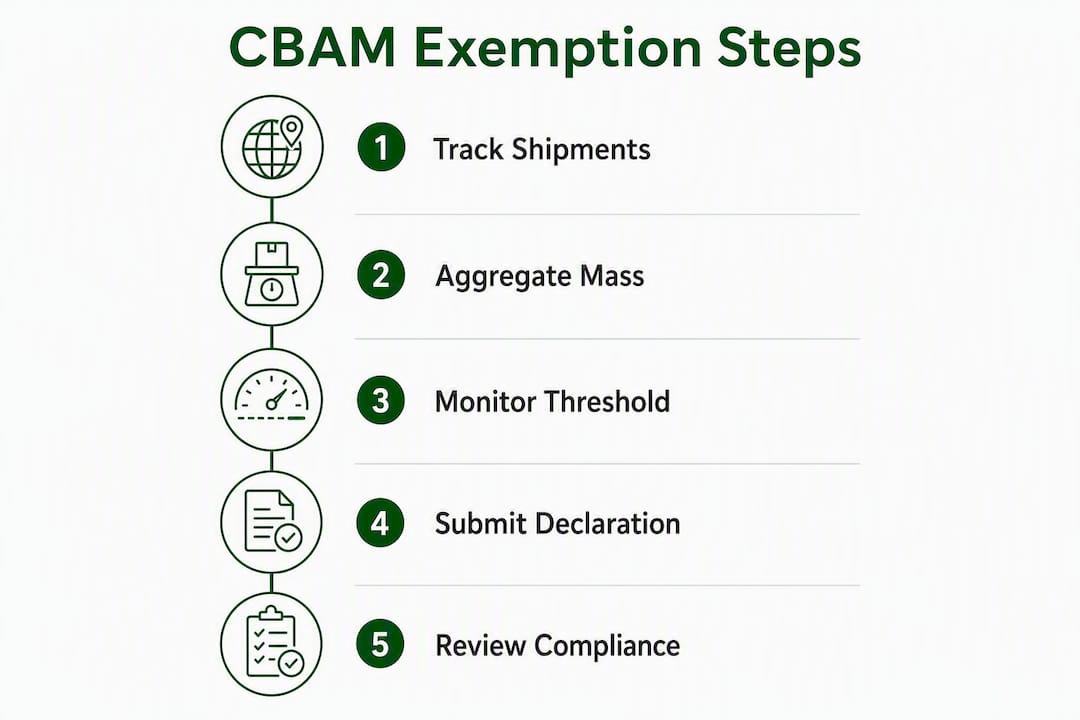
Map all goods to CN codes. Pull your customs declarations for the current calendar year. Identify every 8-digit CN code. Cross-reference against CBAM Annex I to confirm which codes are in scope. This step alone catches most aggregation errors.
-
Build YTD mass tracking. Use the spreadsheet template from the calculation section above. The critical column is the running cumulative total across all CN codes. Update it with every shipment.
-
Set threshold alerts at 75% (37,500 kg) and 90% (45,000 kg). At 37,500 kg, trigger an internal review. At 45,000 kg, begin the authorised declarant application process immediately.
-
Collect supplier emissions data. For each CBAM-covered supplier, request embedded emissions data in the format the EU registry expects. Where supplier-specific data is unavailable, EU default values by CN code apply. Store all supplier declarations and correspondence as part of your audit trail.
-
Understand your indirect representative situation. The regulation is explicit: if an indirect customs representative declares goods on your behalf, the mass still counts against your total. Confirm your representative’s authorisation status and ensure they are reporting mass data back to you.
-
Apply for authorised CBAM declarant status before crossing 50 tonnes. If you expect to exceed the threshold in 2026, the March 31, 2026 transitional window has passed. You need authorisation in place before the threshold is crossed. Contact the relevant national competent authority in the EU member state where you are established or where most of your imports enter.
-
Plan for certificate purchasing if you expect to exceed the threshold. CBAM certificates are purchased through national registries. Factor certificate costs into your import pricing and cash flow planning.
-
Retain all records for at least five years. Customs declarations, supplier emissions data, CN code mapping documentation, and YTD tracking records all form your audit trail.
Pro Tip: CarbonOps automates steps 2 through 5 in this checklist. You enter each shipment’s HS code, mass, and country of origin. The platform maps CN codes, applies EU default emission values where supplier data is missing, tracks your cumulative YTD mass, and generates the CBAM declaration PDF in the format the EU registry expects. For importers managing multiple product lines across different suppliers, that automation eliminates the manual aggregation error that causes most threshold breaches.
Research-backed insights: common mistakes, audit costs, and the leniency nuance
The de minimis exemption is not a “do nothing” option. Compliance experts consistently flag that importers who treat the exemption as a reason to stop tracking create the most expensive compliance problems.
The aggregation blind spot is the most common mistake. The threshold does not apply per consignment or per CN code. It applies to the total net mass aggregated per importer across all CN codes. Teams that manage steel and aluminium procurement separately, with no shared tracking system, routinely miss the combined total until year-end reconciliation. By then, the threshold may already be exceeded and retroactive obligations are locked in.
Audit trail costs are underestimated. Even importers who stay under 50 tonnes should maintain basic records. If customs authorities question your status, you need documentation showing your cumulative mass for the year. Reconstructing that data retroactively from fragmented customs declarations is expensive and time-consuming.
The 10% leniency margin is narrower than it sounds. Five tonnes sounds like meaningful headroom. In practice, a single additional shipment of steel or aluminium can exceed it. The leniency reduces the penalty; it does not reduce the declaration and certificate obligations. Importers who rely on it as a buffer tend to discover this distinction at the worst possible moment.
- Track from the first shipment of the year, not from the point where you think you might be getting close.
- Keep supplier emissions data requests in a shared folder with timestamps. Regulators and auditors look for evidence that you requested data in good time, not just that you eventually received it.
- Use conservative rounding: if a shipment’s net mass is uncertain, round up, not down.
Pro Tip: The cost comparison that matters: proactive YTD tracking costs a few hours of setup and ongoing data entry. Retroactive compliance, if you breach the threshold unexpectedly, means back-calculating emissions across every shipment, chasing supplier data you did not collect at the time, potentially paying for third-party verification, and purchasing certificates at whatever the current market price is. The administrative burden alone typically exceeds a full year of proactive tracking costs.
Key Takeaways
The 50-tonne de minimis CBAM exemption covers most importers by count but carries a retroactive compliance cliff that makes proactive YTD mass tracking non-negotiable from the first shipment of the year.
| Point | Details |
|---|---|
| 50-tonne annual threshold | Cumulative net mass across all CBAM CN codes per importer per calendar year; not per shipment or per product code. |
| Retroactivity risk | Exceeding 50 tonnes triggers obligations for all CBAM imports in that calendar year, not just the shipment that crossed the line. |
| Authorisation timing | Apply for authorised CBAM declarant status before crossing 50 tonnes; the March 31, 2026 transitional window has now closed. |
| 10% leniency limit | Exceeding the threshold by up to 5 tonnes may reduce the penalty but does not eliminate declaration or certificate obligations. |
| Climastry / CarbonOps | CarbonOps automates YTD mass tracking, CN mapping, EU default emission values, and CBAM declaration PDF generation on a pay-per-declaration basis. |
Why US importers consistently underestimate this rule
The aggregation requirement catches US importers more often than their European counterparts, and the reason is structural. US procurement teams typically organize purchasing by product category, with separate teams handling steel, aluminium, and other materials. Each team tracks its own volume. Nobody owns the cross-category total. That organizational gap is exactly where the 50-tonne threshold gets breached without warning.
Indirect imports through intermediaries compound the problem. A US company that sources CBAM goods through a European trading house may not realize those imports count against its threshold, particularly if the intermediary is the one filing customs declarations. The regulation is unambiguous: the mass counts against the importer, not the representative. US importers need to ask their EU-based intermediaries for mass data on every CBAM-covered shipment, every quarter.
The pragmatic priorities are three: set up reliable YTD mass tracking now, secure supplier emissions data while relationships are fresh and suppliers are cooperative, and use the authorisation windows strategically rather than reactively. The importers who handle CBAM well are not the ones with the most sophisticated systems. They are the ones who started tracking early and did not assume the exemption meant they could stop paying attention.
CarbonOps makes CBAM threshold monitoring straightforward
Filing a CBAM declaration manually means assembling customs data across multiple shipments, mapping HS codes to CN codes, chasing supplier emissions figures, applying EU default values where data is missing, and formatting everything to match the EU registry’s requirements. For importers managing more than a handful of shipments, that process is where errors accumulate.
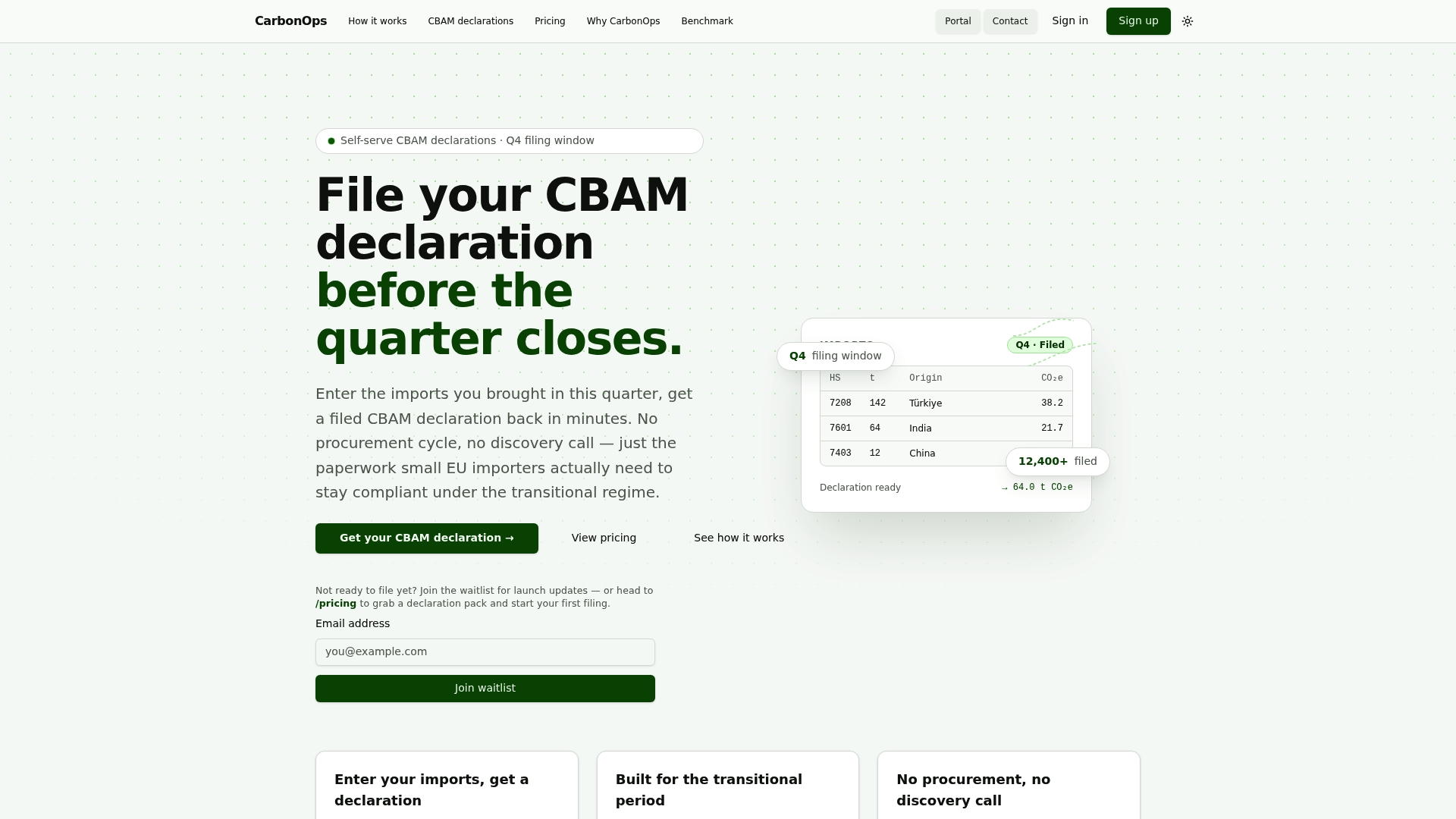
CarbonOps, built by Climastry, handles that process in four steps. You enter each shipment’s HS code, net mass, and country of origin. The platform validates the data, maps CN codes, applies published EU default emission values where supplier-specific figures are unavailable, and tracks your cumulative YTD mass against the 50-tonne threshold automatically. When you are ready to file, it exports the completed declaration in the format the EU CBAM registry expects, with your full filing history retained for audit purposes.
The pay-per-declaration model means no subscription, no platform deployment, and no long-term commitment. You pay for the declarations you need, when you need them. For US importers who are approaching the 50-tonne threshold or already planning for authorised declarant status, that is a faster path to compliance than building a tracking system from scratch. Start your first CBAM declaration at climastry.com.
Useful sources for verifying the primary rules
| Source | Best used for |
|---|---|
| Regulation (EU) 2025/2083 — Official Journal (EUR-Lex) | Primary legal text of the Omnibus I CBAM amendments |
| Consolidated CBAM Regulation text (EUR-Lex, updated October 2025) | Article 2a, Annex VII, and the full aggregated regulatory text |
| European Commission CBAM guidance for EU importers | Operational guidance on reporting obligations and CN code mapping |
| European Commission CBAM hub (Taxation and Customs Union) | Official updates, registry access, and Commission notices |
| Council press release: CBAM simplification sign-off | Policy intent behind the 50-tonne threshold and SME relief rationale |
| Mayer Brown: 10 Key Amendments and Challenges Ahead | Penalty structure, 10% leniency nuance, and registry monitoring details |
| PwC: Simplifying the Carbon Border Adjustment Mechanism | Authorisation timing, March 31, 2026 transitional window, and implementation steps |
| Slaughter and May: 90% of importers excluded, 99% of emissions retained | Quantified impact analysis of the 50-tonne threshold by importer count and emissions coverage |
This article provides general information about EU CBAM regulations and is not legal or compliance advice. Verify current rules with the European Commission’s official guidance or a qualified legal professional before making compliance decisions.