CBAM Transitional Reporting: A Practical Guide for EU Importers

CBAM Transitional Reporting: A Practical Guide for EU Importers
Every EU importer of CBAM-covered goods must submit a quarterly report covering the embedded greenhouse gas emissions in their shipments for the previous quarter. No certificate purchases, no financial adjustments. Just data. Your three immediate actions: confirm who is the legal reporting declarant for your imports, request embedded emissions data from your suppliers for the most recent quarter, and register with your National Competent Authority (NCA) to access the CBAM Transitional Registry if you have not already done so.
Quarterly filing deadline: one month after quarter end.
Quarterly reports are due one month after the quarter ends, starting with the first quarter ending in December 2023 and the last in December 2025, with report submission deadlines following each quarter accordingly.
The legal basis is Regulation (EU) 2023/956, which established CBAM, and Implementing Regulation (EU) 2023/1773, which sets out the transitional reporting rules in detail.
Key Takeaways
Transitional CBAM reporting requires quarterly submission of embedded GHG emissions data for all Annex I goods imported into the EU, with no certificate purchases required until January 1, 2026.
| Point | Details |
|---|---|
| Quarterly deadline | Reports are due one month after each quarter ends; the first was January 31, 2024. |
| No financial obligation yet | The transitional phase (October 1, 2023 to December 31, 2025) requires emissions reporting only, not certificate purchases. |
| Default values have limits | Commission defaults were unrestricted through Q2 2024; from Q3 2024, restrictions apply to complex goods. |
| Definitive phase starts 2026 | From January 1, 2026, importers must purchase and surrender CBAM certificates and obtain third-party verification. |
| CarbonOps | Maps CN codes, applies Commission defaults, and exports filing-ready declarations with a full audit trail. |
Primary sources for transitional CBAM reporting
The sources below are the authoritative references for every rule, deadline, and methodology described in this guide.
- Regulation (EU) 2023/956: the founding CBAM regulation. Use this to verify which goods are in scope (Annex I) and the legal basis for the transitional period.
- Commission guidance for EU importers (November 2023): the primary practical reference for importers. Covers mandatory report fields, the optional supplier communication template (Excel), and registry access. Download the template from this page.
- Commission guidance for EU importers (updated): the updated version of the importer guidance, covering Annex I and Annex IV data requirements in detail.
- Commission default values document: the published default emission factors by CN code and country of origin. Use this to look up the applicable default when supplier data is unavailable and to understand the 2016–2020 baseline methodology.
- CBAM Transitional Registry archive: the Commission’s archive of the transitional registry, including XSD schema files and XLS helper files for XML upload. Use this to download the technical specifications for automated report generation.
This article is general information, not a substitute for advice from a qualified lawyer. Consult a qualified legal professional about your own circumstances before acting on anything here.
Table of Contents
- What goods and importers fall under transitional CBAM reporting?
- What does a quarterly CBAM report need to contain?
- How to request and document supplier emissions data
- How to register and file quarterly reports in the CBAM Registry
- When and how to use Commission default values
- What changes when the definitive CBAM phase starts in 2026?
- Common mistakes that create audit risk in CBAM filings
- How CarbonOps produces a filing-ready CBAM declaration in four steps
- Sources
What goods and importers fall under transitional CBAM reporting?
CBAM covers six sectors during the transitional phase: cement, iron and steel, aluminum, fertilizers, electricity, and hydrogen. Each covered product is identified by its Combined Nomenclature (CN) code, which maps directly to the Harmonized System (HS) code your customs broker already uses. If a CN code for your imported product appears in Annex I of Regulation (EU) 2023/956, that shipment is in scope.

Who is the reporting declarant?
The reporting declarant is the person legally responsible for submitting the quarterly CBAM report. Three categories qualify:
- The importer of record listed on the customs declaration
- An authorized CBAM declarant approved by the NCA on behalf of the importer
- An indirect customs representative who declared the goods in their own name
One critical rule: one tonne of goods gets reported once. If an indirect customs representative filed the customs declaration, they carry the CBAM reporting obligation for that shipment. The importer cannot also report it. Double-reporting the same quantity is one of the most common errors NCAs flag during reviews.
CN/HS code mapping: a quick reference
This is not an exhaustive list. Always verify against the current Annex I product list before mapping your import flows.
Inward processing and the correct import date
The relevant date for CBAM reporting is the customs “release to the market” date, meaning the date of customs clearance, not the shipping date or the date goods arrived at your warehouse. This distinction matters most for inward-processing arrangements, where goods may arrive, be processed, and only later be released to free circulation. The Commission guidance for importers explicitly flags this, and teams that pull import dates from arrival manifests instead of customs clearance records routinely misassign shipments to the wrong reporting quarter.
Pro Tip: Cross-reference your CBAM import list against your customs clearance records, not your goods-receipt log. A shipment that arrived in September but cleared customs on October 3 belongs in the Q4 report, not Q3.
What does a quarterly CBAM report need to contain?
The Implementing Regulation (EU) 2023/1773 specifies the mandatory data fields for each quarterly report. The Commission’s guidance document organizes these into Annex I (importer-level report fields) and Annex IV (producer-supplied installation data). Here is what you need per shipment line:
| Field | What to report | Source |
|---|---|---|
| CN code | 8-digit CN code for the imported good | Customs declaration |
| Installation ID | Identifier of the producing installation | Supplier / operator |
| Quantity imported | Net mass or MWh (electricity) per CN code | Customs declaration |
| Direct embedded emissions | CO₂e per tonne of good, from production process | Supplier data or default |
| Indirect embedded emissions | CO₂e from electricity consumed in production | Supplier data or default |
| Electricity emission factor | Country or grid factor used for indirect emissions | Supplier or published factor |
| Carbon price paid abroad | Any carbon cost already paid in country of origin | Supplier evidence |
| Source of emissions data | Supplier-specific, equivalent method, or default | Your records |
Three acceptable calculation methods
During the transitional period, you are not locked into a single methodology. Three routes are permitted:
-
Full EU methodology per Implementing Regulation (EU) 2023/1773: the supplier measures and reports actual embedded emissions from their installation. This is the most defensible approach and the one the definitive phase will require.
-
Equivalent methods: where a third country operates a monitoring and reporting system that the Commission has recognized as equivalent, those figures can be used directly. This applies to a limited set of countries and sectors.
-
Commission default values: published emission factors by CN code and country of origin, available through the CBAM Transitional Registry. Unrestricted use was permitted for Q4 2023 and Q1–Q2 2024. From Q3 2024 onward, use of defaults and estimations became restricted for complex goods, so importers with multi-component products need to track what share of their portfolio still relies on defaults.
The flexibility was intentional. The Commission designed the transitional period as a data-collection pilot, and early reporting errors were treated with more latitude than the definitive phase will allow.
Attributing emissions to a shipment
Embedded emissions are reported per tonne of imported good, not per shipment or invoice. If a supplier produces steel at multiple installations and ships from one, the embedded emissions must correspond to the specific installation that produced the goods in that shipment. Where a supplier aggregates production across sites, you need installation-level attribution, not a plant average. This is the detail most importers underestimate when they first set up their data collection process.
Pro Tip: Before submission, run a reconciliation: total the quantities on your CBAM report lines and compare them to the total CBAM-covered quantities on your customs declarations for the same quarter. Any gap means a shipment is either missing from the report or double-counted.
How to request and document supplier emissions data
The reporting declarant is responsible for the accuracy of the data in the quarterly report, even when that data originates with a third-country operator. That legal exposure makes supplier data collection a compliance function, not just a procurement task.
What to request from each supplier
- Installation identifier: the unique ID for the production facility (name, address, and any national registration number)
- Measurement period: the calendar period the emissions data covers (must align with your reporting quarter or the most recent available annual period)
- Direct emissions: total CO₂e from combustion and process emissions per tonne of good produced
- Electricity consumption: total MWh consumed in production of the reported good
- Electricity emission factor: the factor used to convert electricity consumption to CO₂e (grid average, direct technical link, or power purchase agreement)
- Precursor emissions: for complex goods (e.g., steel products that incorporate pig iron), the embedded emissions of each precursor material used
- Carbon price evidence: documentation of any carbon cost already paid in the country of origin, including the applicable rate and the quantity covered
The Commission’s guidance includes an optional Excel communication template that structures this data exchange. Using it reduces back-and-forth with suppliers because the fields map directly to Annex IV of the Implementing Regulation.
Validation checks to run on received data
Once supplier data arrives, apply these checks before entering it into the registry:
- Unit consistency: confirm emissions are expressed in CO₂e per tonne of good, not per batch, per shipment, or in a non-standard unit
- Period alignment: verify the measurement period covers the quarter you are reporting, or document why a prior-year annual figure is the best available
- Installation identification: confirm the installation ID matches the facility that actually produced the goods in the shipment
- Carbon price documentation: if a carbon price is claimed, the supporting document must show the rate, the coverage, and the period. A general statement that “carbon taxes apply in our country” is not sufficient.
- Precursor traceability: for complex goods, each precursor’s embedded emissions must be traceable to its own installation
Recordkeeping
Retain all supplier communications, data files, and supporting evidence for at least four years after the reporting period. Store them in a format that lets you trace each data point in the CBAM report back to the underlying supplier document. A shared drive organized by quarter and supplier works; a single folder of mixed PDFs does not.
Pro Tip: Add a short data-provision clause to your supplier contracts now. Something as simple as “Supplier agrees to provide CBAM Annex IV emissions data within 30 days of quarter end” gives you a contractual basis to escalate when data arrives late, and it signals to suppliers that this is a recurring obligation, not a one-off request.
How to register and file quarterly reports in the CBAM Registry
Registration checklist
Registration happens through your National Competent Authority, not directly through the EU Commission. The NCA for your EU member state of import is the entry point.
- Identify your NCA: each EU member state has designated an NCA for CBAM. If you import into multiple member states, you register in the member state where you are established (or where the majority of your imports clear customs).
- Submit legal entity documentation: typically your VAT registration, EORI number, and proof of legal establishment in the EU.
- Request registry access: the NCA creates your account in the CBAM Transitional Registry and sends login credentials.
- Confirm declarant status: if an indirect customs representative will file on your behalf, their access must be set up separately and linked to your imports.
The CBAM Transitional Registry supported both manual data entry and XML upload. For importers with more than a handful of shipment lines per quarter, the XML route is significantly faster. The Commission published XSD schema files and XLS helper files to structure the upload, and both are available through the registry archive.
Filing calendar with correction windows
The extended correction window for the first two reports (Q4 2023 and Q1 2024) reflected the Commission’s recognition that importers were still building their data pipelines. Both could be corrected until July 31, 2024, which is the deadline that applied to the third quarterly report.
Pre-submission controls
Before clicking submit, run three checks:
- Quantity reconciliation: total CBAM report quantities match customs declaration quantities for the same quarter and CN codes.
- Duplicate check: no installation appears twice for the same CN code and quarter.
- Completeness check: every line has an installation ID, an emissions figure (supplier-specific or default), and a documented source.
When and how to use Commission default values
The Commission published default emission values specifically for the transitional period. These are country- and CN-code-specific factors that reflect a five-year historical average (2016–2020) for electricity emission factors and similar baselines for other goods. They are available through the CBAM Transitional Registry and apply until the end of 2025.
When defaults are permitted
- Q4 2023 and Q1–Q2 2024: unrestricted use of Commission default values for all CBAM goods. If your supplier could not provide actual emissions data, you could apply the relevant default without any cap or justification requirement.
- Q3 2024 onward: defaults and estimations became restricted for complex goods. Importers should track what proportion of their portfolio relies on defaults, because exceeding the permitted estimation cap for complex goods creates a compliance exposure. The defaults are legally treated as “estimations” under the Implementing Regulation, and the restriction was introduced precisely to push importers toward actual supplier data.
Alternatives to Commission defaults for electricity
For the electricity emission factor specifically, three alternatives to the Commission’s published country average are permitted:
- Direct technical link: if the installation is directly connected to a specific power source (e.g., a dedicated renewable plant), that source’s emission factor applies.
- Power purchase agreement (PPA): a documented PPA for renewable electricity can support a lower emission factor than the country average.
- Publicly available country averages: where the Commission default does not exist for a specific country, a publicly available national grid emission factor may be used, provided it is documented.
Documenting default value use
When you apply a default value in the registry, document:
- The CN code and country of origin the default applies to
- The specific default value used and its source (Commission publication date)
- The reason actual supplier data was unavailable
- Whether the good is classified as simple or complex (relevant to the Q3 2024 restriction)
Pro Tip: Default values will be revised after the transitional period using the actual data collected during 2023–2025. If your early reports used defaults that overstated your emissions, the revised defaults in the definitive phase may be lower. But if your actual production emissions are lower than the defaults, getting real supplier data now protects you from overstating your future CBAM certificate liability.
What changes when the definitive CBAM phase starts in 2026?
The operational shift is significant. During the transitional phase, the worst outcome for a late or inaccurate report is a correction request from the NCA. In the definitive phase, under-reporting embedded emissions means under-purchasing certificates, which carries financial penalties.
Key changes to plan for:
- Certificate purchase and surrender: importers must hold CBAM certificates in their registry account and surrender them annually based on verified embedded emissions from the prior year.
- Mandatory verification: embedded emissions reported in the definitive phase must be verified by an accredited third-party verifier, similar to the verification requirement under the EU ETS.
- Narrower indirect emissions scope: during the transitional phase, indirect emissions (from electricity) are reported for all CBAM goods. In the definitive phase, indirect emissions will be included only for certain product categories per Annex II. Importers should track indirect emissions now regardless, because the data will inform verification and the scope may be broader than expected for their specific products.
- Default values methodology revision: the Commission will revise default values using data collected during the transitional period. The revised defaults will likely be more granular and may differ substantially from the 2016–2020 historical averages currently in use.
Actions to take in 2025 to prepare
- Complete at least one full supplier data collection cycle using actual installation-level emissions, not defaults.
- Identify which of your suppliers will need to engage a verifier and begin those conversations now.
- Map your CBAM certificate procurement process: who in your organization will authorize purchases, and through which registry account.
- Review your customs and trade finance workflows to understand where CBAM certificate costs will land in your cost structure.
Common mistakes that create audit risk in CBAM filings
The most frequent errors in transitional CBAM reports fall into five categories, and most of them are avoidable with a pre-submission checklist.
Top reporting mistakes
- Wrong import date: using the shipping date or goods-receipt date instead of the customs clearance date. This misassigns shipments to the wrong quarter.
- Double-reporting: the same tonne of goods appears in reports filed by both the importer and an indirect customs representative. Establish in writing who is the declarant before the quarter closes.
- Missing installation ID: a report line shows emissions but no installation identifier. NCAs cannot verify the data without it, and the line is effectively unauditable.
- Mismatched units: emissions reported in tonnes CO₂ instead of tonnes CO₂e, or quantities reported in kilograms when the CN code requires tonnes. Unit errors compound across a full year of reporting.
- Unverified supplier numbers: using a supplier’s self-reported emissions figure without any supporting documentation. If the NCA asks for evidence and you have only an email from the supplier, that is a problem.
Red flags NCAs look for
- Emission intensity figures that are significantly below the Commission default for the same CN code and country, with no supporting documentation
- Installation IDs that do not correspond to any known facility in the country of origin
- Carbon price claims for countries that do not operate a recognized carbon pricing mechanism
- Quantities that do not reconcile to the customs declarations for the same period
Compliance checklist for each quarterly filing
- [ ] Customs clearance dates confirmed as the import date for all lines
- [ ] Declarant identity confirmed in writing (no overlap with indirect customs representative)
- [ ] Supplier data received and validated for all in-scope shipments
- [ ] Default values applied only where permitted and documented
- [ ] Installation IDs present for every report line
- [ ] Units consistent across all fields (CO₂e per tonne of good)
- [ ] Carbon price evidence on file for any claims
- [ ] Quantity reconciliation to customs declarations completed
- [ ] Duplicate check run across all lines
- [ ] Internal sign-off obtained before submission
Pro Tip: If you discover an error after submission, use the registry correction window rather than waiting for the NCA to contact you. Proactive corrections are treated more favorably than corrections made in response to an NCA inquiry. For the first two quarters, the extended window gave importers until July 31, 2024. For subsequent quarters, the standard window is two months after quarter end.
How CarbonOps produces a filing-ready CBAM declaration in four steps
For compliance teams managing multiple suppliers and CN codes, the manual process of collecting, validating, and formatting CBAM data is where most of the time goes. CarbonOps is built specifically to compress that process.
- Enter imports: input each shipment with its CN code, mass, and country of origin. The system validates the data and maps it to the CBAM-covered goods it applies to.
- Match CN codes: each line is matched to its CBAM CN code and sector, showing exactly which imports are in scope and which still need emissions data.
- Apply emissions: where supplier-specific embedded emissions are missing, CarbonOps applies the Commission’s published default values per CN code and country, so every line resolves to a complete, reviewable figure.
- Export and file: the completed declaration is exported in the format the CBAM Registry expects, retained with your filing history for the audit trail.
Features that support each step:
- HS/CN code matching and sector classification
- Supplier-level data intake with validation checks
- Commission default-value application by CN code and country
- Audit trail linking each report line to its data source
- PDF and XLS export formatted for the CBAM Transitional Registry
Pro Tip: Most compliance teams find the first filing takes the longest because it requires building the supplier data request process from scratch. Subsequent quarters are significantly faster once templates and supplier contacts are established. CarbonOps retains your filing history, so data from prior quarters can be reused and updated rather than rebuilt each time.
The transitional period is a readiness window, not just a paperwork exercise
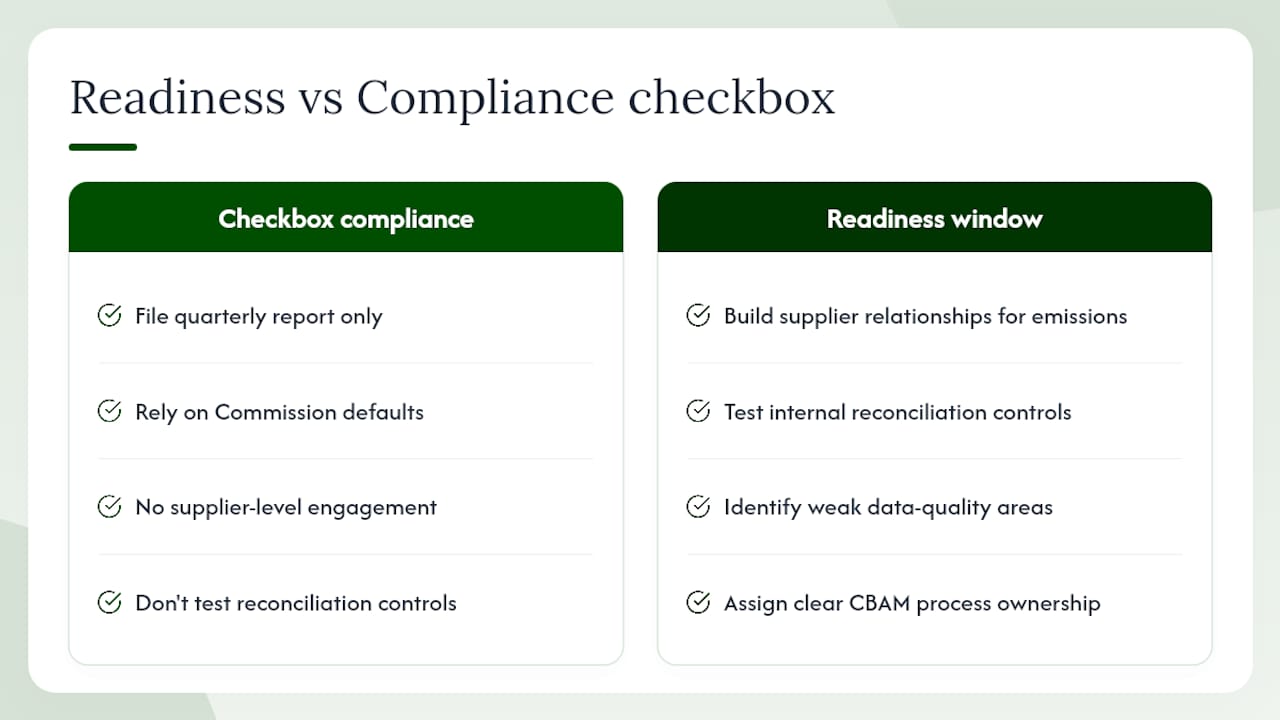
Most importers are treating the 2023–2025 phase as a compliance checkbox: file the report, move on. That framing misses the point. The Commission designed this period explicitly as a pilot, and the data collected now will directly shape the default values, verification standards, and enforcement posture of the definitive phase starting in 2026.
The importers who will be in the strongest position when certificate purchases begin are the ones who used the transitional period to build real supplier relationships around emissions data, test their internal reconciliation controls, and identify which parts of their supply chain have the weakest data quality. A quarterly report filed with Commission defaults tells you almost nothing about your actual carbon exposure. A report built on installation-level supplier data tells you exactly where your certificate liability will land.
Compliance teams should treat each transitional quarter as a dry run for the definitive phase. That means assigning clear ownership of the CBAM process (not leaving it to whoever has bandwidth), establishing a supplier data calendar that runs ahead of the filing deadline, and reviewing each submitted report for data quality trends, not just completeness. The governance infrastructure you build now is the same one that will handle certificate procurement, third-party verification, and NCA audits in 2026 and beyond.
One practical priority for this quarter: identify the three suppliers who represent the largest share of your CBAM-covered import volume and get actual installation-level emissions data from them, even if you have been using defaults. Those three suppliers likely account for the majority of your future certificate liability.
CarbonOps turns your import data into a filed CBAM declaration
Filing a CBAM transitional report without a structured tool means manually mapping CN codes, chasing supplier data, applying country-specific defaults, and formatting everything to the registry’s specifications. That process is error-prone and time-consuming, especially across multiple suppliers and quarters.
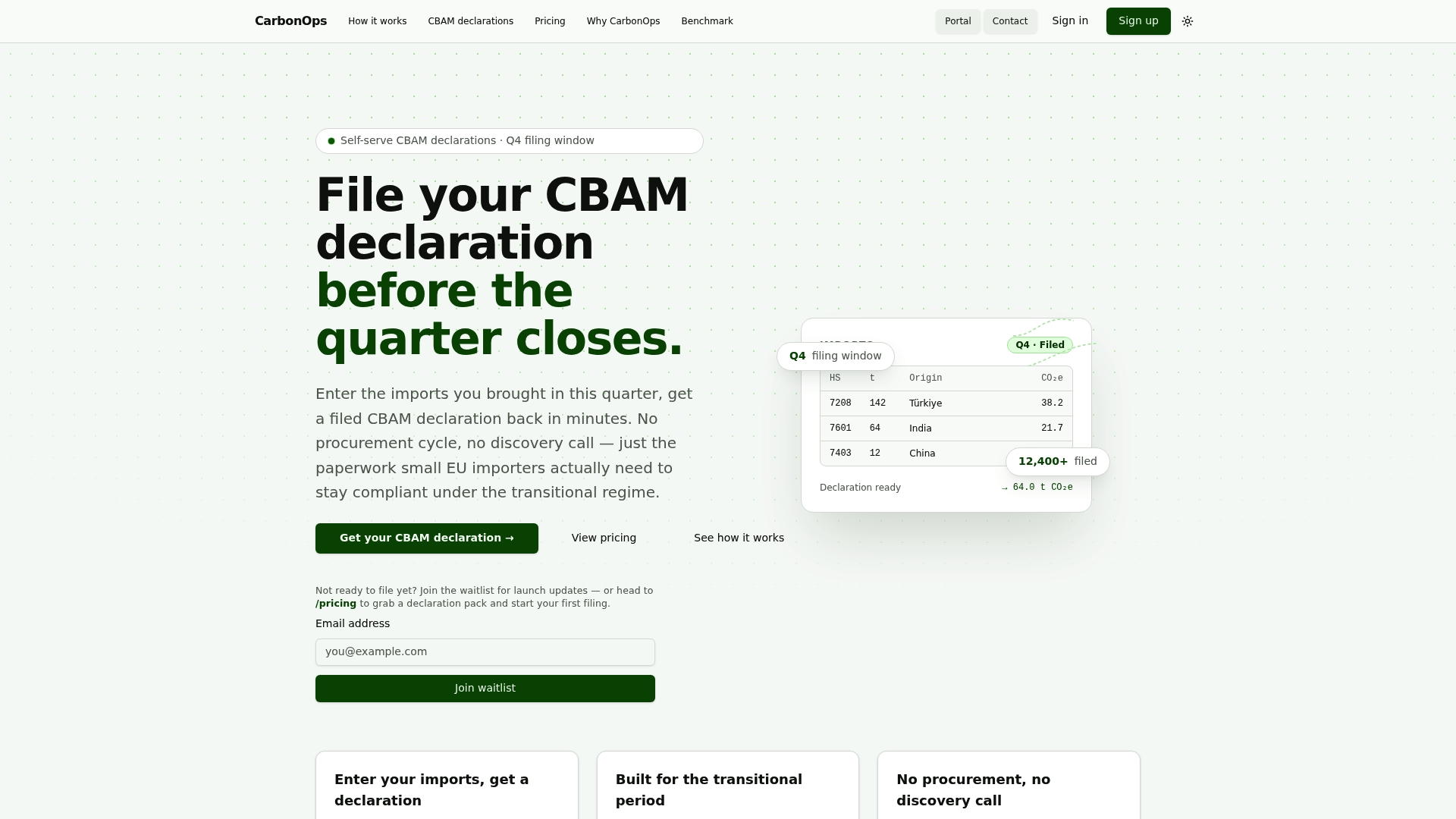
CarbonOps handles the full workflow: enter your shipments with HS/CN codes and origin countries, validate supplier emissions data, apply Commission defaults where data is missing, and export a filing-ready declaration with a complete audit trail. No platform deployment, no subscription, no onboarding cycle. You pay per declaration and get the paperwork back.
Core features for transitional reporting:
- CN code matching and sector classification against CBAM Annex I
- Supplier-level emissions intake with built-in validation
- Commission default-value application by CN code and country of origin
- Audit trail linking every report line to its data source
- PDF and XLS export formatted for the CBAM Registry
Ready to file your next quarterly report without the spreadsheet chaos? Start your CBAM declaration on CarbonOps today.
Sources
- Carbon Border Adjustment Mechanism (CBAM)
- GUIDANCE DOCUMENT ON CBAM IMPORTERS OF GOODS INTO THE EU
- CBAM BETWEEN 1 OCTOBER 2023 AND 31 DECEMBER 2025 (default values document)
- GUIDANCE DOCUMENT ON CBAM IMPORTERS OF GOODS INTO THE EU
- CBAM archive - Taxation and Customs Union - European Commission