CBAM Indirect Emissions: What Importers Must Report

CBAM Indirect Emissions: What Importers Must Report
Indirect emissions come into play only for goods listed in Annex I of the CBAM regulation that are not also listed in Annex II, meaning cement, fertilizers, and precursor products like sintered ore fall under the rule while most aluminum and hydrogen goods do not. Importers can meet the requirement two ways: apply the Commission’s five-year country-grid default value, or submit verified actual data. Either way, the first move is checking your CN code against Annex I and starting supplier outreach for electricity data now.
TL;DR:
- Indirect emissions apply only to specific sectors like cement and fertilizers under Annex I, not to most aluminum or hydrogen goods.
- Using the default five-year country-grid emission factor is mandatory when supplier data is unavailable, but may be less accurate for fast-decarbonizing or volatile grids.
- Verified actual data can lower CBAM liabilities but requires detailed proof of energy flow, supplier attestations, and comprehensive metering evidence.
- When a precursor’s indirect emissions are high and unverified, the default value is used, influencing the final embedded emissions calculation.
- Upcoming changes include weekly certificate prices from February 2027 and ongoing calibration of default emission factors for different sectors and countries.
Table of Contents
- What CBAM Indirect Emissions Actually Cover
- Direct vs. Indirect vs. Specific Embedded Emissions: The Terms That Matter
- The Five-Year Default Value Method Explained
- Switching to Actual Values: What Verifiers Want to See
- Precursors: When a Supplier’s Electricity Becomes Your Problem
- Filing Under the Definitive Regime: Steps and Certificate Costs
- A Practical Sequence for Getting This Right the First Time
- How Indirect Emissions Accounting Changes the Math for Importers and Exporters
- CBAM vs. Other Carbon Pricing Mechanisms on Indirect Emissions
- Why Indirect Emissions Measurement Still Draws Criticism
- What Could Change Next in the CBAM Indirect Emissions Rules
- Publisher Perspective: What We See in Indirect-Emissions Data Collection
- Turn Supplier Data Into a Filed CBAM Declaration
- Where to Verify These Rules Yourself
- Sources
What CBAM Indirect Emissions Actually Cover
CBAM indirect emissions cover the greenhouse gases released to generate the electricity consumed while producing a covered good, not the emissions from combustion or process chemistry inside the plant. That second category, direct emissions, gets counted for every CBAM good without exception. Indirect emissions are narrower: they apply only where Regulation (EU) 2023/956 and the relevant implementing rules place a sector into Annex I’s indirect-emissions scope, while excluding it from Annex II.
Cement, fertilizers, and certain iron and steel precursors, like sintered or agglomerated ore, are the clearest examples where indirect emissions apply. Aluminum and most iron and steel finished goods sit closer to the Annex II side, where the electricity-intensity calculation is handled differently.
A quick scope check runs in three steps:
- Pull your product’s CN code and confirm its sector classification against the current Annex I list.
- Check whether that same code appears in Annex II’s exclusion set, since inclusion there removes the indirect-emissions obligation.
- Trace your production route (not just the end product) because precursor inputs can carry their own indirect-emissions requirement even when the finished good does not.
Get this classification wrong and you either overreport a liability you don’t owe or, worse, underreport one you do.
Direct vs. Indirect vs. Specific Embedded Emissions: The Terms That Matter
Guidance No. 3 defines indirect emissions strictly as those tied to purchased electricity consumed during production. This mirrors the logic behind the EPA’s Scope 2 accounting framework, which draws the same line between emissions you generate directly and emissions embedded in energy you buy. Direct emissions cover fuel combustion and process chemistry on-site. “Specific embedded emissions” is the term that combines both into a single per-unit figure for your declaration.
A few distinctions matter for how you fill out the paperwork:
- Report emissions per tonne of product or per the relevant functional unit specified for your CN code, since mixing units corrupts any aggregate calculation across a shipment.
- Electricity generated on-site (say, a captive gas turbine) is treated as a direct-emissions source, not an indirect one, if it feeds the same installation.
- Purchased grid electricity, or electricity bought under contract from an off-site generator, is what triggers the indirect calculation.
The Five-Year Default Value Method Explained
Where you don’t have verified supplier data, the Commission’s default applies automatically. It’s calculated as a simple average of the country-of-origin electricity grid emission factor across the most recent five-year period with reliable data, according to Commission Implementing Regulation (EU) 2025/2547.
Pro Tip: Don’t assume the default always works against you. In countries where the grid has decarbonized quickly, a five-year average can sit meaningfully below last year’s actual factor, since it smooths out one bad year of coal-heavy generation.
That averaging window exists for a reason. It’s a deliberate balance between capturing a country’s decarbonization trend and avoiding a single anomalous year, like a drought that knocked out hydropower, from swinging your liability. Importers who don’t submit actual values are assigned this default automatically per CN code and country of origin, with no exceptions or waiting period. In practice, that means your CBAM liability moves in lockstep with a slow-moving national average rather than your specific supplier’s grid mix. That gap, between a national average and your actual supplier’s cleaner (or dirtier) electricity, is exactly what the actual-values route is built to correct.
Switching to Actual Values: What Verifiers Want to See
Moving off the default and onto a verified actual factor can lower your CBAM liability, but it raises the documentation bar considerably. The Commission’s own technical study on indirect emissions is blunt about the tradeoff: actual data helps your number, but the verification burden under the definitive regime is real, not a formality.
Here’s the sequence that gets an actual-value claim accepted rather than bounced back:
- Establish the technical link. Smart metering or comparable evidence must show the electricity from a specific generator physically flows to the installation making your claim, per the implementing regulation’s evidentiary requirements.
- Gather the supporting documents. This means dated supplier attestations, the power purchase agreement (PPA) itself if one exists, and metering exports covering the full production period, not a sample month.
- Apply weighted averaging if you draw from multiple sources. Guidance No. 3 requires a consumption-weighted average across electricity sources unless you can prove the process ran on a single source exclusively.
- Route the package through an accredited verifier before the declaration deadline, leaving buffer time for follow-up requests.
The most common way an actual-value claim falls apart is simple math: operators average emission factors across suppliers without weighting by how much electricity each source actually contributed. Guidance No. 3 treats that as a rejectable error, not a rounding issue.
Precursors: When a Supplier’s Electricity Becomes Your Problem
Complex goods often carry embedded emissions from inputs made somewhere else entirely, and CBAM tracks those inputs, not just the final processing step. Iron and steel production is the clearest case: sintered or agglomerated ore, a precursor to finished steel, can carry its own indirect-emissions obligation that then feeds into the specific embedded emissions of the final product.
A few rules govern how this works in practice:
- Whether a precursor’s indirect emissions must be added depends on that precursor’s own Annex I and Annex II status, evaluated separately from the finished good.
- Verification of a precursor’s actual values follows the same evidentiary standard as any other actual-value claim, including smart-metering proof and accredited verifier sign-off.
- Where a precursor supplier won’t or can’t provide verified data, the default value fallback applies to that input specifically, even if the rest of your declaration uses actual figures.
A steel producer using sintered ore with high default indirect emissions, for instance, sees that number carried forward into the final product’s specific embedded emissions figure, whether or not the finished steel itself sits in Annex I’s indirect scope.
Filing Under the Definitive Regime: Steps and Certificate Costs
The definitive regime took effect on January 1, 2026, replacing the transitional reporting-only period with actual financial obligations tied to CBAM certificate surrender. Authorized declarants importing above the 50-tonne threshold need to follow a specific filing sequence.
- Confirm authorized declarant status and the 50-tonne threshold applies to your import volume before the reporting period closes.
- Populate each line item with specific direct emissions per tonne, and specific indirect emissions per tonne wherever Annex I scope applies, using either the default or a verified actual value.
- Track certificate pricing by quarter. In 2026, CBAM certificate prices follow the EU ETS auction-weighted average, published quarterly: €75.36 for Q1 and €75.28 for Q2, according to the Commission’s certificate pricing page. From February 2027, that publication shifts to weekly, which tightens the window for budgeting certificate purchases.
Treat certificate pricing as a moving cost line in your budget, not a fixed number you set once a year.
A Practical Sequence for Getting This Right the First Time
Run the workflow in order: confirm Annex status, request supplier verification, secure metering or PPA documentation, then assemble the verifier pack. Skipping ahead to metering before you’ve confirmed scope wastes effort on goods that never needed indirect emissions in the first place.
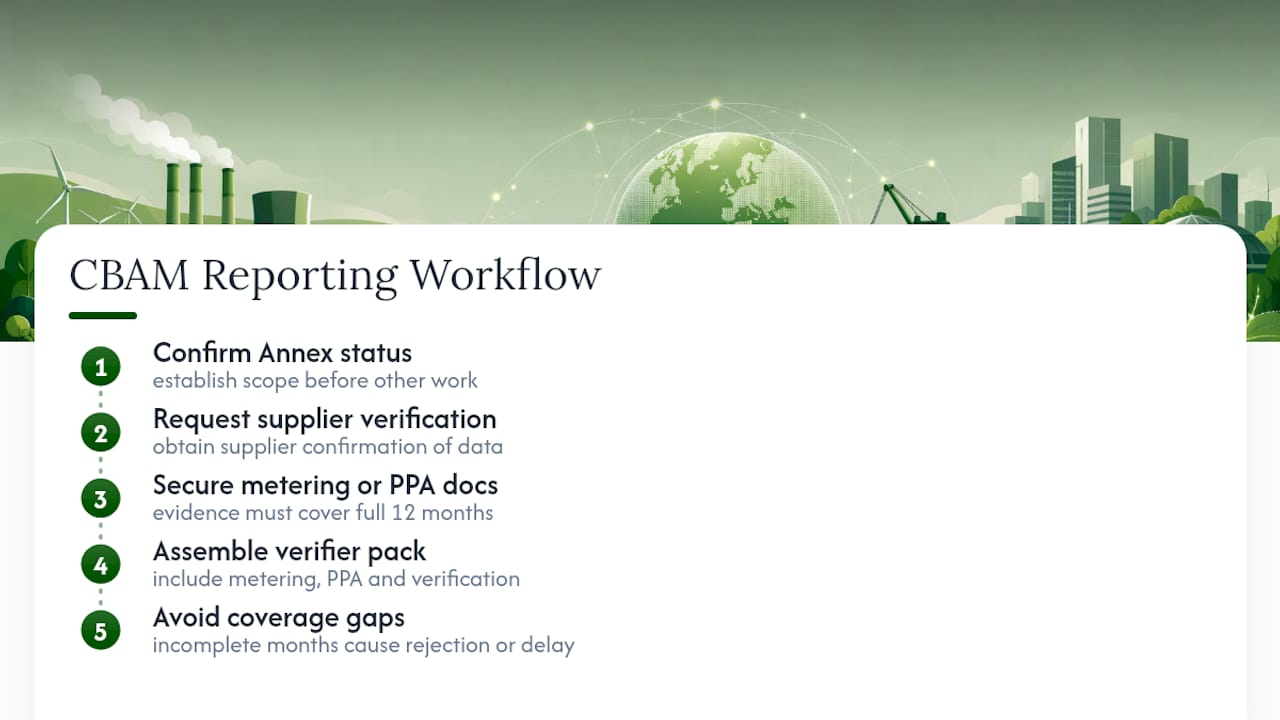
Pro Tip: The most frequent verification delay isn’t bad data, it’s an incomplete coverage period. If your metering evidence covers ten months of a twelve-month reporting window, expect the verifier to reject or delay the claim rather than approve it on a pro-rated basis.
How Indirect Emissions Accounting Changes the Math for Importers and Exporters
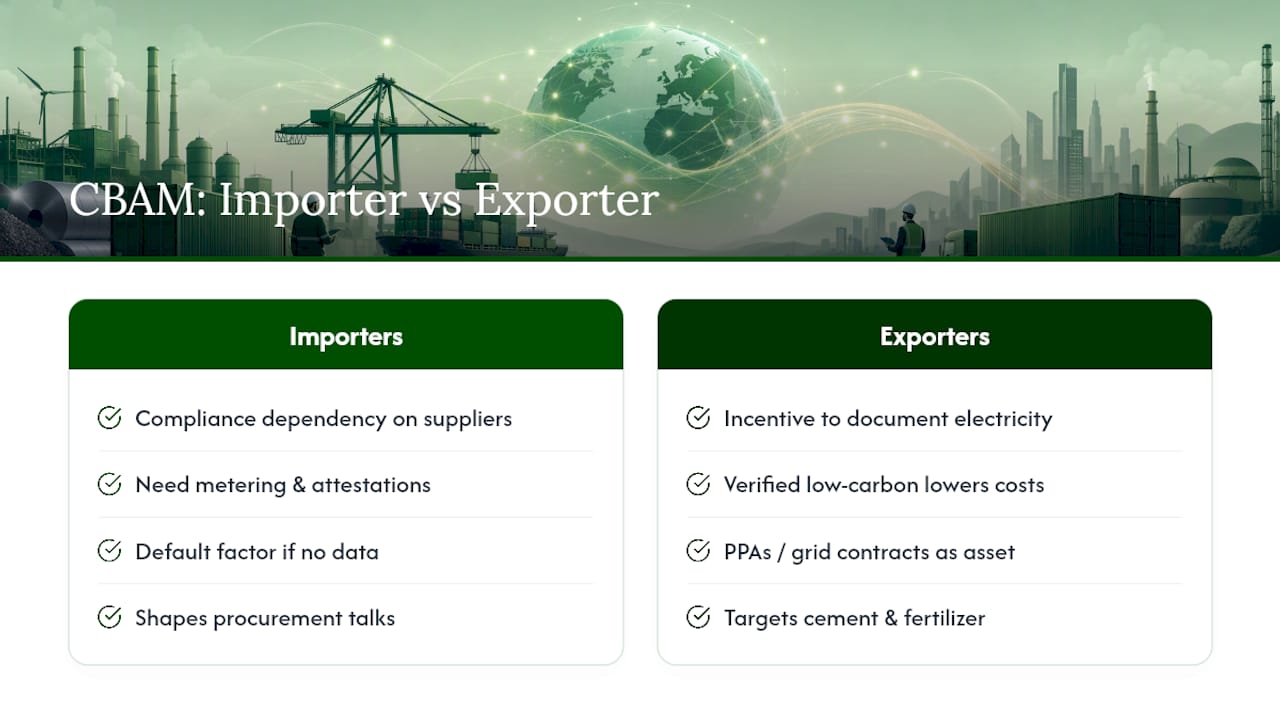
For importers, indirect emissions accounting turns a supplier relationship into a compliance dependency. You can’t produce a defensible actual-value claim without your supplier’s cooperation on metering data, attestations, and contract terms, which means CBAM compliance now shapes procurement conversations that used to be purely commercial. An importer sourcing cement from a supplier unwilling to share grid-connection documentation is stuck with the default, full stop, regardless of how clean that supplier’s actual electricity mix might be.
Exporters outside the EU face a parallel shift. Non-EU producers now have a direct financial incentive to document their electricity sourcing carefully, since a verified low-carbon factor can make their goods more price-competitive against the default once CBAM certificate costs are added at the border. This has started to change how exporters in electricity-intensive sectors, cement and fertilizer production particularly, negotiate PPAs and grid contracts, treating carbon documentation as a sales asset rather than a back-office task.
The practical effect ripples through pricing conversations on both sides. An importer facing a high default factor has a reason to ask its supplier for actual data before the next filing cycle, and a supplier with genuinely cleaner electricity has a reason to spend the money proving it. Where that conversation doesn’t happen, either because a supplier lacks metering infrastructure or an importer doesn’t ask, the default value becomes a de facto tax on the relationship, absorbed as a straight cost rather than optimized away.
CBAM vs. Other Carbon Pricing Mechanisms on Indirect Emissions
CBAM’s indirect emissions treatment is narrower and more mechanical than how most domestic carbon pricing systems handle electricity. The EU ETS, for comparison, prices direct emissions from installations covered by the scheme and generally leaves indirect electricity emissions to be addressed through the carbon price already embedded in the electricity generator’s own compliance costs, rather than requiring downstream buyers to calculate a separate factor.
Corporate voluntary reporting frameworks, meanwhile, tend to give companies more flexibility. Scope 2 guidance under the GHG Protocol allows organizations to report either a location-based factor (the grid average) or a market-based factor (contracts, PPAs, renewable energy certificates), and companies can choose whichever framing suits their sustainability narrative. CBAM offers no equivalent choice: the default is the grid-based figure, and market-based claims only count if they clear the far stricter technical-link and metering evidence bar under Guidance No. 3.
That difference matters practically. A company already reporting Scope 2 emissions on a market basis, backed by renewable energy certificates alone, cannot simply carry that figure over into a CBAM declaration. CBAM demands a physical, verifiable connection between the generator and the installation, not a contractual instrument detached from the actual electrons consumed. Businesses used to the relative flexibility of voluntary carbon accounting often find this the single biggest adjustment when their compliance teams first tackle a CBAM filing.
Why Indirect Emissions Measurement Still Draws Criticism
The country-grid default is the most contested part of the entire indirect-emissions framework, and the objections come from more than one direction. Producers in countries with fast-decarbonizing grids argue the five-year average understates their current performance, since a 2026 filing partly reflects electricity generated years earlier under a dirtier mix. Producers in countries with volatile generation, heavy hydropower dependence that swings with rainfall, for instance, argue the opposite: that even a five-year average can misrepresent a typical year.
Smaller suppliers raise a different complaint entirely. The metering and technical-link evidence required to claim an actual value assumes infrastructure, smart meters, dedicated grid connections, documented PPAs, that not every producer, especially in developing economies, has in place. That gap risks locking smaller or less-resourced suppliers into the default value regardless of their real emissions performance, which critics argue works against the goal of rewarding genuinely cleaner production.
There’s also a methodological argument about weighted averaging for multi-source electricity. Guidance No. 3’s requirement to weight by consumption share is precise on paper but hard to audit in practice when a facility draws from a mix of grid power, on-site generation, and a PPA simultaneously, and allocation between production lines isn’t always cleanly documented. Verifiers and operators don’t always agree on where the burden of proof should sit when the underlying metering infrastructure wasn’t built with CBAM in mind.
What Could Change Next in the CBAM Indirect Emissions Rules
The shift to weekly certificate pricing from February 2027, already scheduled under the Commission’s pricing framework, is the clearest confirmed change on the horizon. It moves CBAM cost management closer to how ETS-covered installations already manage carbon price exposure, week to week rather than by quarter.
Beyond that, expect continued refinement of the default-value tables themselves as more countries’ grid data becomes available and as the five-year averaging windows roll forward each year. The Commission has also signaled openness to expanding sector coverage over time, and any sector added to Annex I in the future would need its own indirect-emissions determination, following the same Annex I versus Annex II test that governs cement and fertilizers today.
Evidentiary standards for actual values are likely to tighten rather than loosen as more declarants attempt to use them and verifiers build a track record of what claims hold up. Compliance teams that build a strong verifier pack now, with metering data and supplier attestations in a format that’s easy to update, are better positioned for whatever documentation standard comes next than teams treating each filing as a one-off scramble.
Publisher Perspective: What We See in Indirect-Emissions Data Collection
The data gap between importers and suppliers is usually structural, not willful. Structured intake, mapping CN codes and flagging missing electricity data early, cuts weeks off verification versus discovering the gap at filing time, which is the logic behind CarbonOps’ four-step workflow.
— Jake Stevens
Turn Supplier Data Into a Filed CBAM Declaration
The gap between having supplier electricity data and having a filing-ready declaration is where most compliance teams lose time, not in understanding the rules. CarbonOps closes that gap directly: enter each shipment’s HS/CN code, mass, and country of origin, and the platform matches it to its CBAM sector, flags which lines need indirect-emissions data, and applies the Commission’s published default values automatically wherever supplier-specific figures aren’t available yet.
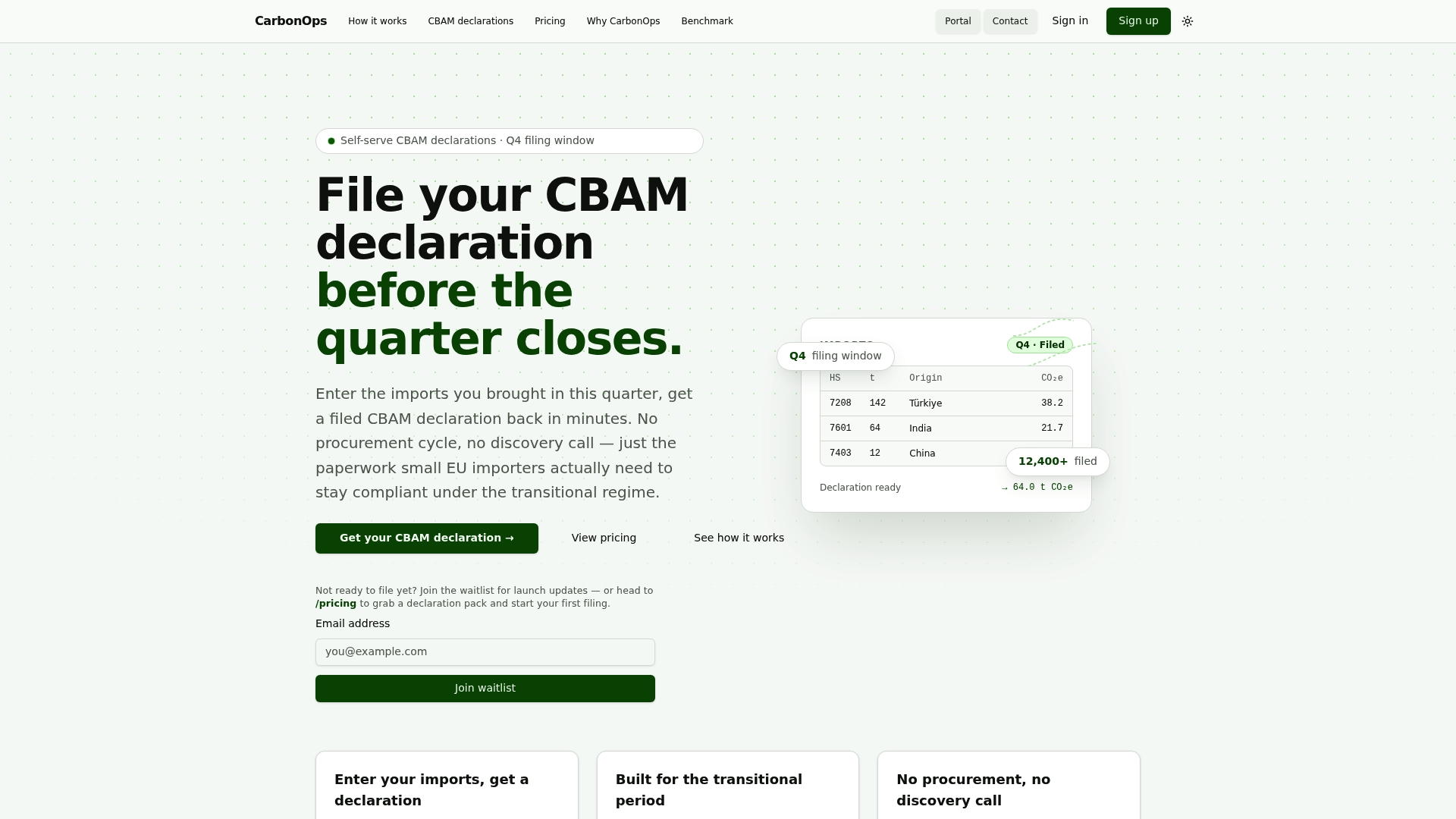
That means CN code mapping, default-value application, and evidence tracking happen inside one workflow instead of across spreadsheets and email threads with suppliers. The final export matches the format the EU CBAM Registry expects, retained with your filing history for the audit trail. There’s no subscription, no platform rollout, and no sensor installation required. You buy declarations one at a time, or in packs of five or fifteen if you’re filing across multiple quarters. If your next filing deadline is approaching, start a declaration with CarbonOps and see how far your existing supplier data gets you before you need to chase anything new.
Where to Verify These Rules Yourself
- Regulation (EU) 2023/956: the legal basis defining embedded emissions and Annex scope.
- Commission Implementing Regulation (EU) 2025/2547: default-value calculation methods.
- Guidance No. 3: calculation and verification detail for practitioners.
- CBAM definitive regime page: operational obligations and certificate rules.
Consult the regulation for legal definitions, the implementing rules for calculation methods, and Guidance No. 3 when preparing a verifier pack.
Sources
- Commission Implementing Regulation (EU) 2025/2547 on methods for the calculation of emissions embedded in goods
- Guidance No.3 — CBAM methods for the calculation of emissions embedded in goods
- Regulation (EU) 2023/956 establishing a carbon border adjustment mechanism