CBAM Default Values for U.S. Importers: 2026 Guide

CBAM Default Values for U.S. Importers: 2026 Guide
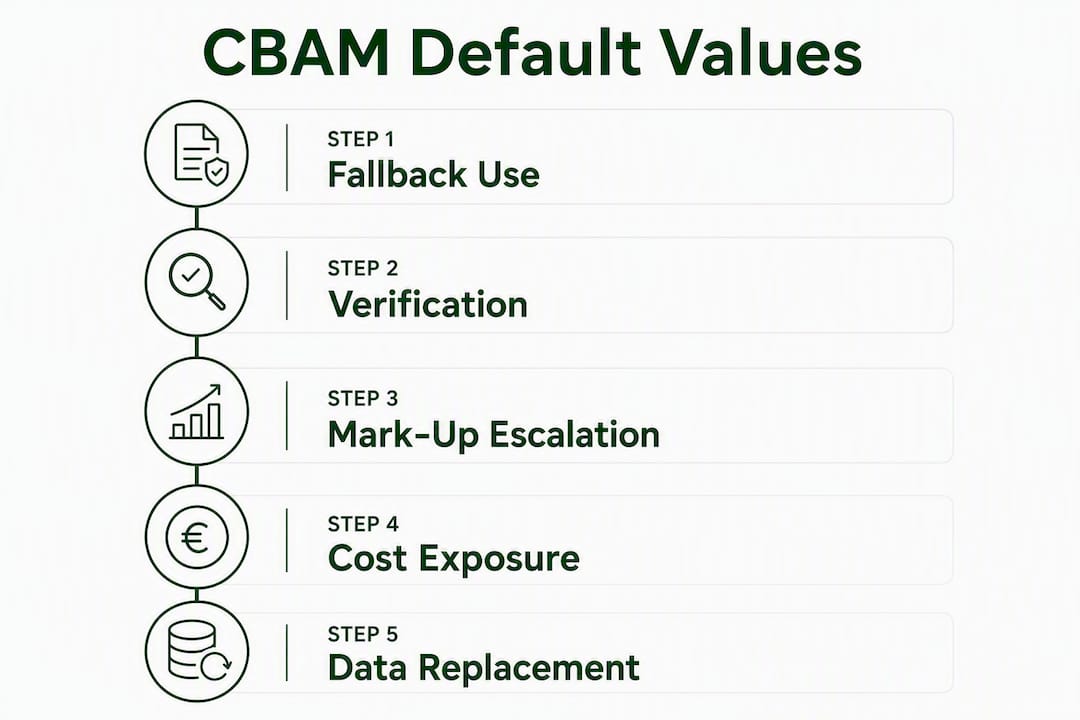
CBAM default values are Commission-published emission intensities, set by country and product, that EU importers must use when they cannot provide verified, installation-specific emissions data from their supplier. The legal basis is Article 7(2)(a) of Regulation (EU) 2023/956, and the definitive values are now codified in Implementing Regulation (EU) 2025/2621, published December 31, 2025, and enforceable from January 1, 2026.
The critical detail most importers miss: defaults are not a neutral fallback. They carry a staged mark-up that raises your CBAM certificate cost above what verified data would produce.
- Mark-up schedule: +10% on the base default in 2026, +20% in 2027, +30% from 2028 onward (fertilizers are a narrow exception at +1%).
- Immediate action: Check whether your supplier can provide installation-specific verified emissions data. If not, pull the Commission’s official XLS for the relevant CN code and country before you file, and document every attempt to obtain supplier data.
- Quick risk note: For high-volume commodities like steel or cement from China or Turkey, the gap between the default and actual mill emissions can be large, meaning the mark-up compounds an already inflated baseline.
Pro Tip: Document supplier data requests with timestamps from day one. If an EU auditor reviews your declaration, the paper trail showing you attempted to obtain verified data is what keeps a default-based filing defensible.
Table of Contents
- What are CBAM default values, and when must you use them?
- How did the Commission derive the default values, and when will they change?
- Where do you find the official default-value files, and how do you read them?
- How do default values feed into your SEE calculation and certificate obligations?
- Why do defaults create serious cost exposure for U.S. importers?
- How do you replace defaults with verified supplier data?
- How a declaration platform handles missing supplier data in practice
- Key Takeaways
- The case for treating defaults as a short-term emergency measure
- File your next CBAM declaration without the spreadsheet scramble
- Useful sources
What are CBAM default values, and when must you use them?
Default values are the Commission’s conservative estimate of how much CO₂ is embedded in one tonne of a given product from a given country. They exist because the CBAM regulation requires every declaration to carry an embedded emissions figure, and not every importer can extract verified data from a foreign supplier on short notice.
Three distinct sets of defaults exist under the regulation:
- Direct emission defaults: Applied to non-electricity goods (steel, cement, aluminum, fertilizers, hydrogen). These reflect the CO₂ emitted during the production process itself, averaged across a country’s sector.
- Indirect emission defaults (electricity factors): Applied to the electricity consumed during production. These are grid-average CO₂ intensities for the country of origin, used when the supplier cannot document the specific power source.
- Imported electricity factors: A separate set for goods that are electricity itself, covering cross-border power flows into the EU.
The regulation is clear that defaults are a fallback, not a standing election. Article 7(2)(a) permits their use only where installation-specific verified data “cannot reasonably be obtained.” That phrase matters legally. Declarations that use defaults must explicitly cite which default was applied and reference the implementing regulation — the choice is visible and auditable, not buried.
The transition from the 2023–2025 period also matters here. Transitional defaults under Regulation (EU) 2023/1773 used different methodologies and different numbers. The definitive values in IR (EU) 2025/2621 are generally higher than their transitional counterparts, particularly for Chinese steel. Importers who assumed continuity from the transitional period faced an abrupt cost increase entering 2026.

How did the Commission derive the default values, and when will they change?
The Commission did not pick these numbers arbitrarily. The methodology draws on Joint Research Centre data, International Energy Agency grid emission factors, and country-sector production statistics compiled during the transitional reporting period. Understanding the derivation tells you how stable the numbers are and where to watch for revisions.
- Direct emission defaults use country-sector production averages. Where a country’s data is unreliable or unavailable, the Commission substitutes the average of the ten highest-emitting exporting countries for that sector. That contingency rule is why defaults for some smaller exporters can look surprisingly high.
- Indirect emission factors (electricity) are calculated as a five-year simple average of IEA grid CO₂ data. The five-year window smooths out anomalous years, which means electricity-based defaults shift slowly. Direct-emission defaults, tied more tightly to production mix, are where you should focus verification effort.
- Mark-up rationale: The staged escalation (+10% in 2026, +20% in 2027, +30% from 2028) is deliberate policy design. Defaults are set above best-available data to give importers a financial incentive to collect verified data rather than treat defaults as a permanent convenience. The fertilizer sector gets a +1% mark-up instead, reflecting a different policy consideration.
- Review schedule: IR (EU) 2025/2621 mandates a periodic review, with the first revision due by December 2027 at the latest. Values can change before that date if the Commission determines the underlying data has shifted materially. Your compliance team needs a process to check for updates, not just archive the 2026 XLS and walk away.
Pro Tip: Because electricity factors evolve slowly (five-year averaging), concentrate your near-term verification budget on direct-emission-heavy sectors like steel and cement, where country-sector averages are more volatile and the default/actual gap is widest.
Where do you find the official default-value files, and how do you read them?
Two documents are your primary sources. Open both before you file a single declaration.
- Implementing Regulation (EU) 2025/2621 — the legal instrument. Its Annexes contain the country-by-CN-code default tables that carry legal force. This is the document you cite in your declaration.
- Commission-published XLS/CSV — the operational file. The European Commission’s DG TAXUD published a spreadsheet of default values keyed to CN codes and country combinations, making it easier to filter and extract values than reading the regulation’s Annexes directly.
Navigating the spreadsheet
| Column / Field | What it contains | How to use it |
|---|---|---|
| CN code | Combined Nomenclature code | Filter to your product’s CN code first |
| Country of origin | ISO country code | Match to your supplier’s country |
| Production route | e.g., BF-BOF, EAF for steel | Select the route your supplier uses (or the default route if unknown) |
| Direct default (tCO₂e/t) | Base direct emission intensity | Core figure for SEE calculation |
| Indirect default (tCO₂e/t) | Electricity-based emission intensity | Add to direct for total embedded emissions |
| 2026 mark-up value | Direct + indirect × 1.10 | The figure you actually use for 2026 declarations |
Walking through a real example
Take steel slab produced via blast furnace/basic oxygen furnace (BF-BOF) in China. The base default is 3.167 tCO₂e/t. Apply the 2026 mark-up:
3.167 × 1.10 = 3.484 tCO₂e/t for 2026 declarations.
Compare that to the BF-BOF benchmark of 1.370 tCO₂e/t. The default is well above the benchmark before the mark-up even enters the picture. Every tonne you import using the default rather than verified data is priced at the EU ETS auction price on that gap.
Pro Tip: Archive the exact XLS file you used for each declaration, including the download date and the Commission publication reference. If the file is updated mid-year and you are audited, you need to prove which version was current at the time of filing.
How do default values feed into your SEE calculation and certificate obligations?
The arithmetic is straightforward once you have the right default figure. Here is the calculation path from imported mass to CBAM cost.
Step-by-step calculation
- Select the applicable default (tCO₂e/t) from the Commission XLS for your CN code, country, and production route, including the relevant year’s mark-up.
- Multiply by imported quantity: Default (tCO₂e/t) × shipment mass (tonnes) = total specific embedded emissions (SEE) in tCO₂e.
- Subtract any free allocation applicable to the exporting country’s sector (currently zero for most non-EU countries, but check the regulation for exceptions).
- Multiply by the prevailing EU ETS price to arrive at your CBAM certificate obligation in euros.
Worked example: Turkish Portland cement
The default for Turkish Portland cement is approximately 1.584 tCO₂e/t, while typical Turkish kiln actuals run around 0.88 tCO₂e/t. Apply the 2026 mark-up:
1.584 × 1.10 = 1.742 tCO₂e/t (2026 default, mark-up included).
For a 1,000-tonne shipment, the certificate cost difference between the 2026 default and a typical verified actual illustrates why the Commission designed defaults to sting.
Reporting and recordkeeping requirements
Under Article 6 of the CBAM regulation, your declaration must state:
- Which default value was applied (the exact figure)
- The implementing regulation reference (IR (EU) 2025/2621)
- Documentation of attempts to obtain supplier-specific data
Audit checklist items to maintain:
- Timestamped supplier data requests (email or platform records)
- Verifier communications and any verifier reports received
- The archived XLS version used at the time of filing
- Reconciliation logs matching each shipment to its CN code, mass, and applied default
Why do defaults create serious cost exposure for U.S. importers?
U.S. exporters selling into the EU face CBAM through their EU-based customers, who are the declarants. But the cost lands on the commercial relationship. When the EU importer uses a default for U.S.-origin goods, the certificate bill reflects the default, not the actual plant emissions, and that cost typically flows back through pricing negotiations or contract terms.
O’Melveny’s legal analysis flags elevated cost risk specifically for U.S. steel exporters, noting that better U.S. production data is the primary lever to avoid inflated default-based liabilities. The same logic applies to aluminum, fertilizers, and any other CBAM-covered product where U.S. mills run cleaner than the country-sector average the Commission used.
Sector-specific exposure hotspots:
- Steel (BF-BOF, China and Turkey): Largest absolute gaps between defaults and efficient mill actuals. Chinese BF-BOF default exceeds the benchmark by a substantial margin before mark-up.
- Cement (Turkey): Approximately 80% differential between the default and typical kiln actuals, as noted above.
- Fertilizers: Lower mark-up (1%) but high import volumes mean aggregate exposure can still be material.
The mark-up escalator amplifies every year you delay. A company importing 10,000 tonnes of steel slab annually from China at the default faces a materially higher certificate bill in 2027 than in 2026, and higher still in 2028, without any change in the underlying production process. Delay is not neutral; it compounds.
Prioritization rule: Start with your highest-volume, lowest-margin product-country pairs. Then identify where the default/actual gap is widest. Steel and cement from high-default countries are almost always the first triage targets.
Pro Tip: Mis-declaration penalties under CBAM are separate from the certificate cost. If your declaration uses a default without documenting the attempt to obtain supplier data, an audit finding can trigger both a corrected certificate obligation and an administrative penalty. The documentation burden is low; the risk of skipping it is not.
How do you replace defaults with verified supplier data?
Replacing a default is not a single conversation with a supplier. It is a workflow with defined handoffs, lead times, and documentation requirements. Here is how to build it.
End-to-end workflow
- Supplier mapping: Identify every supplier by CN code, country, and production route. Flag which ones currently have no verified data on file.
- Data request: Send a formal written request (email with read receipt, or through a supplier portal) specifying the data fields required and the declaration deadline.
- Data validation: Check received data against the minimum evidence standard: installation identifier, activity data (fuel mix, electricity consumption), CN code mapping, and the reporting period covered.
- Verifier engagement: Engage an accredited verifier early. Verifier capacity is constrained, particularly in Q4 when declaration deadlines cluster. Batch multiple shipments from the same supplier to reduce per-shipment verification cost.
- Documentation and declaration update: Once verification is complete, replace the default in your declaration with the verified figure, attach the verifier report reference, and update your reconciliation log.
Key data fields to request from suppliers
- Installation identifier (as registered with the relevant national authority)
- Fuel mix and consumption data for the reporting period
- Electricity consumption and source documentation
- Production volume (to calculate per-tonne intensity)
- CN code mapping for each product produced
Timing constraints
Accredited verifiers typically need four to eight weeks from data receipt to issue a verification report. For quarterly declarations, that means supplier data requests should go out at least ten weeks before the declaration deadline. If verification cannot be completed in time, you fall back to the default for that quarter, but the documentation of the attempt still protects you in an audit.
Contract language to add going forward
Insert a CBAM data provision clause into new purchase orders and supplier contracts. At minimum, it should require the supplier to provide installation-level emissions data in a specified format within a defined number of days of each shipment, and to cooperate with EU-accredited verifier requests.
Pro Tip: Batch supplier requests by country and sector rather than by shipment. A single data request covering all steel shipments from a Turkish mill in a quarter is far more likely to get a complete response than twelve individual shipment-level requests.
How a declaration platform handles missing supplier data in practice
A well-designed CBAM declaration workflow handles the default/verified-data split automatically, without requiring your compliance team to manually cross-reference the Commission XLS for every shipment.
Here is what that looks like operationally:
- Data intake: The platform ingests each shipment’s HS/CN code, mass, and country of origin. Where supplier-specific embedded emissions are present, they are validated against the regulation’s minimum evidence standard. Where they are absent, the platform flags the gap.
- Default lookup: The platform applies the current Commission default for the relevant CN code and country, including the applicable year’s mark-up, and records which version of the regulation and XLS was used.
- Supplier-data tracking: Outstanding supplier data requests are tracked against the declaration deadline, surfacing as pending items so nothing falls through the cracks before filing.
- Verifier handoff: Shipments with supplier data ready for verification are grouped for efficient verifier engagement, reducing per-shipment cost.
- PDF export: The completed declaration is exported in the format the EU CBAM registry expects, with the default citation, regulation reference, and supporting documentation references embedded in the audit trail.
An auditable declaration needs specific fields stamped and retrievable:
- Timestamped supplier data request records
- The exact default value applied, with the IR (EU) 2025/2621 citation
- The version of the Commission XLS used (download date and publication reference)
- Verifier report reference number, where applicable
Climastry’s CarbonOps platform is built around this workflow. It applies published EU default values by CN code and country when supplier data is missing, maintains a versioned archive of the Commission XLS used for each declaration, and exports the completed declaration as a PDF ready for the EU registry. No platform deployment, no sensor rollout, no procurement cycle.
Pro Tip: The audit trail is not just for regulators. When a supplier eventually provides verified data for a prior period, a clean audit trail lets you amend a prior declaration efficiently rather than reconstructing which default you used and why.
Key Takeaways
CBAM default values carry a staged mark-up (10% in 2026, 20% in 2027, 30% from 2028) that converts every tonne of default-based embedded emissions directly into a higher certificate cost, making verified supplier data a financial priority, not just a compliance checkbox.
| Point | Details |
|---|---|
| Defaults are a legal fallback | Article 7(2)(a) permits defaults only when verified data cannot reasonably be obtained; declarations must cite the exact default and IR (EU) 2025/2621. |
| Mark-up escalates every year | The +10%/+20%/+30% schedule means delaying verified data collection increases total certificate cost each year. |
| Steel and cement carry the largest gaps | China BF-BOF default (3.167 tCO₂e/t) exceeds the benchmark by a substantial margin; Turkish cement default is significantly above typical kiln actuals. |
| Documentation is non-negotiable | Timestamped supplier requests, archived XLS version, and verifier references are required to survive an EU audit of a default-based declaration. |
| Climastry CarbonOps | Applies Commission defaults by CN code automatically, archives the XLS version used, and exports audit-ready declarations with no platform deployment. |
The case for treating defaults as a short-term emergency measure
Most compliance guides present CBAM default values as a practical tool. They are, but only in the same way a spare tire is practical: fine for getting home, not for the daily commute.
The Commission designed defaults to be uncomfortable on purpose. The mark-up escalator is not a rounding error; it is a policy signal. Every year a company relies on defaults for a high-volume commodity, it is paying a premium above what verified data would cost in certificates. By 2028, that premium is 30% on top of an already-conservative baseline. For a steel importer running 50,000 tonnes annually from a high-default country, the cumulative difference between defaults and verified actuals over three years is not a rounding error in the P&L.
What I find underappreciated in most discussions is the procurement angle. Supplier data collection is not purely a compliance function. It is a negotiating lever. A U.S. mill that can provide verified, installation-level emissions data is a more attractive supplier to an EU importer than one that cannot, because the importer’s certificate cost is lower. That competitive advantage is real and growing as the mark-up escalates.
The practical advice: use defaults this quarter if you have to, but treat every default-based declaration as a project trigger to obtain verified data for the next quarter. Prioritize the product-country pairs with the widest default/actual gaps, engage a verifier early, and get the contract language in place so future shipments arrive with data attached.
File your next CBAM declaration without the spreadsheet scramble
For EU importers who need declarations filed accurately and on time, the default-lookup and documentation burden is the part that slows everything down. Climastry’s CarbonOps platform removes that friction.
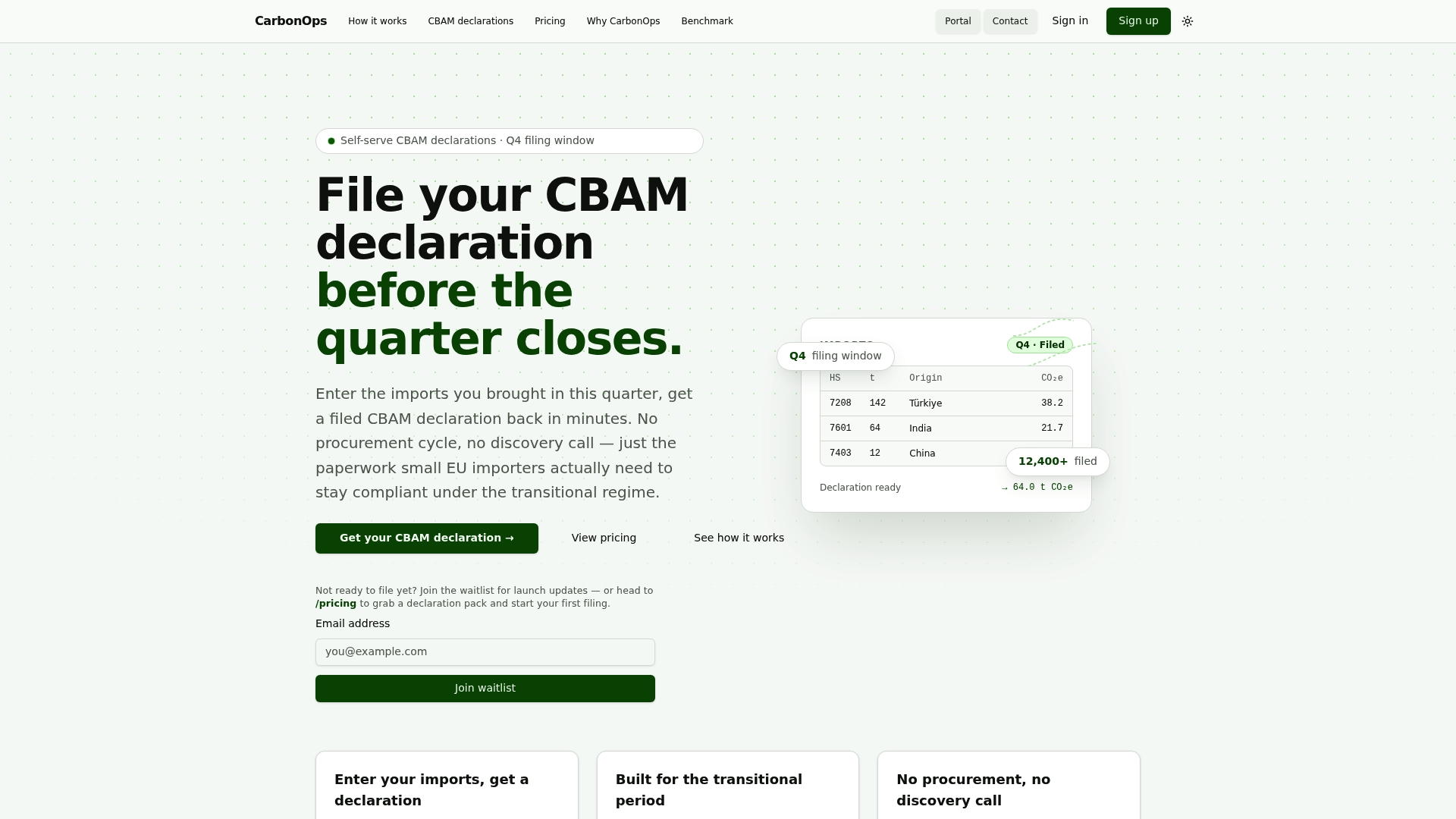
You enter each shipment’s HS code, mass, and country of origin. Where supplier data is present, CarbonOps validates it. Where it is missing, the platform applies the current Commission default for that CN code and country, marks up correctly for the filing year, and records the exact regulation reference in the audit trail. The completed declaration exports as a PDF ready for the EU CBAM registry, with your filing history retained for future audits.
No subscription, no deployment, no onboarding cycle. CarbonOps runs on a pay-per-declaration model, with single-declaration and multi-pack options. If you are filing now or preparing for your next quarterly window, start your first declaration on CarbonOps and see how long it actually takes.
Useful sources
The following primary and authoritative sources are the ones your compliance team should bookmark and revisit as the regulation evolves.
- Implementing Regulation (EU) 2025/2621 — The legal instrument containing definitive country-by-CN-code default values and the mark-up schedule. This is the document to cite in every declaration that uses a default. Download the Annexes and archive them.
- Commission DG TAXUD default values spreadsheet — The operational XLS/CSV published by the European Commission, keyed to CN codes and country combinations. Filter by your product and origin country to extract the applicable default. Archive the version you use for each declaration period.
- CBAM legislation and guidance hub (DG TAXUD) — The Commission’s central page for CBAM legal texts, guidance documents, and updates. Check here for methodology papers and any revision notices before each filing window.
- O’Melveny legal note on U.S. exporter exposure — A practical legal analysis of how country-specific defaults affect U.S. steel and other exporters, with guidance on the data collection steps that reduce liability.
- CBAM Journal: default values vs. verified emissions — A clear explanation of the policy rationale behind defaults, the declaration citation requirements, and the compliance implications of treating defaults as a permanent election rather than a fallback.
- Joint Research Centre — The Commission’s scientific body that supplies the underlying production and emissions data used to derive sector defaults. Useful for understanding the data lineage behind specific country-sector figures.