Submit CBAM Filings Without IT for EU Importers, Avoid 10% Markup

Submit CBAM Filings Without IT for EU Importers, Avoid 10% Markup
Yes, you can prepare and submit CBAM declarations without integrating any IT systems. Importers do this today with spreadsheets, email templates, and disciplined recordkeeping. The catch is operational, not technical: you need authorised declarant status sorted, supplier data chased down early, defaults applied correctly when data is missing, and a verifier booked well ahead of your deadline. Skip any one of those, and the paperwork gets expensive fast.
TL;DR:
- Only authorized CBAM declarants can submit declarations, and delays in obtaining this status can cause filing bottlenecks and penalties.
- Collecting and verifying emissions data requires early supplier outreach and documented default value usage, increasing costs, especially for indirect emissions.
- Default values incorporate a 10% markup in 2026, making reliance on actual supplier data more cost-effective over time, particularly for high-volume imports.
- Booking verifiers early and preparing evidence bundles in advance helps prevent last-minute delays and ensures smooth verification and submission processes.
- Manual filing remains practical for small import batches, but becomes inefficient and more costly than automation when managing numerous installations or tight quarterly deadlines.
Table of Contents
- Who Needs Authorised CBAM Declarant Status Before Filing?
- What Emissions Data Does a CBAM Declaration Actually Require?
- How Do You Build a CBAM Declaration Manually, Step by Step?
- Why Is Booking a CBAM Verifier So Difficult?
- What Are the Key CBAM Deadlines Through 2027?
- How Much Do Default Values Really Cost You?
- How CarbonOps Handles Filing Without Integration
- When Manual Compliance Makes Sense, and When It Doesn’t
- Get Your CBAM Declaration Filed Without the IT Project
- Where to Verify These Rules Yourself
- Sources
Who Needs Authorised CBAM Declarant Status Before Filing?
Only an Authorised CBAM Declarant can submit a declaration through the CBAM Registry. This isn’t optional paperwork you can push to next quarter. Importing CBAM-covered goods without that authorization exposes you to penalties and can block future shipments from clearing customs until the status is sorted out.
The importer of record is legally responsible for the report. An indirect customs representative may submit on the importer’s behalf only where national rules permit it, and that permission varies by country and by how CBAM reporting responsibilities are structured. A third-party consultant or software provider cannot file the declaration in your name. They can prepare it, but the submission itself sits with the authorised entity.
Before you touch a single emissions number, get these administrative pieces in place:
- Confirm your EORI number is active and linked to the correct legal entity.
- Apply for Authorised CBAM Declarant status through your national competent authority (NCA), not the European Commission directly.
- Register in the CBAM Registry once authorization comes through, since the registry account is tied to that status.
- Decide now whether an indirect customs representative will file for you, and confirm in writing that your NCA allows it.
Our guide to becoming an authorised declarant walks through the application sequence in more detail, including typical processing times that catch importers off guard.
What Emissions Data Does a CBAM Declaration Actually Require?
A valid declaration needs specific data points tied to specific goods, and there’s no shortcut around collecting them. For every shipment, you need the CN code, the mass or quantity imported, the country of origin, the producing installation’s identifier, and both direct and indirect embedded emissions for that installation.
Direct emissions come from the production process itself. Indirect emissions cover the electricity consumed making the goods, and they’re notoriously harder to pin down because suppliers rarely track them the way they track fuel use. Our breakdown of indirect emissions reporting covers why this single field causes more back-and-forth with suppliers than anything else on the form.
Here’s what you’re allowed to submit when a supplier can’t or won’t provide actual figures:
- Actual (verified) emissions data from the producing installation, ideally supported by the supplier’s own monitoring records.
- EU default values, published by the Commission per CN code and country, used when supplier data is unavailable or incomplete.
- “Other countries and territories” substitute values, used when no country-specific default exists for that CN code, a gap that shows up more often than most importers expect.
Statistic Callout: Default values carry a built-in markup of 10% in 2026, rising in later years under the definitive regime. That markup is deliberate. The Commission wants defaults to be the expensive fallback, not a convenient shortcut you lean on indefinitely.
One tool worth knowing about: the Operators Portal (O3CI) lets non-EU installation operators upload their own emissions data and share it directly with declarants. It’s genuinely useful for cutting down email chains, but don’t mistake it for a compliance engine. It doesn’t calculate embedded emissions, doesn’t map CN codes, and doesn’t verify anything. You still reconcile whatever comes through it against your own import records and the Commission’s guidance by hand.
How Do You Build a CBAM Declaration Manually, Step by Step?
There’s a logical order to this, and skipping ahead almost always means redoing work later. Here’s the sequence that keeps a manual process from turning into a scramble.
- Scope your imports. Pull every shipment from the reporting period and sort it by CN code against the CBAM-covered goods list. Flag which supplier and which installation produced each batch. This inventory becomes the backbone of everything else.
- Reach out to suppliers early. Use the Commission’s standard communication template to request installation-level emissions data, not aggregate company figures. Log every response, including the non-responses, since you’ll need that record later to justify using a default value.
- Apply defaults where data doesn’t arrive. When a supplier can’t or won’t provide actual figures, pull the matching Commission default value for that CN code and country. Document, in writing, exactly why you used it. A one-line note in your working file (“supplier non-responsive as of [date]”) is enough, but it has to exist.
- Prepare your verification file. Even goods reported using defaults may need supporting documentation. Assemble installation IDs, raw supplier correspondence, and your calculation worksheets into one package before you contact a verifier, not after.
- Assemble and export the declaration. Structure the final numbers into the format the CBAM Registry expects, cross-check totals against your original import inventory, and retain every version as part of your audit trail.
Pro Tip: Build your supplier outreach log as a shared spreadsheet from day one, with columns for date sent, date responded, data received, and default used. Verifiers and auditors ask for this exact record more often than any other single document.
The registry itself is a submission portal, not a compliance engine. It expects clean, finished numbers, not raw material, so all the reconciliation work happens offline before anything gets uploaded. Our declaration template guide shows the field structure the registry actually expects, which helps avoid rework at submission time.
Why Is Booking a CBAM Verifier So Difficult?
Verification is where manual timelines get squeezed the hardest. Accredited verifiers are limited in number relative to the volume of declarants who need sign off, and slots fill up well before major deadlines. Waiting until a month before your filing date to look for one is a common and avoidable mistake.
Verifiers work from a specific evidence package, and showing up without it wastes your slot, not theirs. They expect installation IDs matched to specific shipments, raw supplier records rather than summarized figures, and your own calculation worksheets showing how you got from raw data to a final emissions number.
A few habits reduce the friction considerably:
- Pre-format your evidence bundle by installation before you ever contact a verifier, so nothing gets assembled under deadline pressure.
- Book your verification slot as soon as you know your reporting period is closing, not after your numbers are final.
- Keep a standing default-value justification template ready, since verifiers ask for the same rationale documentation repeatedly across different declarants.
Pro Tip: If you’re using a supplier’s data through the Operators Portal, print or export the raw upload alongside your reconciled figures. Verifiers want to see both versions side by side, not just your final number.
What Are the Key CBAM Deadlines Through 2027?
The definitive regime, which phases in from 2026 under Regulation (EU) 2023/956, changes the rhythm of compliance from quarterly reporting to annual declarations tied to certificate surrender. That shift matters for how you plan your manual workload across the year.
- Registry authorization: apply for Authorised CBAM Declarant status well before your first definitive-regime filing, since NCA processing times vary and delays block your registry account.
- Annual declaration: definitive-regime declarations are filed annually, covering the prior calendar year’s imports, with certificate surrender tied to that same cycle.
- Certificate purchases: CBAM certificates need to be bought progressively across the year rather than in one lump purchase before surrender, so cash flow planning matters as much as the paperwork.
A realistic internal calendar starts supplier outreach at the beginning of the reporting year, not near the deadline. Book your verifier once your reporting period closes. Purchase certificates on a rolling basis so you’re not exposed to price swings in a single buying window. Our reporting window checklist breaks this into a month-by-month sequence if you need something more granular than a quarterly overview.
How Much Do Default Values Really Cost You?
Relying on default values isn’t free, and it isn’t meant to be. The markup structure is designed to push declarants toward real supplier data over time, and the gap in cost between actual and default figures widens in later years of the definitive regime.
For an importer bringing in several product lines from multiple installations, the defaults become the most expensive line item in the whole compliance process, not the cheapest shortcut.
A few practical moves limit that exposure without touching a single IT system:
- Prioritize supplier outreach for your highest-volume CN codes first. That’s where a percentage markup does the most dollar damage.
- Build emissions data requirements into supplier contracts going forward, so future renewals include a data-sharing obligation rather than a voluntary request.
- Keep every piece of outreach correspondence on file. Auditors and verifiers both want to see that you tried to get actual data before falling back on defaults, since that record is part of what justifies the substitution.
Documentation isn’t busywork here. It’s the difference between a defensible default-value decision and one that looks like you never asked your supplier at all.
How CarbonOps Handles Filing Without Integration
CarbonOps runs this exact workflow without asking you to connect any system. You enter each shipment with its HS/CN code, mass, and country of origin, and the data gets validated and matched to the CBAM CN code it falls under. Where supplier-specific emissions aren’t available, the Commission’s published default values are applied automatically per CN code and country, so every line resolves to a complete figure.
You still need to supply validated supplier data where you have it, your invoices and shipping documents, your EORI number, and confirmation of your authorised declarant status. What you don’t need is a procurement cycle or a platform rollout. The output is a declaration exported in the format the CBAM Registry expects, retained with a full filing history for your audit trail.
When Manual Compliance Makes Sense, and When It Doesn’t
If you’re importing a handful of CN codes from a small supplier list a few times a year, manual compliance is genuinely fine. The math changes once you’re juggling dozens of installations, chasing indirect emissions across multiple countries, or filing on a tight quarterly cadence. That’s when the hours spent on spreadsheets start costing more than a managed alternative would.
Over the next 30 to 90 days: confirm your authorised declarant status, start supplier outreach for your highest-volume CN codes now, and book a verifier before your reporting window closes rather than after.
— Jake Stevens
Get Your CBAM Declaration Filed Without the IT Project
CarbonOps skips the part of CBAM compliance that eats the most time: building or buying a system just to produce one filing. You get a completed declaration back after entering your shipment details, without a procurement process, a platform deployment, or an onboarding call standing between you and a filing-ready export.
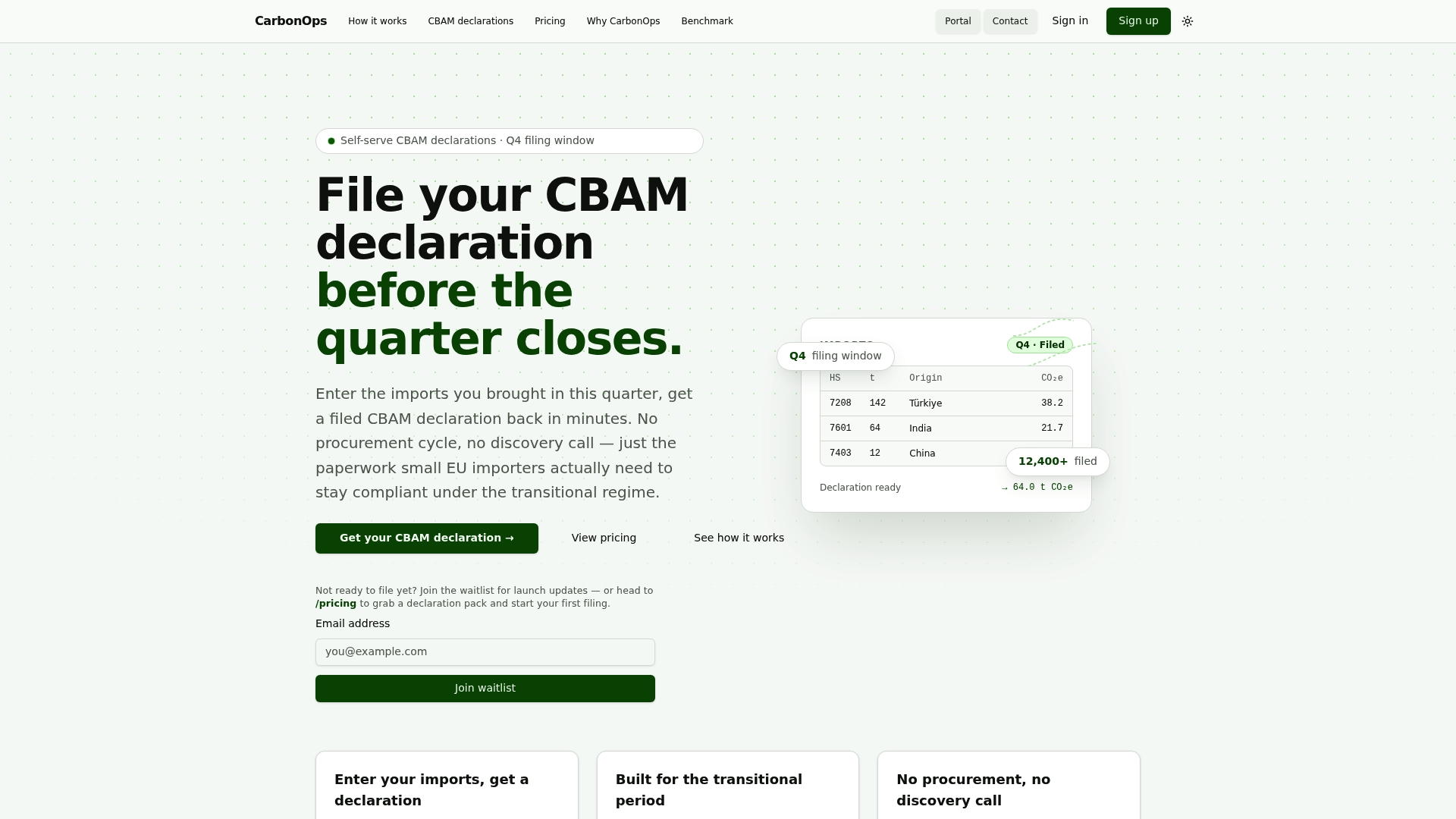
The workflow mirrors what’s outlined above. You bring the import details and whatever supplier data you have; CarbonOps maps each line to its CBAM CN code and applies Commission default values automatically wherever supplier figures are missing. What comes back is a declaration formatted for direct submission to the CBAM Registry, with your filing history retained for audit purposes.
Pricing works per declaration rather than as a subscription, with single filings or multi-packs of five or fifteen for importers filing across several reporting periods. If you’re weighing a one-off filing against building out an internal manual process, check what a benchmark filing looks like before you commit either way. If you’d rather build the manual process yourself first, our CBAM automation guide covers smaller workarounds for teams not ready to hand off the filing entirely, and the emissions calculation walkthrough is worth bookmarking either way.
Where to Verify These Rules Yourself
- Regulation (EU) 2023/956 — the legal text establishing CBAM.
- European Commission CBAM guidance — default values, registry rules, Operators Portal details.
- Check supplier data readiness with the DPP readiness checker before your next outreach round.
This article is general information, not a substitute for advice from a qualified financial advisor. Consult a qualified financial professional about your own circumstances before acting on anything here.
Sources
- Regulation (EU) 2023/956
- EU Commission – Carbon Border Adjustment Mechanism guidance
- CBAM Journal — EU CBAM definitive regime 2026