CBAM Reporting Window: US Importer Timeline & Checklist

CBAM Reporting Window: US Importer Timeline & Checklist
The CBAM reporting window runs quarterly, and the single most critical compliance date is the annual September 30 surrender deadline, when authorised declarants must surrender CBAM certificates equal to their declared embedded emissions. Miss that date and you are not just late on paperwork; you are exposed to enforcement by your member state’s national competent authority (NCA).
Three things to confirm right now:
- Verify your authorised declarant status in the EU CBAM Registry before your next import shipment clears customs.
- Gather operator-specific embedded emissions from your overseas suppliers, or identify which EU default values apply per CN code and country of origin.
- Prepare a registry-ready export of your declaration so it can be submitted and retained for audit.
The CBAM definitive regime has applied since January 1, 2026, bringing full financial obligations: authorisation, quarterly reporting, and certificate purchase and surrender. This is no longer a dry run.
Key Takeaways
The September 30 certificate-surrender deadline is fixed regardless of which quarter goods were imported, making early certificate procurement and quarterly data discipline the two most important levers for US importers.
| Point | Details |
|---|---|
| Quarterly filing cadence | Each CBAM report covers one calendar quarter and is due within one month of the quarter’s end. |
| September 30 surrender | Certificates covering all prior-year imports must be surrendered by September 30 of the following year. |
| Authorised declarant first | Confirm registry access and authorised declarant status before your next shipment clears EU customs. |
| Operator data drives accuracy | Use supplier-specific embedded emissions where available; apply EU defaults only when documented. |
| CarbonOps for filing | CarbonOps converts import records into a registry-ready declaration in four steps, with no deployment required. |
Table of Contents
- What is the CBAM reporting window and when are filings due?
- Who must file CBAM reports and what does an authorised declarant do?
- What data do you need for each reporting period?
- How do you calculate and reconcile embedded emissions?
- How does the CBAM Registry connect to the surrender deadline?
- What happens if you miss a quarterly report or the surrender deadline?
- Pre-deadline checklist for US importers
- How CarbonOps turns import records into a filing-ready declaration
- Running a CBAM filing from a US compliance officer’s desk
- CarbonOps gets you from import records to a filed declaration
- Sources
What is the CBAM reporting window and when are filings due?
Each CBAM reporting window covers one calendar quarter. Under the transitional period that ran from October 1, 2023 through December 31, 2025, quarterly reports were due no later than one month after the quarter ended. The first report covered October through December 2023 and was due January 31, 2024. That same one-month cadence continues into the definitive regime.
Here is how the filing calendar maps across a full year:
| Quarter | Reporting period | Submission deadline |
|---|---|---|
| Q1 | January 1 – March 31 | April 30 |
| Q2 | April 1 – June 30 | July 31 |
| Q3 | July 1 – September 30 | October 31 |
| Q4 | October 1 – December 31 | January 31 (following year) |
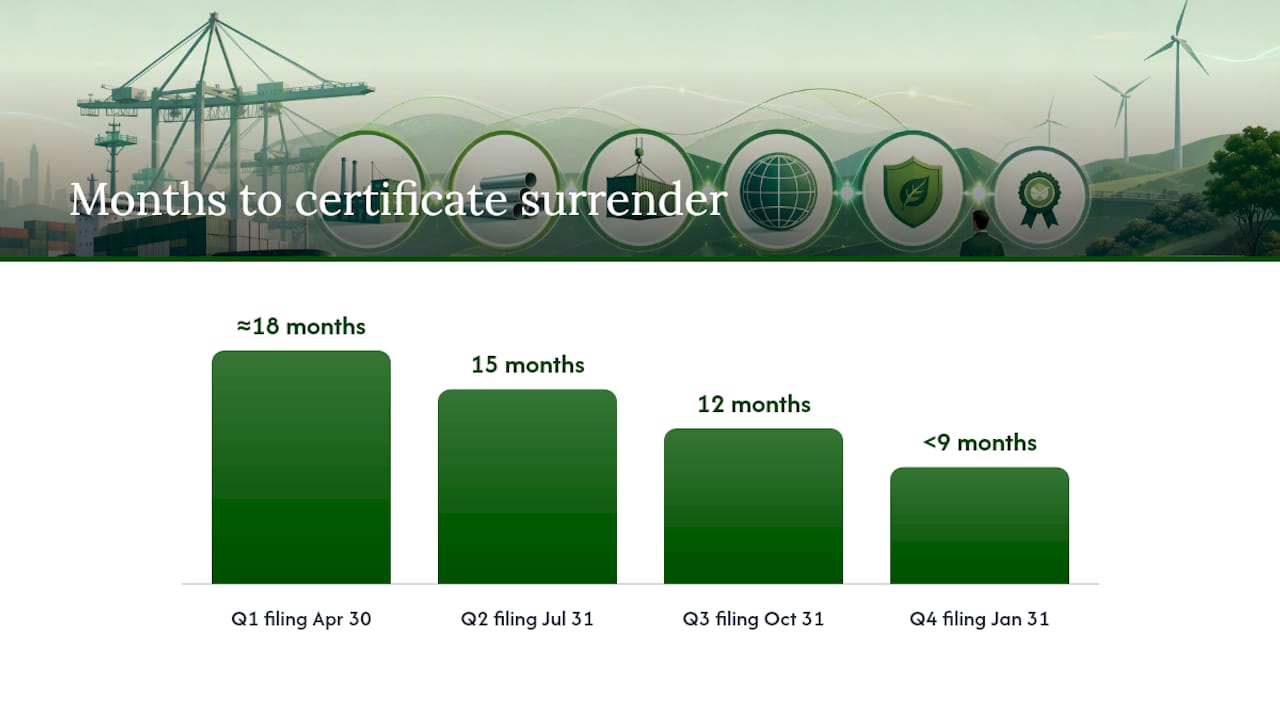
The certificate-surrender deadline sits separately from the quarterly filings. Certificates must be surrendered by September 30 following the importation year. For example, goods imported during 2026 must have their certificates surrendered by September 30 of the following year. That means a Q4 import gives you less than nine months from the end of the quarter to procure and surrender certificates, while a Q1 import gives you closer to eighteen months. Plan accordingly.
Pro Tip: Start procuring CBAM certificates well before the September 30 deadline. Certificate prices track EU ETS carbon prices, which can move sharply. Buying in advance smooths your cost exposure and avoids the market squeeze that tends to hit when multiple declarants rush purchases in August and September.
Who must file CBAM reports and what does an authorised declarant do?
The filing obligation falls on the authorised CBAM declarant, which is either the importer of record or an indirect customs representative acting on the importer’s behalf. Being an authorised declarant is not automatic — it requires a formal application and approval through the CBAM Registry before you can submit declarations or hold certificates.
Core responsibilities of an authorised declarant:
- Submit a quarterly CBAM declaration covering all in-scope goods imported during the period.
- Maintain an active registry account with sufficient certificates to cover declared embedded emissions.
- Surrender the correct number of certificates by September 30 each year.
- Retain supporting documentation for audit purposes.
Checklist to confirm authorised-declarant readiness:
- Confirm your registry account is active and your EORI number is linked.
- Identify a named compliance contact responsible for each quarterly filing.
- Verify record-retention procedures cover at least five years of import and emissions data.
- Confirm your NCA contact details for your EU member state of importation.
What data do you need for each reporting period?
Every quarterly CBAM declaration requires a specific set of fields. Missing even one can delay submission or trigger a correction request.
Mandatory fields per shipment line:
- HS/CN code (8-digit Combined Nomenclature code)
- Mass or quantity of goods imported
- Country of origin
- Supplier or installation operator ID
- Specific embedded emissions (direct and indirect, in tonnes of CO₂ equivalent per tonne of goods)
- EU default values where supplier-specific data is unavailable
- Carbon price paid abroad, if applicable
| Report field | Typical evidence source | Recommended format |
|---|---|---|
| CN code | Customs entry / import declaration | 8-digit numeric string |
| Mass/quantity | Commercial invoice, packing list | Metric tonnes |
| Country of origin | Certificate of origin, invoice | ISO alpha-2 code |
| Operator/supplier ID | Supplier declaration | EU installation ID or name |
| Embedded emissions | Operator MRV report or EU default table | tCO₂e per tonne of goods |
| Carbon price paid | Supplier invoice, tax receipt | EUR amount per tonne CO₂ |
The CBAM guidance document for importers sets out the full required report contents and explains acceptable documentation, including operator monitoring, reporting, and verification (MRV) outputs, supplier declarations, and transport records. Retain all of it for at least five years.
How do you calculate and reconcile embedded emissions?
Use operator-specific emissions first. EU default values are a fallback, not a preference, and their use must be documented. The guidance for importers confirms that importers must apply the most recent operator-provided data, even when that data refers to a prior production period.
Step-by-step emissions calculation per shipment:
- Obtain the operator’s latest MRV-verified embedded emissions figure (tCO₂e per tonne of goods).
- Multiply by the mass of goods imported in that shipment.
- If no operator data is available, apply the EU Commission’s published default value for that CN code and country of origin.
- Aggregate all shipment-level figures within the quarter to produce the total quarterly embedded emissions.
- Cross-check the quarterly total against your certificate holdings before the next surrender date.
The mismatch between operator reporting cycles (typically a 12-month calendar or fiscal year) and your quarterly importer cadence is a known friction point. Operators report annually; you report quarterly. Use the operator’s most recently communicated annual figure, pro-rated or applied as-is per the guidance, and document the basis clearly.
Pro Tip: Keep a version-controlled log of every operator emissions figure you receive, including the date received and the production period it covers. If you later need to correct a filed report, that log is the difference between a clean correction and a contested one.
How does the CBAM Registry connect to the surrender deadline?
The CBAM Registry is the central platform for submitting declarations, holding certificates, and demonstrating compliance to competent authorities. Certificates must be physically present in your registry account before they can be surrendered. You cannot surrender certificates you have not yet purchased and transferred into your account.
The relationship between quarterly filings and the annual surrender works like this:
| Action | Timing |
|---|---|
| Submit quarterly declaration | Within one month of quarter end |
| Accumulate certificates in registry | Ongoing throughout the year |
| Surrender certificates | By September 30 of the following year |
| Retain export file for audit | Indefinitely (minimum five years recommended) |
The registry accepts declaration exports in the format it specifies for upload. Retain a copy of every exported file alongside your filing history — this is your primary audit trail if an NCA queries a past submission.
Pro Tip: Download and archive your registry export immediately after each quarterly submission, not just before the surrender deadline. Reconstructing a filing history from memory six months later is far harder than maintaining a dated folder of exports as you go.
What happens if you miss a quarterly report or the surrender deadline?
Missing a quarterly submission does not automatically close the door. The CBAM Q&A documentation notes that registry functions exist to request delayed submission for technical errors, and correction windows applied during the transitional period. Under the definitive regime, your NCA is the first call.
Immediate steps after a missed deadline:
- Contact your NCA promptly and document the reason for the delay in writing.
- Use the CBAM Registry’s delayed-submission or correction request functions where available.
- File the corrected or late declaration as soon as possible with full supporting documentation.
- If the surrender deadline was missed, secure certificates immediately and surrender them with a corrective filing.
- Do not wait for the NCA to contact you — proactive disclosure typically results in better outcomes than reactive enforcement.
Enforcement consequences under the definitive regime can include financial penalties proportional to the shortfall in surrendered certificates. Transparent, documented corrective action is the strongest mitigation available.
Pre-deadline checklist for US importers
US importers face an added layer of complexity: your suppliers and operators are overseas, their data arrives on their schedule, and the EU registry operates on Central European Time. Build lead time into every step.
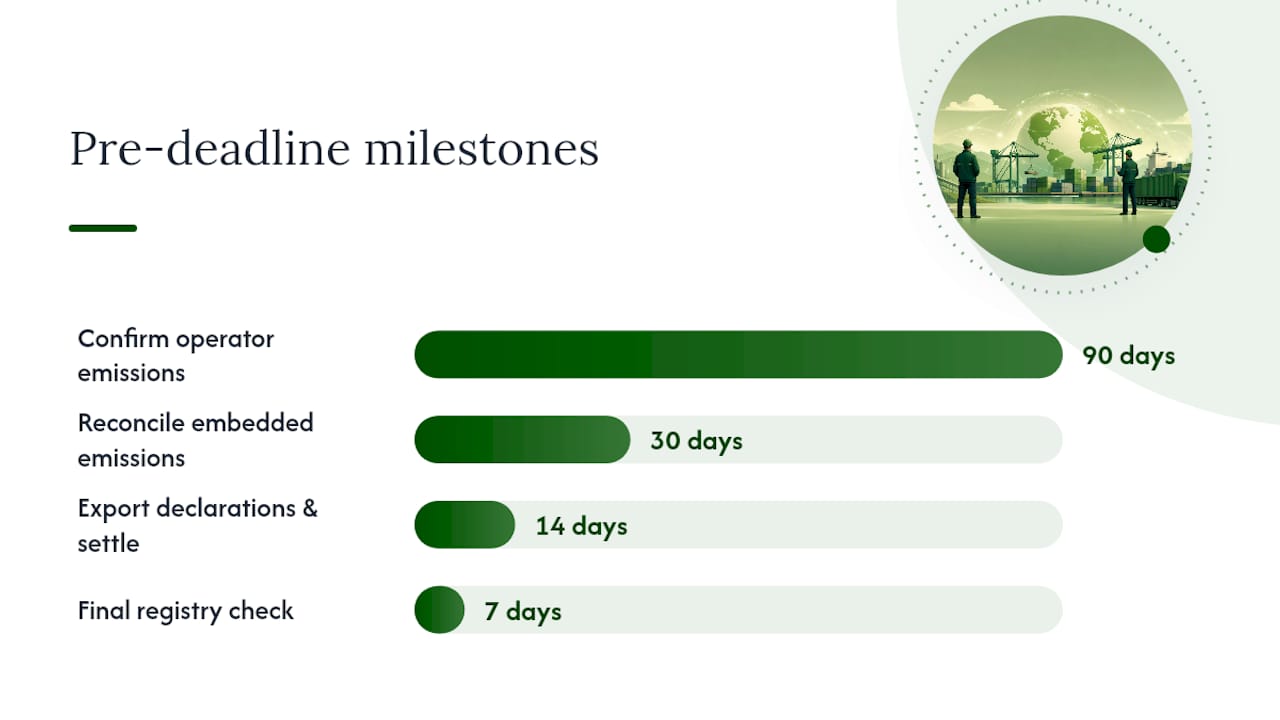
90-day countdown to September 30 surrender:
- 90 days out: Confirm operator emissions data has been received for all Q1–Q4 imports of the prior year. Flag any gaps and request updated figures from suppliers.
- 30 days out: Reconcile total embedded emissions across all quarterly declarations. Verify your certificate holdings in the registry match or exceed that total.
- 14 days out: Complete the registry export for each quarterly declaration and store it. Confirm certificate purchase orders are settled and certificates are in your account.
- 7 days out: Run a final registry account check. Confirm the surrender function is accessible and the certificate count is correct.
- Day of surrender: Execute the surrender in the registry before end of business on September 30. Download the surrender confirmation immediately.
Pro Tip: Build a standing data-request email to your overseas operators scheduled for the first week of each new quarter. Operators on a calendar-year reporting cycle often finalize their annual figures in February or March — if you wait until August to ask, you are already behind.
How CarbonOps turns import records into a filing-ready declaration
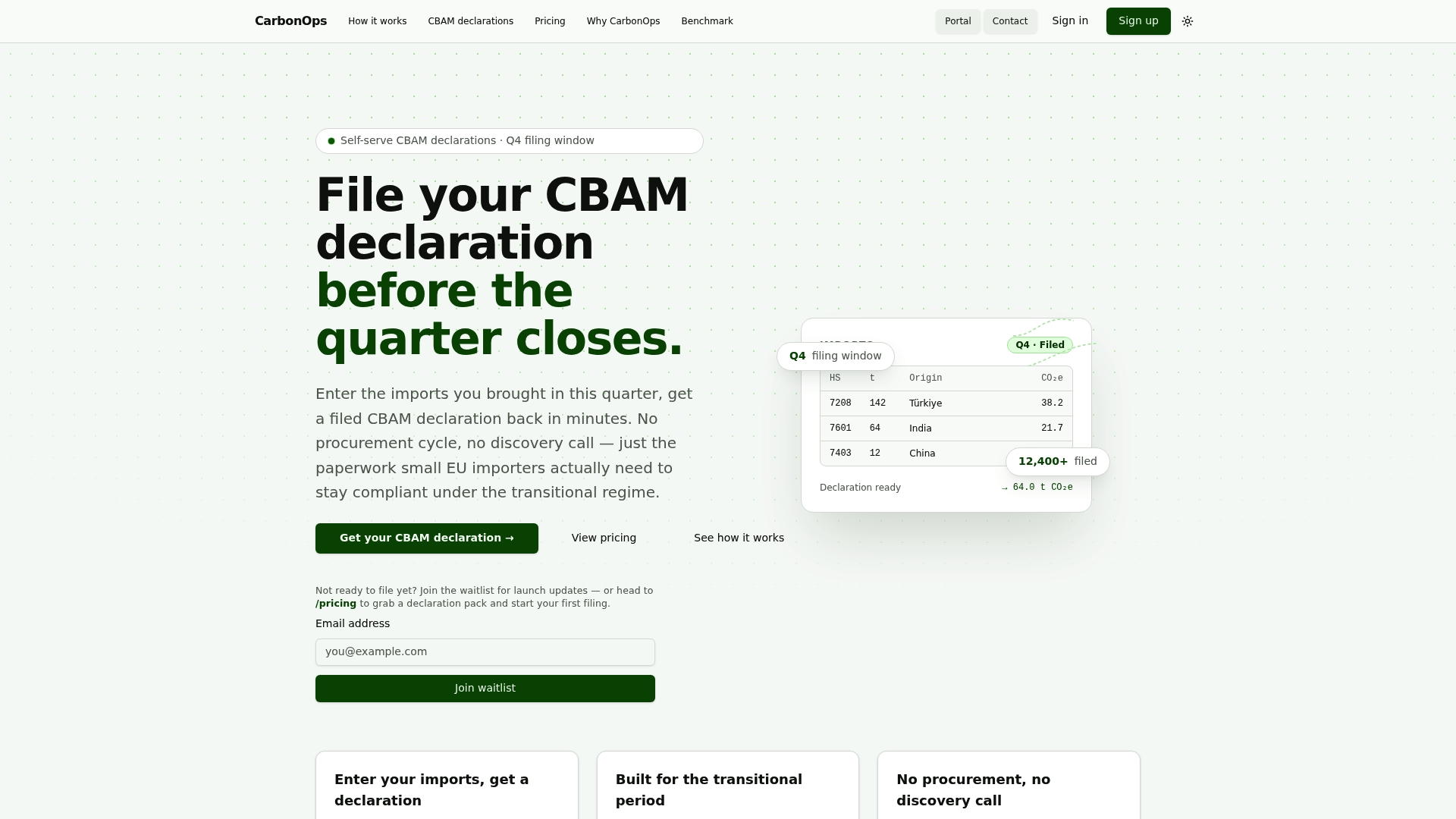
CarbonOps converts a batch of imported goods into a CBAM declaration ready for registry upload in four steps, with no platform deployment or procurement cycle required.
- Enter imports: Input each shipment’s HS/CN code, mass, and country of origin. Supplier data is validated and mapped to CBAM-covered goods.
- Match CN codes: Each line is matched to its CBAM CN code and sector, showing exactly which imports are in scope and what emissions data each still needs.
- Apply emissions: Where supplier-specific figures are missing, CarbonOps applies the Commission’s published default values per CN code and country, so every line resolves to a complete figure.
- Export and file: The completed declaration exports in the format the EU CBAM Registry expects, retained with your filing history for the audit trail.
Pro Tip: CarbonOps’s pay-per-declaration model means you are not locked into an annual subscription for a compliance obligation that runs quarterly. File when you need to, at the pace your import volume requires.
Running a CBAM filing from a US compliance officer’s desk
Registry access and early operator data validation are the two variables that determine whether a quarterly filing goes smoothly or turns into a scramble. A realistic task list for the week before a quarterly submission deadline: pull the operator emissions log, cross-reference it against the import manifest for the quarter, verify CN code assignments on any new product lines, and confirm the registry export function is working under your account credentials.
The one thing a US compliance lead can do this week to cut surrender risk: send a written data request to every overseas supplier now, specifying the exact format and period you need, and set a calendar reminder to follow up in 30 days if you have not received a response. Waiting until Q3 to chase Q1 operator data is how September 30 becomes a crisis.
CarbonOps gets you from import records to a filed declaration
For US importers who need a quarterly CBAM declaration without standing up a new compliance platform, CarbonOps is the direct route. You bring the supplier data; the four-step workflow handles CN code matching, default-value application, and registry-format export. No deployment, no subscription, no waiting on an IT procurement cycle.
The exported declaration file is retained in your filing history, giving you a ready audit trail for every quarter. Pay per declaration, file when you need to, and meet the September 30 surrender deadline with a complete, documented record behind you. Start your first declaration at CarbonOps.
Sources
Keep these primary sources bookmarked. They are the authoritative references for every deadline, field requirement, and registry rule in this article.
- CBAM definitive regime - Taxation and Customs Union - European Commission
- Carbon Border Adjustment Mechanism (CBAM) Questions and Answers
For registry-specific questions, contact the NCA for the EU member state where your goods enter customs. Each NCA maintains its own contact point for CBAM declarant queries.