How to Become an Authorized CBAM Declarant: 2026 Guide

How to Become an Authorized CBAM Declarant: 2026 Guide
Any EU-established importer of CBAM-covered goods must hold authorized CBAM declarant status before importing under the definitive regime. Indirect customs representatives who accept CBAM liability on behalf of non-EU importers also need the status. The fastest next step: confirm your EORI number, gather your establishment documents, and open an application in the CBAM Registry Authorisation Management Module (AMM) today.
Three immediate actions:
- Verify your EORI number is active and correctly attributed to the importing legal entity.
- Check your prior-year net import mass against the 50-tonne annual threshold per CN code group. If you stay below 50 tonnes for iron, steel, aluminum, cement, or fertilizers in a calendar year, you may qualify for an exemption from authorization in that sector. Hydrogen and electricity importers have no threshold: authorization is always required regardless of mass.
- Contact your national competent authority (NCA) and start your AMM application. The CBAM Q&A guidance confirms that the NCA consultation procedure should not exceed 15 working days as a guideline, but real-world timelines depend on how complete your file is on day one.
Key Takeaways
Becoming an authorized CBAM declarant requires meeting four formal criteria, submitting a complete AMM application, and maintaining ongoing reporting and certificate obligations from the moment authorization is granted.
| Point | Details |
|---|---|
| Authorization is mandatory | Only authorized CBAM declarants may import CBAM-covered goods into the EU under the definitive regime. |
| 50-tonne threshold | Importers below 50 tonnes per calendar year per CN code group are exempt, except for hydrogen and electricity, which always require authorization regardless of mass. |
| April 2026 deadline passed | The transitional derogation closed April 1, 2026; missing authorization now risks import blocks. |
| Certificate mechanics | One CBAM certificate equals one tonne of CO2; certificates must be surrendered annually by September 30. |
| CarbonOps for declarations | CarbonOps handles CN code matching, default emissions, and exports filing-ready declarations for the CBAM Registry. |
A note on what the checklist doesn’t show you
The steps in this guide are accurate, but they flatten something that only shows up when you are actually working through a filing: the time it takes to get usable emissions data from suppliers. That is consistently the longest part of the process, and it is the one most importers underestimate when they plan their application timeline.
Suppliers outside the EU, particularly in sectors like steel and aluminum, often have no existing process for calculating or reporting embedded emissions. Getting a signed, verifiable emissions figure from a supplier who has never heard of CBAM can take weeks of back-and-forth. Starting that conversation before you submit your AMM application, not after, is the single most valuable thing you can do to shorten your path to a complete, auditable declaration.
Table of Contents
- Who must be an authorized CBAM declarant, and who is exempt?
- How do you apply for authorized CBAM declarant status?
- What documents do you need to prove eligibility?
- What happens after you apply, and how long does it take?
- What are your ongoing obligations once you are authorized?
- How can US-headquartered importers comply with CBAM?
- What are the most common application mistakes, and how do you fix them?
- How CarbonOps maps to each step of the authorization and filing workflow
- Filing your first CBAM declaration without the usual overhead
- Sources
Who must be an authorized CBAM declarant, and who is exempt?
Only authorized CBAM declarants may import CBAM-covered goods into the EU under the definitive regime. The consolidated regulation is unambiguous on this point: no authorization, no import. Four formal criteria determine whether an entity qualifies.
The four formal criteria
The CBAM Q&A sets out the requirements clearly:
- Established in an EU Member State — the applicant must have a registered place of business or permanent establishment in the EU.
- Valid EORI number — the EORI must be active and attributed to the correct legal entity making the customs declaration.
- Operational and financial capacity — the applicant must demonstrate it can meet CBAM obligations: internal procedures, qualified staff, IT systems, and financial soundness.
- Clean compliance record — no serious or repeated infringements of customs or tax rules, and no record of serious criminal offenses related to economic activity.
The 50-tonne threshold and sector scope
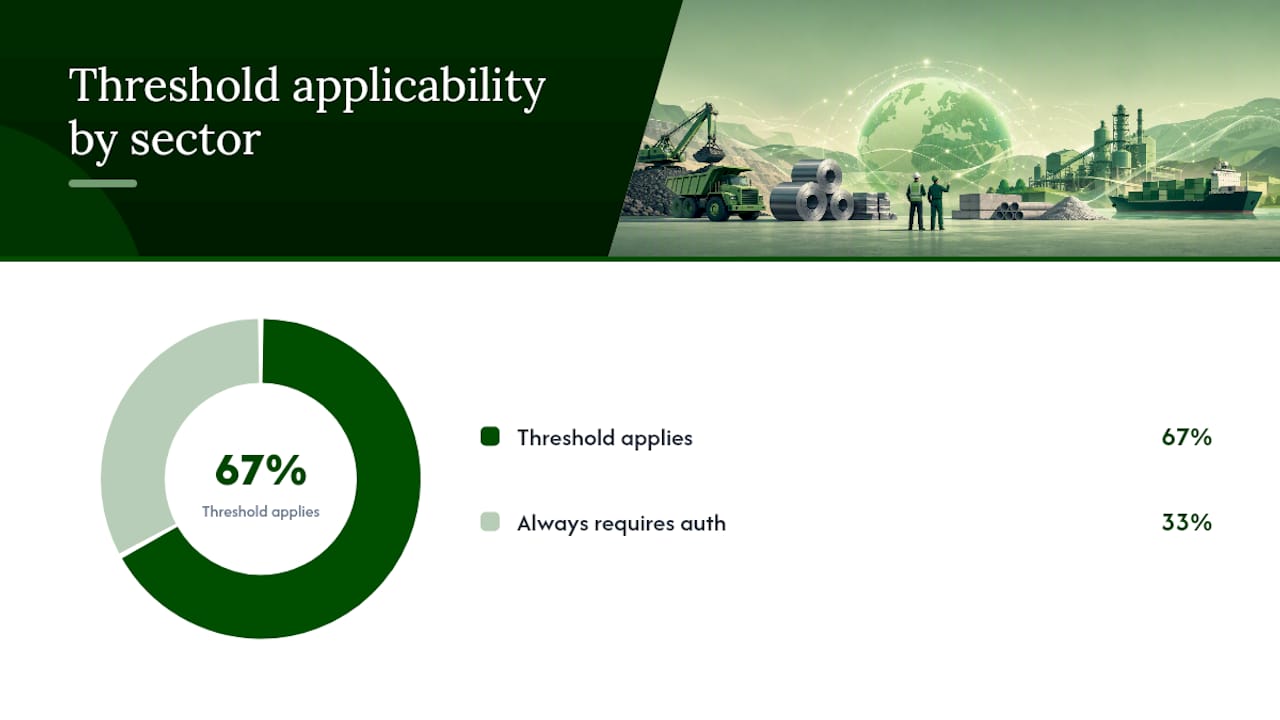
The threshold is generally understood to be 50 tonnes per calendar year, measured as net mass aggregated per importer and per CN code group. If your total imports of a covered good stay below 50 tonnes in a calendar year, you are exempt from the authorization requirement for that sector. The exemption applies to iron and steel, aluminum, cement, and fertilizers; hydrogen and electricity always require authorization regardless of import volume.
When goods fall below the threshold, the exemption must still be declared correctly in the customs entry. Failing to do so creates a compliance gap even when no authorization is technically required.
| Sector | 50-tonne threshold applies? | Always requires authorization? |
|---|---|---|
| Iron and steel | Yes | No |
| Aluminum | Yes | No |
| Cement | Yes | No |
| Fertilizers | Yes | No |
| Hydrogen | No | Yes |
| Electricity | No | Yes |
EORI attribution and liability
The EORI number is not just an identifier. It links goods, reporting obligations, and legal liability to a specific entity. If a group of companies imports under multiple EORIs, each importing entity carries its own CBAM obligations. Centralizing filing through a single indirect customs representative is possible, but the reporting obligations analysis from Squire Patton Boggs makes clear that legal liability stays with the importing entity, not the representative filing on its behalf.
How do you apply for authorized CBAM declarant status?
The application runs entirely through the AMM inside the CBAM Registry. There is no paper form and no separate national portal in most Member States. Here is the sequence.
- Obtain your EORI number if you do not already have one. Apply through your Member State’s customs authority. Without an active EORI, the AMM will not accept your application.
- Access the CBAM Registry via the European Commission’s Taxation and Customs Union portal. You will need an EU Login account or the equivalent national access management credential your Member State uses.
- Log into the Authorisation Management Module. From the Registry dashboard, locate the AMM and select “New Authorisation Application.”
- Complete the applicant identity section. Enter the legal entity name, registered address, EORI number, VAT registration, and the Member State of establishment. The system cross-references the EORI against customs databases, so the details must match exactly.
- Fill in the establishment details section. Confirm the registered office address, the date of establishment, and upload or reference your certificate of incorporation or equivalent proof.
- Complete the compliance record declaration. You will be asked to confirm no serious customs or tax infringements and no relevant criminal convictions. If there is a prior infringement, disclose it with context rather than omitting it: NCAs check independently.
- Submit capacity statements. Describe your operational procedures for managing CBAM obligations (staff, IT systems, internal controls) and provide financial evidence. This section is where most applications stall — see the documents section below for what to attach.
- Pre-submission check. Before clicking submit, confirm: EORI evidence is attached, proof of establishment is uploaded, financial and operational capacity statements are complete, and all declarations are signed by an authorized signatory.
Once submitted, the NCA receives the application through the registry and begins its assessment. The CBAM Registry page confirms that NCAs record their decisions directly in the registry, and approved declarants receive a CBAM account number granting access to declaration submission and certificate management.
What documents do you need to prove eligibility?
A complete file on submission day is the single biggest factor in a fast decision. NCAs request additional information when evidence is thin, and each round of back-and-forth adds weeks. Prepare these before you open the AMM form.
Core identity and establishment documents:
- EORI certificate or confirmation letter from your customs authority
- Certificate of incorporation, commercial register extract, or equivalent establishment proof
- VAT or tax registration certificate
- Proof of registered address (utility bill, lease, or official correspondence dated within three months)
Financial capacity evidence:
- Most recent audited annual accounts or balance sheet
- Bank reference letter or credit facility confirmation
- Solvency indicators: current ratio, net equity position, or credit rating if available
- Insurance certificates covering commercial operations
Operational capacity evidence:
- Written description of internal CBAM procedures: who is responsible, how declarations are prepared, how supplier emissions data is collected
- Evidence of staff qualifications or training in customs and environmental compliance
- Description of IT systems used for customs declarations and data management
Compliance record:
- Self-declaration of no serious infringements, signed by an authorized officer
- If there is a prior customs penalty, include a brief explanatory note and evidence of corrective action
Pro Tip: Build your document file as a named, dated folder before you start the AMM form. Use a consistent naming convention: “EntityName_EORI_Certificate_YYYY-MM-DD.pdf.” Timestamped files and a clear version history reduce the risk of an NCA questioning whether evidence is current. Apply the same discipline to supplier emissions confirmations: a signed supplier statement with a date is far stronger than an email thread. Transparent, well-organized documentation is a hallmark of strong compliance programs, and the same principles that apply to corporate compliance recordkeeping apply equally here.
What happens after you apply, and how long does it take?
The NCA reviews your application and may consult other authorities before issuing a decision. The CBAM Q&A guidance states the consultation procedure should not exceed 15 working days as a general guideline. In practice, the clock starts running from the day your file is considered complete, not the day you submit.
Common reasons NCAs request additional information:
- EORI details in the AMM do not match the customs authority’s records exactly
- Financial evidence is incomplete (missing accounts, no bank reference, or accounts more than 12 months old)
- Operational capacity statement is too vague: “we have a compliance team” without describing procedures or naming responsible staff
- Supplier emissions data is absent or unverified, raising questions about whether the applicant can meet reporting obligations
If your application is refused:
- You have the right to appeal through the NCA’s administrative review process and, if needed, through national courts.
- Identify the specific grounds for refusal and address each one directly in a corrective submission.
- The operational consequence is severe: under the Belgian NCA’s guidance, the transitional derogation that allowed provisional imports during processing closed after March 31, 2026. From April 1, 2026, there is no derogation. If you are not authorized, national customs can block your imports of CBAM-covered goods.
On timing: the 15-working-day consultation window is a guideline, not a statutory deadline in most Member States. Applications submitted with complete, well-organized files consistently move faster than those that trigger information requests. Early contact with your NCA before submission, to confirm local documentation expectations, is the most reliable way to shorten the timeline.
What are your ongoing obligations once you are authorized?
Authorization is the starting line, not the finish. The compliance burden shifts from a one-off permission to recurring administration once you hold the status.
Annual CBAM declaration
- Prepare your annual declaration covering all CBAM-covered goods imported during the prior calendar year. The declaration must include embedded emissions per shipment, the CN code, country of origin, and the quantity.
- Submit by September 30 of the year following the import year. The first annual declarations under the definitive regime cover imports from January 1, 2026 onward, with the first submission deadline falling on September 30, 2027.
- Reconcile your customs entries against your CBAM declaration before submission. Discrepancies between customs data and CBAM data are a primary audit trigger.
Certificate purchase and surrender
- Purchase CBAM certificates corresponding to your declared embedded emissions. Dutch Customs guidance explains the mechanics: one CBAM certificate equals one tonne of CO2 equivalent. Certificate sales are scheduled to begin in early 2027.
- Meet quarterly minimum purchase requirements from February 1, 2027 onward. The quarterly minimum is calculated as a proportion of your estimated annual obligation.
- Surrender certificates annually by September 30, matching the number surrendered to the total embedded emissions declared for the prior year.
Recordkeeping and audit readiness
- Retain all supporting documentation for at least five years: customs declarations, supplier emissions data, embedded emissions calculations, certificate purchase and surrender records, and correspondence with your NCA.
- Keep supplier data organized by shipment and CN code. NCAs audit declarations by tracing embedded emissions back to the supplier evidence or, where supplier data is unavailable, to the Commission’s published default values.
- Monitor for NCA audit triggers: significant year-on-year changes in declared emissions, discrepancies between customs entries and CBAM declarations, or late submissions all attract scrutiny.
How can US-headquartered importers comply with CBAM?
A US company cannot hold authorized CBAM declarant status directly: the establishment requirement means the authorized entity must be registered in an EU Member State. Three practical routes exist.
| Route | Who holds the authorization | Liability | Documentation overhead | Speed to market |
|---|---|---|---|---|
| Set up an EU subsidiary or branch | The EU entity | Stays with the EU entity | High (incorporation, EORI, full application) | Slowest |
| Appoint an EU indirect customs representative | The representative | Stays with the importing entity; representative accepts CBAM obligations | Medium (representative agreement, power of attorney) | Moderate |
| Import through an existing EU affiliate | The EU affiliate | Stays with the affiliate | Low if affiliate is already authorized | Fastest if affiliate qualifies |
Route 1: establish an EU entity
Incorporating a subsidiary or registering a branch in a Member State gives the US parent full control over CBAM filings. The new entity applies for its own EORI and submits an AMM application in its own name. The overhead is real: incorporation takes weeks to months depending on the jurisdiction, and the new entity must demonstrate its own operational and financial capacity. This route suits companies with significant, long-term EU import volumes.
Route 2: appoint an indirect customs representative
An EU-based customs broker or freight forwarder who accepts CBAM obligations can act as the authorized declarant. The Squire Patton Boggs analysis notes that while a representative can file centrally, legal liability for CBAM obligations remains with the importing entity. The representative agreement must explicitly state that the representative accepts CBAM declarant obligations, not just customs clearance duties. A power of attorney and a written service agreement are the minimum documentation requirements.
Route 3: use an existing EU affiliate
If the US parent already has an EU affiliate that imports goods, that affiliate can apply for authorization under its own EORI. The US parent supplies the goods; the EU affiliate is the importer of record and the authorized declarant. EORI attribution is critical here: goods must be declared under the affiliate’s EORI, not the US parent’s.
Practical checklist for US companies:
- Confirm which EU entity will hold the EORI and the authorization before starting the AMM application.
- For the representative route: obtain a signed representative agreement and power of attorney before submission.
- For a new EU entity: gather incorporation documents, registered address proof, and initial financial statements.
- Regardless of route: collect supplier emissions data early. US suppliers may be unfamiliar with CBAM reporting requirements, and getting signed emissions confirmations takes time.
What are the most common application mistakes, and how do you fix them?
Most delays and refusals trace back to a short list of predictable errors.
- Wrong EORI attribution. The EORI in the AMM must belong to the legal entity making the customs declaration, not a parent company, a trading name, or a related entity. Check the EORI against your customs authority’s records before submitting.
- Missing or outdated proof of establishment. A commercial register extract dated more than three months ago is often rejected. Pull a fresh extract within two weeks of submission.
- Vague operational capacity statements. “We have experienced staff” tells an NCA nothing. Name the responsible person, describe the procedure, and reference the IT system used. A one-page internal procedure document attached to the application is far more persuasive than a paragraph of general assurances.
- Insufficient financial evidence. Accounts more than 12 months old, or accounts that show a net liability position without explanation, will generate an information request. If your most recent accounts show a weak position, include a bank reference letter or a note from your auditor explaining the context.
- No supplier emissions data. Submitting an application without any plan for how you will collect embedded emissions data signals to the NCA that you cannot meet reporting obligations. Address this directly in your operational capacity statement.
Pro Tip: If your supplier cannot provide verified embedded emissions data in time for your application or first declaration, use the Commission’s published default values for the relevant CN code and country of origin. Default values are conservative — they tend to be higher than actual supplier emissions — but they resolve every line to a complete, auditable figure. Document which lines use defaults and why, so your audit trail is clean. Maintaining transparent documentation practices from the start makes later audits far less disruptive.
How CarbonOps maps to each step of the authorization and filing workflow
The administrative load of CBAM compliance sits in two places: preparing the application file and then managing the ongoing declaration cycle. CarbonOps is built specifically for the second of those, and its workflow directly reduces the risk of the errors that cause application delays.
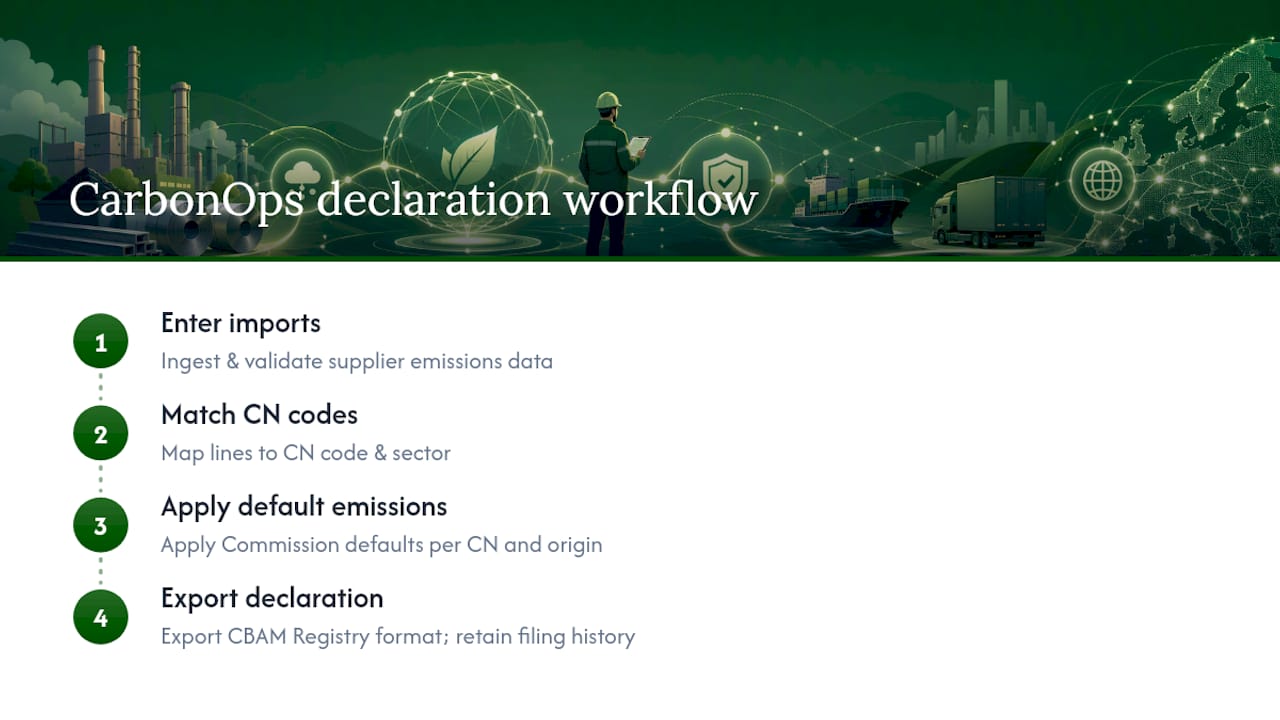
Supplier data intake and validation. CarbonOps ingests supplier-level emissions data and validates it against the expected format. Importers who use the tool during the application phase can demonstrate to their NCA that they have a working process for collecting and verifying supplier data, which directly addresses the operational capacity requirement.
CN code matching. Every import line is matched to its CBAM CN code and sector. This eliminates one of the most common filing errors: applying the wrong code to a shipment, which can result in under-declared emissions or a mismatch with customs entries.
Default emissions application. Where supplier-specific data is missing, CarbonOps applies the Commission’s published default values per CN code and country of origin. Every line resolves to a complete, reviewable figure rather than a gap in the declaration.
Declaration export. The completed declaration is exported in the format the CBAM Registry expects, ready for submission. The filing history is retained for the audit trail, which satisfies the recordkeeping requirement without additional manual archiving.
The four-step workflow (enter imports, match CN codes, apply emissions, export and file) covers the full declaration cycle. No platform deployment is required, and no subscription locks you in. For small and mid-sized importers managing their first filings, that means the tool is usable from day one without an IT procurement cycle.
Filing your first CBAM declaration without the usual overhead
Once you hold authorized CBAM declarant status, the next pressure point is the declaration itself: matching every import line to the right CN code, sourcing embedded emissions data, and producing a file the CBAM Registry will accept.
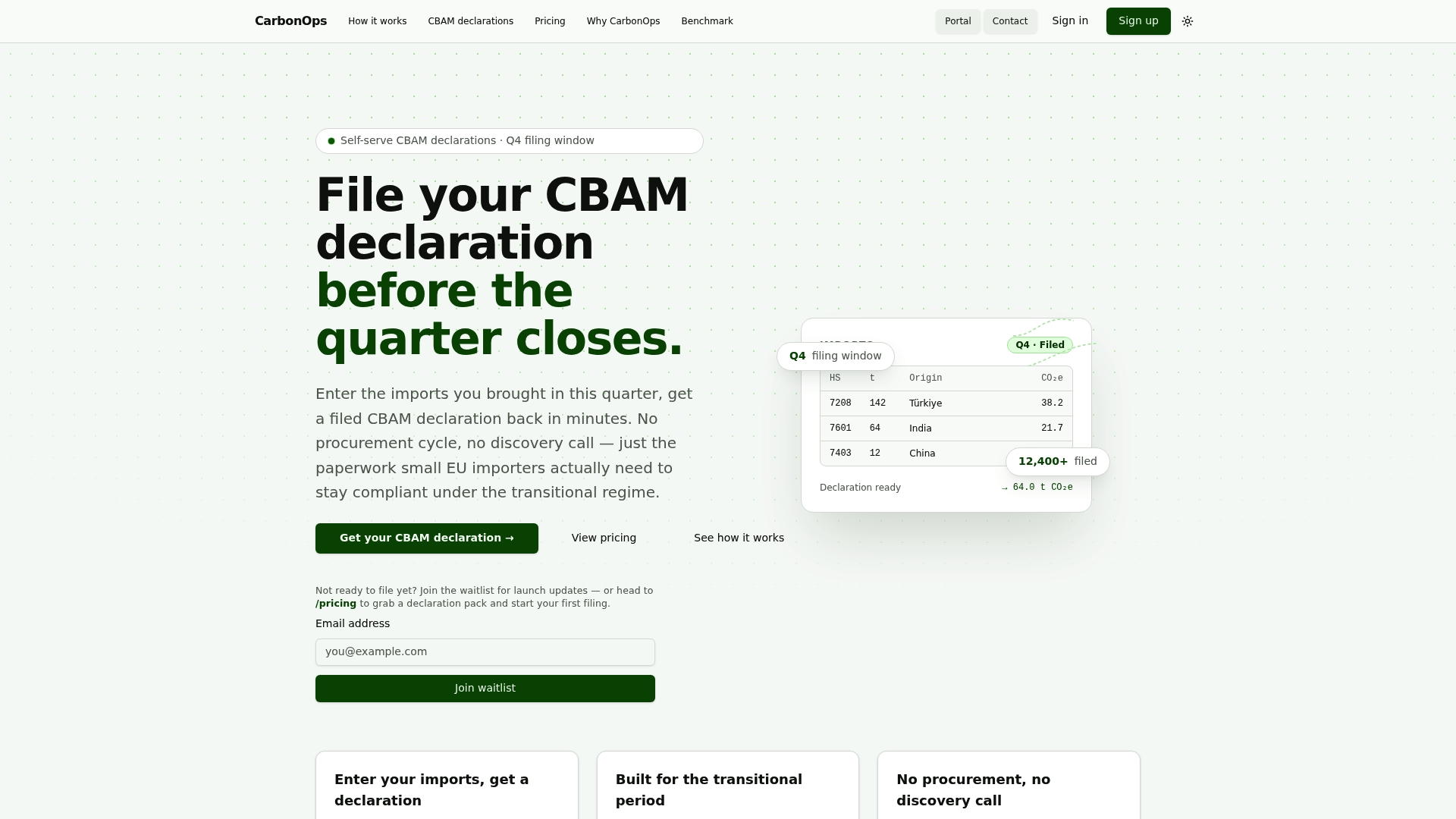
CarbonOps handles that entire cycle in four steps: enter your imports with HS/CN codes and origin, match each line to its CBAM sector, apply Commission default values where supplier data is missing, and export a filing-ready declaration. No subscription, no deployment, no onboarding cycle. You pay per declaration, with multi-pack options (5 or 15 filings) for importers managing multiple quarters.
For compliance officers and customs representatives preparing their first definitive-regime filings, that means you can go from raw supplier data to a submission-ready declaration without building a new internal system. Start your first declaration at CarbonOps and see the workflow before you commit.
This article is general information, not a substitute for advice from a qualified lawyer. Consult a qualified legal professional about your own circumstances before acting on anything here.
Sources
Every Member State’s NCA interprets “operational and financial capacity” with some discretion. Consult your NCA early, before you submit, to confirm what evidence it expects. What satisfies one authority may not satisfy another.
- Consolidated TEXT: 32023R0956 — EN — 20.10.2025
- EU CBAM Reporting Obligations
- Carbon Border Adjustment Mechanism (CBAM) | Dutch Customs
- CBAM Registry - Taxation and Customs Union