CBAM Filing Status: What EU Importers Must Do Now

CBAM Filing Status: What EU Importers Must Do Now
If you import goods covered by CBAM into EU customs territory, you almost certainly need Authorised CBAM Declarant status starting January 1, 2026, when the definitive regime replaces the transitional reporting system entirely. The only way around this requirement is a genuine exemption: shipments under a certain mass threshold for most goods, or specific carve-outs that don’t apply to hydrogen or electricity. Both of these stay in scope regardless of volume.
Here are the dates that actually matter for your filing status:
- January 1, 2026 — the definitive CBAM regime begins; quarterly transitional reporting ended December 31, 2025
- March 31, 2026 — cutoff for provisional importing arrangements in many cases
- February 1, 2027 — first sale of CBAM certificates
- September 30, 2027 — first annual CBAM declaration due, covering all 2026 imports
Your next move, this week, is threefold: confirm your business is established in the EU (or that you’re working through an authorized indirect customs representative), check whether your import volumes clear the 50-tonne threshold, and then either start an application through the CBAM Registry’s Authorisation Management Module or document, in writing, exactly why an exemption applies to you. Waiting until Q3 2026 to figure this out is the single most common mistake compliance teams make, and it’s an expensive one once certificate purchasing and quarterly balance checks kick in.
Key Takeaways
Authorised CBAM declarant status becomes mandatory for most importers of covered goods starting January 1, 2026, and the first annual declaration for those imports is due September 30, 2027.
| Point | Details |
|---|---|
| Authorisation is the default | Most importers of CBAM-covered goods above 50 tonnes need authorised declarant status starting January 1, 2026. |
| Certificates arrive late, obligations don’t | Certificate sales start February 1, 2027, but emissions obligations accrue from the first 2026 import. |
| Quarterly checks matter as much as annual ones | From 2027, declarants must hold certificates covering at least 50% of cumulative emissions each quarter end. |
| Data collection is the critical path | Start requesting supplier emissions data now; late supplier responses are the top cause of missed deadlines. |
| CarbonOps shortens the declaration step | The tool maps CN codes, calculates emissions with supplier or default values, and exports registry-ready filings per declaration. |
Table of Contents
- Understanding CBAM Filing Status: The Three Categories That Matter
- Who Must Apply, and What NCAs Actually Check
- How to Register and Apply Through the CBAM Registry
- Annual Declarations, Certificate Surrender, and the Quarterly Balance Rule
- Which Sectors and CN Codes Actually Fall Under CBAM
- What Verifiers and Auditors Look For
- Planning Cashflow Around Certificate Purchases
- Your 60-Day CBAM Action Plan
- How CarbonOps Turns Import Data Into a Filing-Ready Declaration
- A Faster Path to a Filing-Ready CBAM Declaration
- Sources
Understanding CBAM Filing Status: The Three Categories That Matter
Most confusion around CBAM filing status comes down to not knowing which of three buckets you fall into. Get this right first, and everything else, registry access, deadlines, certificate math, becomes a lot simpler to plan around.
Authorised CBAM declarant is the status most EU-based importers of covered goods will need. This is a formal designation granted by your national competent authority (NCA) after an application through the CBAM Registry. Once authorized, you’re the party legally responsible for submitting annual declarations and surrendering certificates that match your imported goods’ embedded emissions. You cannot import CBAM-covered goods above the threshold without this status, full stop, unless you’re operating under an indirect customs representative arrangement.
Indirect customs representative status applies when a non-EU-established importer needs someone inside the EU to act as declarant on their behalf. This representative takes on the authorised declarant obligations, so a non-EU manufacturer selling into the EU through a customs agent doesn’t need its own EU legal entity to comply. The representative needs to be established in a Member State and holds the same authorisation burden as a direct importer would.
Exempt or small-volume importer status covers anyone whose CBAM-covered imports stay under the single-mass threshold. For most goods, that threshold applies per year, cumulative across CN codes within a sector. Cross it, even by a small margin, and you’re back in the authorised declarant pool. Hydrogen and electricity are always in scope regardless of quantity because they are treated as inherently carbon-intensive imports worth tracking from the first unit.
The application process isn’t a formality check, it’s a systemic capacity review. National authorities are evaluating whether you can actually meet ongoing financial and reporting obligations, not just whether your paperwork is complete.
Who qualifies to apply as an authorised declarant comes down to a short list: legal establishment in an EU Member State, a valid EORI number, and a track record clean enough to pass the fit-and-proper review described in the Commission’s implementing regulation on authorised declarant conditions. Miss any one of those, and your application stalls before it starts.
Who Must Apply, and What NCAs Actually Check
National competent authorities don’t rubber-stamp CBAM applications. They’re running a fit-and-proper assessment that looks a lot more like a credit and compliance review than a customs form.
Here’s what typically gets scrutinized:
- Legal establishment and EORI: your business must be registered in the Member State where you’re applying, with an active EORI number tied to your customs history.
- Customs and tax compliance record: authorities check for a clean history, unresolved infringements or repeated violations can sink an application outright.
- Financial and operational capacity: this is the “systemic capacity” piece, evidence that your business can actually fund certificate purchases and sustain the reporting cycle, not just file one declaration and disappear.
- No serious or repeated infringements: a pattern of customs violations, even minor ones, gets flagged during review.
The consultation and assessment period generally runs through the CBAM Registry itself, and the Commission’s own guidance frames this as an evaluation of whether an applicant can meet reporting and financial obligations on an ongoing basis, not a one-time hurdle. Expect a consultation window of roughly 15 working days once your application lands with the NCA, though complex cases involving multiple supplier relationships or unusual CN code mixes can take longer.
Before you apply, assemble your evidence pack: two to three years of customs and tax filing history, recent financial statements, documentation of internal compliance processes, and copies of supplier communications showing you’ve already started collecting embedded emissions data. Applicants who show up with supplier data already in motion tend to move through review faster than those who apply first and scramble for data second.

Pro Tip: Don’t wait for the NCA to ask for financial capacity evidence. Submit two years of audited or reviewed financial statements with your initial application. Reviewers read incomplete submissions as a signal you haven’t planned for the certificate-purchasing obligations ahead, and that assumption is hard to walk back once it’s made.
How to Register and Apply Through the CBAM Registry
The CBAM Registry is the electronic platform where all of this happens: account creation, authorisation applications through the Authorisation Management Module (AMM), annual declaration submission, and certificate account management. Here’s the sequence to follow.
- Confirm or update your EORI number. Your EORI ties your customs identity to your CBAM Registry account and links you to any suppliers reporting emissions data on your behalf. If your EORI details are outdated, fix that before touching the registry.
- Create a CBAM Registry account through your Member State’s national portal. Access credentials typically route through the same customs authentication system you already use for standard customs declarations.
- Access the Authorisation Management Module and begin the application for authorised declarant status. This is where you formally request the status, not just register interest.
- Attach your supporting evidence: financial statements, compliance history, EORI confirmation, and any documentation of supplier relationships already in place for embedded emissions reporting.
- Submit and track the application through the registry dashboard. Most systems show application status updates, and you’ll want to monitor for requests for clarification rather than waiting passively.
During review, expect a consultation period where the NCA may come back with questions, most commonly about financial capacity documentation or gaps in your CN code coverage. If you applied before the provisional cutoff around March 31, 2026, you may be able to continue importing under provisional rules while the full authorisation is pending, though this varies by Member State practice.
Pro Tip: The fastest way to shorten NCA back-and-forth is pre-validating supplier emissions data before you submit. If your non-EU suppliers haven’t sent verified embedded emissions figures yet, request them now and keep a dated email trail. Reviewers ask fewer follow-up questions when they can see you’ve already built the data pipeline, not just promised to build one.
Annual Declarations, Certificate Surrender, and the Quarterly Balance Rule
The reporting calendar under the definitive regime runs on an annual cycle, but the certificate math underneath it runs quarterly, and mixing those two up is where a lot of compliance teams lose track.
Your annual CBAM declaration is due by September 30 following the import year. For everything you import in 2026, that means your first full declaration, and the certificates that go with it, are due by September 30, 2027. That declaration must account for every tonne of embedded emissions across your covered imports for the full calendar year.
Certificate sales themselves don’t start until February 1, 2027, which means you’re accumulating emissions obligations through all of 2026 before you can buy a single certificate against them. Fall short at a quarterly checkpoint, and you’re exposed to compliance action even before the annual surrender deadline arrives.
| Import Year | Certificate Purchase Window Opens | Quarterly Balance Check Starts | Annual Surrender Deadline |
|---|---|---|---|
| 2026 | February 1, 2027 | Q1 2027 | September 30, 2027 |
| 2027 | Ongoing (already open) | Every quarter | September 30, 2027 |
| 2027 onward | Ongoing | Every quarter | September 30 (following year) |
Miss the quarterly 50% threshold or the annual surrender deadline, and you’re looking at both financial penalties and reputational exposure with your NCA, the kind of history that makes your next fit-and-proper review a lot harder to pass.
Which Sectors and CN Codes Actually Fall Under CBAM
CBAM covers six sectors, and if your imports don’t fall into one of these, none of the filing status rules above apply to you at all.
The covered sectors are iron and steel, cement, aluminum, fertilizers, electricity, and hydrogen. Each sector maps to specific CN (Combined Nomenclature) codes that determine exactly which goods trigger reporting obligations. A shipment of raw aluminum ingots and a shipment of finished aluminum window frames can carry different CN codes and different embedded emissions calculations, even though both are “aluminum” in casual conversation.
| Sector | Typical Goods in Scope | Threshold Treatment |
|---|---|---|
| Iron & steel | Flat-rolled products, wire, tubes, pipes | Subject to 50-tonne single-mass threshold |
| Cement | Portland cement, clinker | Subject to 50-tonne single-mass threshold |
| Aluminum | Unwrought aluminum, bars, plates | Subject to 50-tonne single-mass threshold |
| Fertilizers | Nitrogen-based fertilizers, ammonia | Subject to 50-tonne single-mass threshold |
| Electricity | Imported electrical energy | No threshold, always in scope |
| Hydrogen | Hydrogen gas imports | No threshold, always in scope |
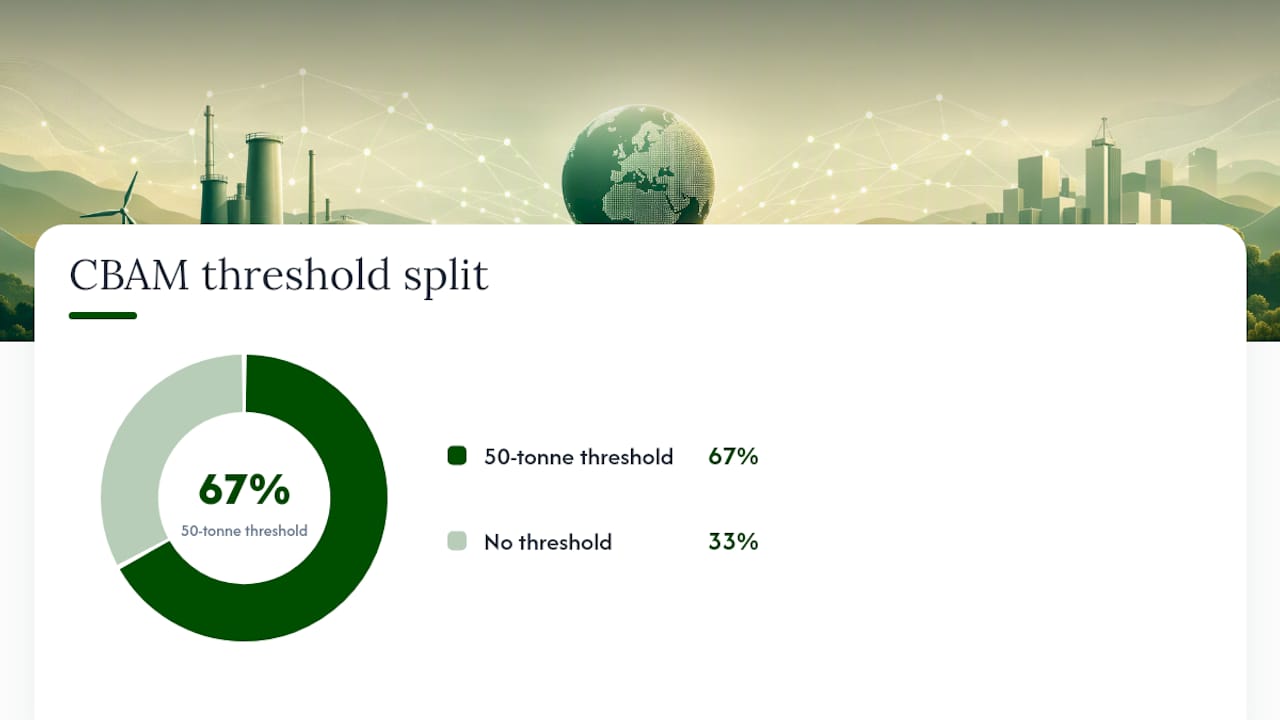
The 50-tonne threshold applies per importer, cumulative across a calendar year, not per shipment. If you bring in four separate 15-tonne shipments of steel wire over the year, you’ve crossed the threshold on the fourth shipment and owe authorisation and reporting for the full volume, not just the overage. Mapping your HS/CN codes against the CBAM sector list should be one of the first things your customs team does, because a code that looks close enough on a packing list can sit entirely outside CBAM scope, or squarely inside it, depending on subheading detail most non-specialists miss.
What Verifiers and Auditors Look For
Verification under CBAM runs on two tracks: supplier-provided, verified embedded emissions data, or the Commission’s published default values when supplier data isn’t available or complete. Third-party verification becomes relevant when your declared emissions rely on supplier-specific figures rather than defaults, since those numbers need independent confirmation before an NCA will accept them at face value.
The audit triggers compliance teams run into most often:
- Embedded emissions figures that don’t reconcile with supplier documentation
- Missing or incomplete supplier emissions reports for a given reporting period
- Inconsistent EORI linkage between the declarant and the actual importing entity
- Late annual declarations or certificate surrender past the September 30 deadline
- Gaps between declared CN codes and the goods actually described on customs entries
Keep your records organized around a simple retention principle: hold onto everything for at least the duration the NCA could reasonably request in an audit, which in practice means several years past the relevant filing year. Build a file for each reporting period that includes:
- Supplier emissions certificates or declarations, dated and attributable to specific shipments
- Customs entry documentation matching CN codes to actual goods
- Internal calculation worksheets showing how you arrived at declared emissions figures
- Correspondence with your NCA, including any clarification requests and your responses
- Certificate purchase and surrender confirmations from the registry
A missing link in any of these five categories is usually what turns a routine registry check into a drawn-out audit.
Planning Cashflow Around Certificate Purchases
CBAM certificate prices aren’t arbitrary. For 2026, pricing references the quarterly average of EU ETS auction clearing prices, shifting to a weekly average starting in 2027. That distinction matters for procurement planning: a quarterly average smooths out short-term ETS price swings, while a weekly average means your certificate costs will track the carbon market more closely once you’re past the first year.
Pro Tip: Treat certificate procurement like any other commodity hedge, not a once-a-year purchase. Stagger buying across the year rather than waiting for the deadline, and get internal budget approval for certificate spend locked in well before Q1 2027. Teams that treat this as a last-minute annual expense tend to face liquidity crunches right when ETS-linked prices are least predictable.
Your 60-Day CBAM Action Plan
If you’re reading this in the first half of 2026 and haven’t started, here’s the priority order that gets you compliant fastest without wasting effort on the wrong tasks first.
- Week 1 to 2: Confirm whether you need authorised declarant status or qualify for an exemption. Check your cumulative import volumes against the 50-tonne threshold by sector.
- Week 2 to 3: If authorisation is needed, gather your EORI details, financial statements, and compliance history, then submit through the CBAM Registry’s AMM.
- Week 3 to 5: Map every import from the past 12 months by CN code and supplier. This becomes your baseline for embedded emissions calculations.
- Week 4 to 6: Reach out to every non-EU supplier and request verified embedded emissions data. Flag which suppliers can’t provide it, you’ll need Commission default values for those.
- Week 5 to 7: Set up CBAM Registry access for whoever on your team will handle ongoing declarations, and confirm they have EORI-linked credentials.
- Week 6 to 8: Get internal sign-off on a certificate procurement budget and approval chain, even though purchasing doesn’t open until 2027.
- Ongoing: Build an offline backup of your registry submissions and emissions calculations. If the registry experiences downtime, the contingency rules still expect you to meet filing deadlines through the CBAM business continuity plan.
Assign clear ownership here: compliance owns the authorisation application and audit files, procurement owns certificate budgeting and supplier emissions data collection, and customs owns CN code mapping accuracy. Split across three people or teams, this becomes manageable. Left with one person juggling all three, it’s how deadlines get missed.
How CarbonOps Turns Import Data Into a Filing-Ready Declaration
The hardest part of CBAM compliance usually isn’t understanding the rules, it’s the mechanical work of turning shipment records into a declaration the registry will actually accept. CarbonOps handles that translation in four steps.
- Intake: enter each shipment with its HS/CN code, mass, and country of origin; the data gets validated and mapped against CBAM-covered goods.
- CN mapping: every line gets matched to its CBAM CN code and sector, so you see exactly which imports are in scope and what emissions data is still missing.
- Emissions calculation: where supplier-specific embedded emissions aren’t available, the Commission’s published default values per CN code and country fill the gap, so every line resolves to a complete figure.
- Export: the finished declaration exports in the format the CBAM Registry expects, ready for review, ready to submit, and retained with your filing history for the audit trail.
This workflow fits smaller import operations and accountants or customs representatives handling filings for multiple clients particularly well, since there’s no platform deployment or onboarding cycle standing between you and a completed declaration. You bring the shipment and supplier data, and the calculation and formatting work happens without a drawn-out setup process.
Lessons from the first year of CBAM filings
The teams that struggled most in early CBAM cycles weren’t the ones with complicated supply chains, they were the ones who treated data collection as a September problem instead of a January one. Late supplier emissions responses, CN codes that didn’t match the actual goods on customs entries, and internal sign-offs that got stuck because nobody had actually assigned an owner, these showed up constantly in the first compliance cycle.
What worked consistently: reaching out to suppliers for EORI and emissions data months before any deadline pressure existed, keeping offline copies of every verification document rather than trusting registry access alone, and running a dry-run declaration in the fourth quarter before the real annual filing was due. That dry run catches the CN code mismatches and missing data gaps while there’s still time to fix them.
The bigger mistake is treating the authorisation application itself as a box to check rather than what it actually is: a formal demonstration that your business can sustain this obligation year after year. NCAs are evaluating systemic capacity, not just paperwork completeness, and applicants who show up with a real data pipeline already running tend to get through review faster and with fewer follow-up requests than those who scramble to assemble evidence after the fact.
A Faster Path to a Filing-Ready CBAM Declaration
Most of the delay in CBAM compliance doesn’t come from understanding the regulation, it comes from the manual work of matching CN codes to shipments and chasing down emissions figures line by line. CarbonOps compresses that into a self-serve process built for exactly this: bring your supplier and shipment data, get a registry-ready declaration back, with no procurement cycle or platform rollout in between.
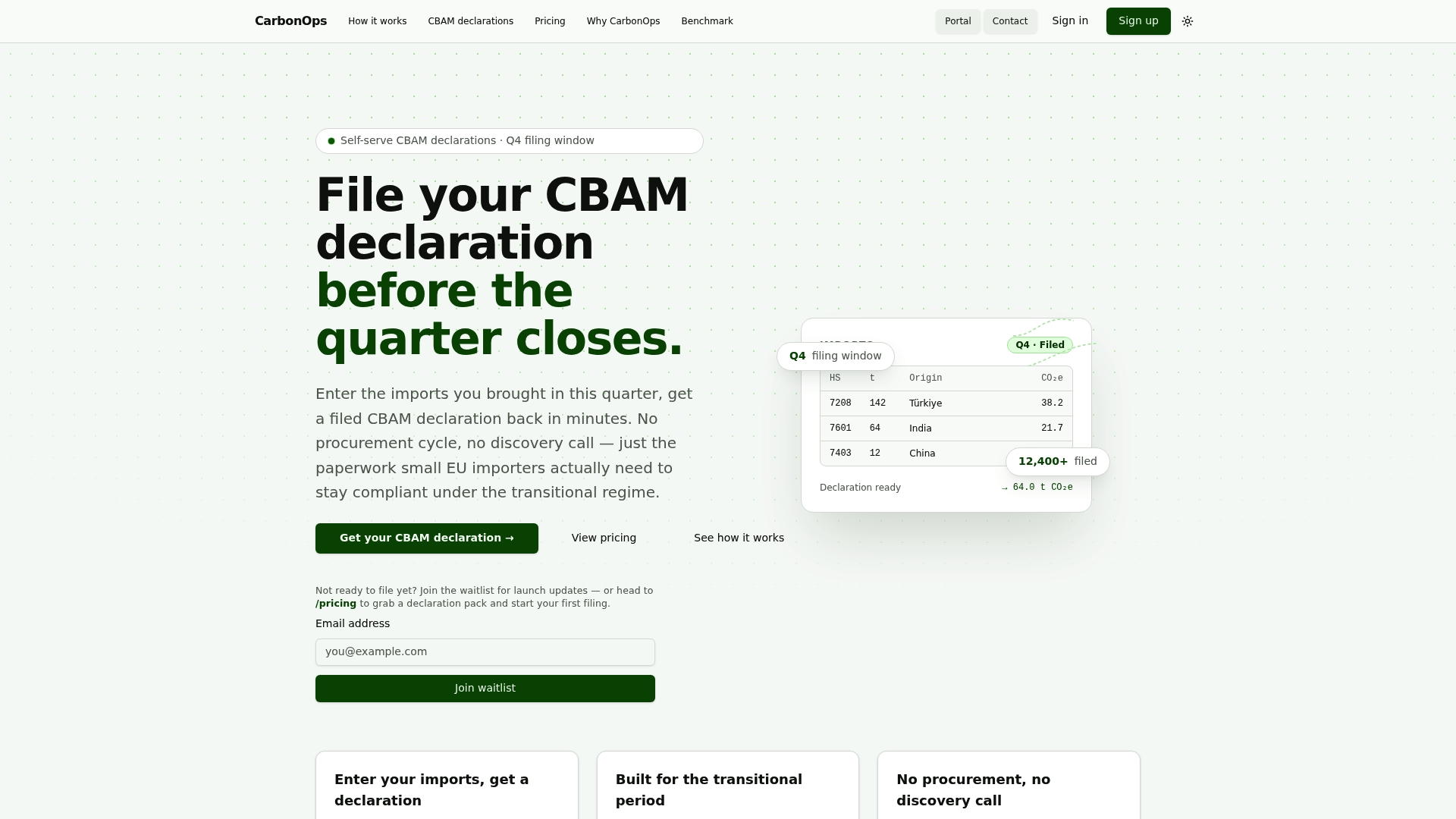
What you get with CarbonOps:
- Supplier data validation mapped directly to CBAM-covered goods
- Automatic CN code and sector matching for every shipment line
- Embedded emissions calculation using supplier data or Commission default values where supplier figures aren’t available
- Export in the format the CBAM Registry accepts, with a retained audit trail
Pricing runs one-time, per declaration, with multi-pack options for five or fifteen filings, so you’re not locked into a subscription for a compliance obligation that varies quarter to quarter. If your first annual declaration is coming up, or you’re still assembling your Q1 2026 import data, start with CarbonOps and see what a completed declaration looks like before your filing deadline gets close.
Sources
- Consolidated text: Commission Implementing Regulation (EU) 2024/3210 — CBAM registry rules
- CBAM timeline and deadlines: every key date from 2026 to 2027 and beyond | CBAMCheck
This article provides general information on CBAM compliance obligations and should not substitute for a review by a qualified customs or trade compliance professional familiar with your specific import operations.