Avoid CBAM Certificate Gaps: Importer of Record Tasks for EU Importers

Avoid CBAM Certificate Gaps: Importer of Record Tasks for EU Importers
If you are the importer of record for goods covered by the Carbon Border Adjustment Mechanism, you carry the compliance obligation unless you have formally appointed an authorized CBAM declarant. Your first move is checking your registry authorization status now, because the first annual declaration, covering 2026 imports, is due by September 30, 2027. The CBAM Registry is where that status is recorded, and where all filings are submitted.
TL;DR:
- Importers must check their registry authorization status now to ensure they are correctly registered as authorized CBAM declarants before the September 30, 2027 deadline.
- CBAM covers specific CN codes in sectors like iron and steel, cement, aluminum, fertilizers, hydrogen, and electricity, with exemptions for consignments under €150.
- The correct identification of the declarant on customs entries is critical since liability remains with the importer if the authorized declarant status is not properly assigned.
- Establishing early supplier emissions data and verifying reports prevents reliance on conservative default values, significantly reducing certificate obligations.
- Coordinating procurement, customs, finance, and compliance teams ensures timely collection of documentation, accurate classification, and proper declaration filings to avoid penalties.
Table of Contents
- What Goods Fall Under CBAM Import Compliance Guidelines
- Importer of Record vs. Authorized CBAM Declarant: Who Answers to Brussels
- How to Register as Importer of Record for CBAM Authorization
- Reporting Deadlines and Certificate Surrender Timing
- Supplier Emissions Data vs. Commission Default Values
- Building an Operational Checklist Across Teams
- What Happens When You Miss a CBAM Deadline
- From Import Data to CBAM Registry Export
- CBAM and Free Trade Agreements: What Preferential Terms Do Not Change
- Transit Goods and Re-Exports: Where CBAM Obligations Actually Trigger
- How to Verify Supplier Emissions Data Before You Rely on It
- Where CBAM’s Sector List Could Expand Next
- A Real-World Scenario: Steel Importer Facing a Certificate Gap
- What Importers Keep Getting Wrong About CBAM
- Get a Filing-Ready CBAM Declaration Without the Manual Rework
- Sources
What Goods Fall Under CBAM Import Compliance Guidelines
CBAM currently covers six sectors: iron and steel, cement, aluminum, fertilizers, hydrogen, and electricity. Each sector maps to specific CN codes listed in Annex I of the regulation, and that mapping is the actual test of whether a shipment is in scope, not the product’s common name. A steel bracket and a steel beam can sit under different CN codes with different reporting treatments, so checking the code before checking the description saves a lot of rework later.
A few practical wrinkles matter here:
- Goods valued under €150 per consignment are exempt from CBAM obligations, mirroring the low-value customs exemption.
- Electricity and hydrogen imports carry sector-specific measurement rules tied to grid or production data rather than standard shipment weight.
- Processed goods made partly from covered materials (certain downstream steel or aluminum products) can still trigger reporting if their CN code appears in Annex I.
The European Commission’s guidance documents maintain the authoritative CN code list, and it is worth bookmarking rather than relying on secondhand summaries, since sector scope has already shifted once since CBAM’s introduction and will likely shift again.
Importer of Record vs. Authorized CBAM Declarant: Who Answers to Brussels
These two roles get conflated constantly, and the confusion costs people money. “Importer” in ordinary customs language means whoever is named on the customs declaration as bringing goods into the EU. “Authorized CBAM declarant” is a distinct legal status created by Regulation (EU) 2023/956, and it is the authorized declarant, not the generic importer, who owes the annual CBAM declaration and the certificate surrender obligation.
Here is where it gets operationally tricky:
- An indirect customs representative can apply for and hold authorized declarant status on an importer’s behalf.
- Doing so does not fully erase the underlying importer’s exposure. If the declarant fails to file or surrender certificates, national authorities can still trace liability back through the customs chain.
- Incoterms shape who controls the import declaration in practice, since a seller handling delivery under DDP terms may end up as the technical importer even when the buyer assumed otherwise.
Check the customs entry itself, specifically box 8 or its digital equivalent, to see whose name is actually attached to the import. If that name does not match who you assumed was handling CBAM, fix the authorization paperwork before your next shipment clears, not after.
Pro Tip: Pull a sample of your last ten customs entries and confirm the declarant field matches the entity you believe is managing CBAM filings. Mismatches here are one of the most common, and most avoidable, compliance gaps.
How to Register as Importer of Record for CBAM Authorization
Getting authorized declarant status is not automatic, and importers who assume it happens by default are the ones scrambling near deadlines. Here is the sequence:
- Submit an application to your national competent authority through the CBAM Registry, providing company identification, EORI number, and details on your import activity.
- Wait for provisional review. Authorities can grant provisional status while your full application is processed, which matters if you have shipments clearing before final approval comes through.
- Receive your Registry account. Once approved, your account auto-populates with import records pulled from customs systems, giving you a running log of covered shipments tied to your EORI.
- Use the certificate module inside the CBAM Registry to track holdings, purchases, and surrender against your declared emissions.
One detail that trips people up: provisional import permissions tied to application cutoff dates are not indefinite grace periods. If your application sits unresolved past the relevant cutoff, you risk having shipments treated as unauthorized imports, which is a different and more expensive enforcement category than a late but authorized filing. Applying early beats applying fast.
Reporting Deadlines and Certificate Surrender Timing
The annual CBAM declaration is the anchor deadline every importer needs on their calendar. It must contain total quantities imported per goods category, the specific embedded emissions per ton for each CN code and country of origin, and any Article 9 carbon price deductions where a carbon price was already paid in the country of production.
Key dates and mechanics to track:
- The first annual declaration, covering all 2026 imports, is due September 30, 2027.
- CBAM certificate purchases begin tracking against 2026 emissions, with surrender obligations calculated once the annual declaration is filed and reconciled.
- Importers need to reconcile certificate holdings against actual import lines quarterly, not just at year-end, because a mismatch discovered in September is much harder to correct than one caught in March.
The IMF’s analysis of CBAM’s trade impact found the aggregate effect on import value is modest, around 0.1 percent, but that number hides a sharper reality: costs concentrate heavily in iron, steel, and aluminum, and importers with weak supplier data face disproportionately larger certificate bills within those sectors. A flat average is not much comfort if you happen to import structural steel.
Our guide on quarterly reporting mechanics breaks down the certificate holding cadence in more detail if you need line-by-line reconciliation help.
Supplier Emissions Data vs. Commission Default Values
The gap between supplier-specific data and Commission default values is where most of the real financial risk in CBAM sits. Supplier-specific figures require monitoring plan documentation, a verification report, and a calculated embedded emissions figure per ton of goods, ideally tied to the exact production facility, not just the country of origin.
When that evidence is missing, Commission default values apply automatically. Those defaults are set conservatively, meaning they tend to assume higher emissions intensity than most efficient producers actually generate. Relying on them consistently across a large import volume can meaningfully inflate your certificate obligations compared to what your actual supply chain would justify.
A few documentation essentials:
- Request the supplier’s monitoring plan and verification report before the shipment ships, not after the declaration deadline is already close.
- For cement, fertilizers, hydrogen, and electricity, indirect emissions from electricity consumption during production may also need reporting, depending on the specific goods category.
- Keep every verification file tied to its corresponding import line, since auditors will ask for that pairing directly.
Pro Tip: Build a standing request template for suppliers asking for CBAM-specific monitoring data at the purchase order stage. Chasing this data after the goods have already shipped is where most importers lose leverage. Our emission factors guide walks through how default values are structured per CN code if you need the mechanics.
Building an Operational Checklist Across Teams
CBAM compliance fails most often not because the regulation is unclear, but because no single team owns the whole workflow. Procurement, customs, finance, and compliance each hold a piece, and if those pieces never get centralized, gaps appear at the worst possible time, right before a filing deadline.
A workable division of labor looks like this:
- Procurement owns supplier outreach, requesting monitoring plans and verification reports at the contracting stage.
- Customs owns CN code mapping and ensures the classification on each entry matches what CBAM requires, not just what standard tariff schedules assume.
- Finance owns certificate purchases and budgeting for potential default-value markups.
- Compliance owns the Registry account, the annual declaration, and record retention.
| Task | Owner | Retention/timing |
|---|---|---|
| Supplier monitoring data request | Procurement | Collected before shipment |
| CN code classification check | Customs | Per shipment, ongoing |
| Certificate purchase tracking | Finance | Quarterly reconciliation |
| Registry account and declaration filing | Compliance | Annual, by Sep 30 deadline |
Retention matters as much as collection. Regulation (EU) 2023/956 requires supporting documentation to be kept for several years past the declaration year, so plan your storage system now rather than trying to reconstruct files during an audit. Our CBAM automation guide covers how to structure this intake so it doesn’t rely on a shared drive folder nobody remembers to update.
What Happens When You Miss a CBAM Deadline
Penalty exposure under CBAM splits into two tiers, and the difference between them is significant. Importing covered goods without authorized declarant status carries steeper penalties than a late but authorized filing, because unauthorized importation is treated as a more serious regulatory failure than a procedural delay.
Common failure patterns worth watching for:
- Late annual declarations, usually caused by waiting on supplier data that should have been requested months earlier.
- Missing or incomplete verification reports, which forces reliance on default values and inflates certificate obligations after the fact.
- CN code misclassification, often inherited from standard customs practice that was never updated to reflect CBAM-specific Annex I mappings.
Mitigation is mostly about timing discipline: apply for provisional authorization before you need it, file corrective declarations promptly if you spot an error rather than waiting for the next cycle, and run an internal audit against your Registry records at least once a quarter. Our penalties breakdown covers the specific rate structures in more depth.
From Import Data to CBAM Registry Export
Turning raw shipment records into a filing-ready declaration is mostly a data-matching problem, not a legal one, and that is exactly where CarbonOps sits in the workflow. You enter each shipment with its HS/CN code, mass, and country of origin, and that data gets validated and mapped to the CBAM goods categories it falls under.
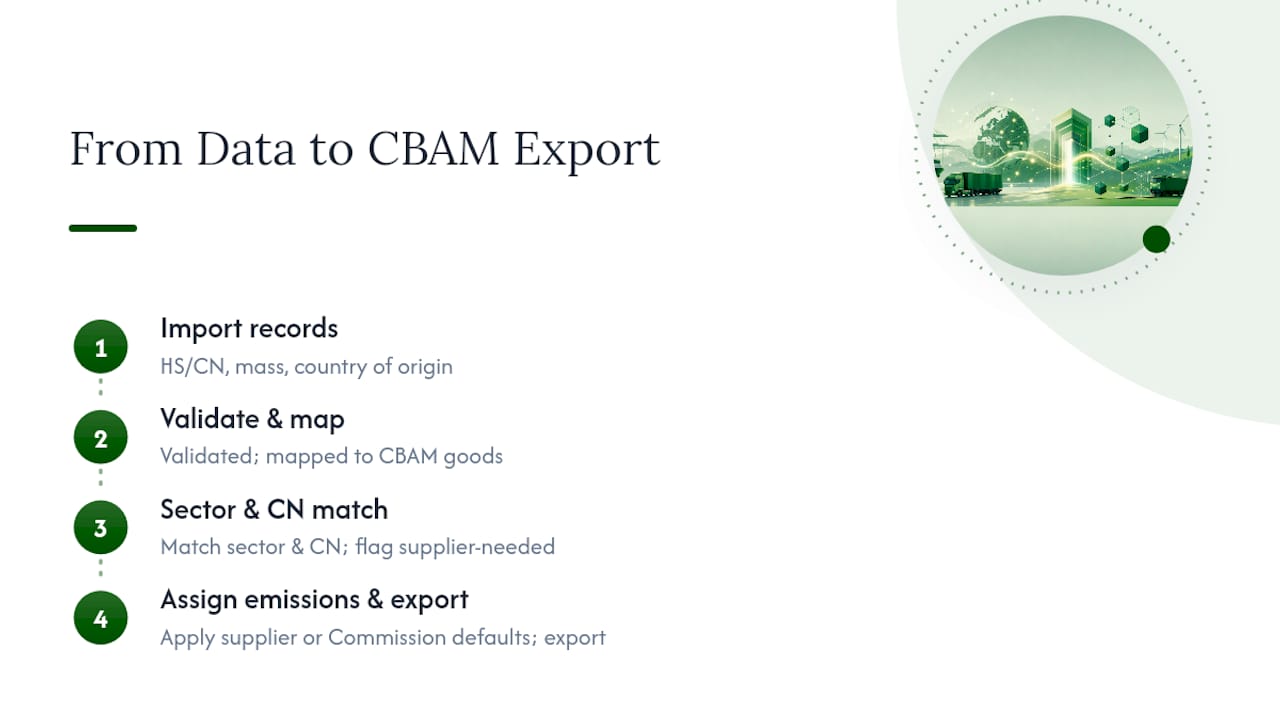
From there, each line is matched to its CBAM sector and CN code, so you can see immediately which imports need supplier emissions data and which are already resolved. Where supplier-specific figures are not available, CarbonOps applies the Commission’s published default values per CN code and country, so no line is left incomplete waiting on a supplier response. The final export comes formatted for the CBAM Registry, ready for review and retained with your filing history for future audits.
CBAM and Free Trade Agreements: What Preferential Terms Do Not Change
Preferential tariff treatment under a Free Trade Agreement does not exempt goods from CBAM. These are two separate regimes solving different problems: an FTA reduces or eliminates customs duties based on origin rules, while CBAM prices embedded carbon emissions regardless of whether the goods entered duty-free.
An importer bringing in steel under a preferential trade agreement still owes a full CBAM declaration for that shipment if the CN code falls within Annex I scope. The FTA might mean zero duty at the border, but the CBAM certificate obligation calculates independently, based on emissions intensity and quantity, not tariff status.
Where this creates real friction is in supply chains that were structured specifically to take advantage of preferential origin rules. A company that shifted sourcing to a partner country for duty savings may now find that country’s grid mix or production methods generate higher embedded emissions than a supplier elsewhere, meaning the tariff win gets partly offset by a larger certificate bill. Reassessing supplier selection purely on landed cost, without factoring in projected CBAM certificate exposure, is a mistake several importers are already correcting.
There is also a carbon price offset mechanism worth knowing: if the country of origin already applies its own carbon pricing to the goods in question, importers can claim a deduction under Article 9 of the regulation, reducing the certificates owed. This does not require the origin country to have an FTA with the EU. It is a separate, emissions-specific credit, and it applies independently of any preferential trade terms already in place.
Transit Goods and Re-Exports: Where CBAM Obligations Actually Trigger
CBAM liability attaches at the point goods are released for free circulation within the EU customs territory, not at the point they physically cross a border. This distinction matters enormously for companies running transit or re-export operations through EU ports.
Goods moving under a customs transit procedure, entering the EU only to pass through to a non-EU destination without being released for free circulation, generally fall outside CBAM’s declaration trigger. The goods never enter the EU market in the customs sense, so no CBAM obligation arises at that stage. This is common for logistics hubs handling cargo bound for further destinations.
Where it gets complicated is partial releases and bonded warehousing. If a shipment sits in a bonded warehouse and only part of it is later released for EU consumption, the CBAM obligation attaches only to that released portion, and the timing of that release, not the original arrival date, is what starts the reporting clock. Re-exported goods that were briefly released for free circulation before being shipped back out can create a more complex situation, since the original release may have already triggered a declaration obligation depending on how the customs procedure was structured.
Importers running transit-heavy operations should map exactly where in their logistics chain goods change customs status, and confirm with their customs broker which movements count as a release for free circulation under EU customs code. Getting this wrong in either direction, either declaring goods that never technically entered EU commerce or missing a declaration on goods that did, creates cleanup work that is far more expensive than getting the classification right the first time.
How to Verify Supplier Emissions Data Before You Rely on It
Supplier-provided emissions figures are only as good as the verification behind them, and taking a number at face value without checking its backing documentation is one of the more expensive mistakes an importer can make.
Start with the monitoring plan itself. A credible supplier monitoring plan should specify the exact facility, the production process being measured, and the methodology used to calculate embedded emissions per ton, aligned with the Commission’s implementing guidance. If a supplier hands over a single emissions figure with no facility-level detail or methodology note attached, treat that as a red flag rather than a usable data point.

Verification reports are the second layer. These should come from an accredited verifier, and they need to specifically confirm the embedded emissions calculation for the goods being imported, not a generic corporate sustainability report covering the supplier’s overall operations. A general emissions disclosure and a CBAM-specific verification report are not interchangeable, even though suppliers sometimes offer the former when asked for the latter.
Cross-checking matters too. Compare supplier figures against sector benchmarks and against the Commission’s own default values for that country and CN code. If a supplier’s reported emissions come in dramatically lower than the relevant default, ask for the underlying calculation before accepting it, since an unusually favorable number without solid backing is exactly the kind of figure that draws audit attention later. Our supplier emissions guide covers outreach templates for requesting this documentation in a format suppliers can actually respond to quickly.
Retain every verification file tied directly to its corresponding import line and declaration period, since reconciling a supplier claim months after the fact, without the original paperwork attached, is far harder than pairing it correctly the first time.
Where CBAM’s Sector List Could Expand Next
CBAM’s initial sector list, iron and steel, cement, aluminum, fertilizers, hydrogen, and electricity, was always framed as a starting point rather than a final boundary. The regulation itself includes provisions for the Commission to assess expanding coverage to additional sectors and to downstream products made from covered materials.
Organic chemicals and polymers have both been discussed as candidates for future inclusion, given their emissions intensity and their exposure to the same carbon leakage concerns that motivated CBAM’s original sector selection. Downstream products, finished goods manufactured using covered materials rather than the raw materials themselves, are also under review, since a narrow scope focused only on raw steel or aluminum creates an incentive to import finished products instead and sidestep the mechanism entirely.
Nothing here is locked in, and importers should not restructure sourcing decisions today based on speculative future scope. But companies with supply chains touching chemicals, polymers, or finished goods made from CBAM-covered materials should treat scope expansion as a near-certain eventuality on some future timeline, not a remote possibility. Building supplier data collection habits now, even for goods not currently in scope, puts you ahead of whatever the next expansion round includes.
A Real-World Scenario: Steel Importer Facing a Certificate Gap
Consider a mid-sized importer bringing structural steel components from a non-EU supplier. The company is named as importer of record on every customs entry, and the finance team assumed compliance was a customs broker’s job. It was not, at least not automatically.
When the CBAM Registry authorization deadline approached, the company discovered its customs broker had never applied for authorized declarant status on its behalf, since that requires an explicit engagement, not a default assumption baked into a standard customs services contract. The importer had to apply directly, which meant a scramble to gather EORI details and import history in the weeks before shipments risked being flagged as unauthorized.
Once authorized, the harder problem emerged: the steel supplier had no monitoring plan and no verification report ready, meaning every shipment defaulted to Commission default values. Those defaults, being conservative, pushed the company’s projected certificate obligation well above what its actual supplier’s production process likely generated, based on publicly available benchmarks for that country’s steel sector.
The fix was not glamorous. Procurement contacted the supplier directly, requested a monitoring plan aligned with CBAM’s methodology, and budgeted six weeks for the supplier’s chosen verifier to complete a report. Once the verified figure replaced the default, the company’s projected certificate spend dropped meaningfully, though the specific figure is not publicly disclosed. The lesson generalizes well beyond steel: the importer of record who assumes someone else is handling authorization, and who accepts default values without pushing for supplier verification, pays for both assumptions eventually, usually at the least convenient moment.
What Importers Keep Getting Wrong About CBAM
Most CBAM guidance treats this like a filing problem. It is not. It is a data problem wearing a filing deadline, and the importers who struggle are almost always the ones who started collecting supplier documentation only after the Registry deadline was already close.
The conventional advice, “check your CN codes and file on time,” is not wrong, but it undersells where the actual risk sits. The IMF’s own findings make the concentration risk clear: aggregate trade impact looks small, but if you happen to import steel or aluminum with a supplier who has no verification report ready, your certificate bill can run well above what an efficient producer would justify. That is not a filing failure. That is a procurement failure that shows up on a compliance line item.
My honest read: the importers who handle this well treat supplier emissions data the same way they treat quality specifications, something you request at the purchase order stage, not something you chase after the shipment has already cleared customs. Authorized declarant status, Registry accounts, and certificate modules are just infrastructure. The real work is building a habit of asking suppliers for numbers before you need them, not scrambling for defaults when a deadline forces your hand.
— Jake Stevens
Get a Filing-Ready CBAM Declaration Without the Manual Rework
A declaration service can process a batch of import records into a Registry-ready declaration without requiring a platform rollout or a procurement cycle to get started. The process involves submitting shipment data, with CN code matching and emissions resolution handled, resulting in a completed export.
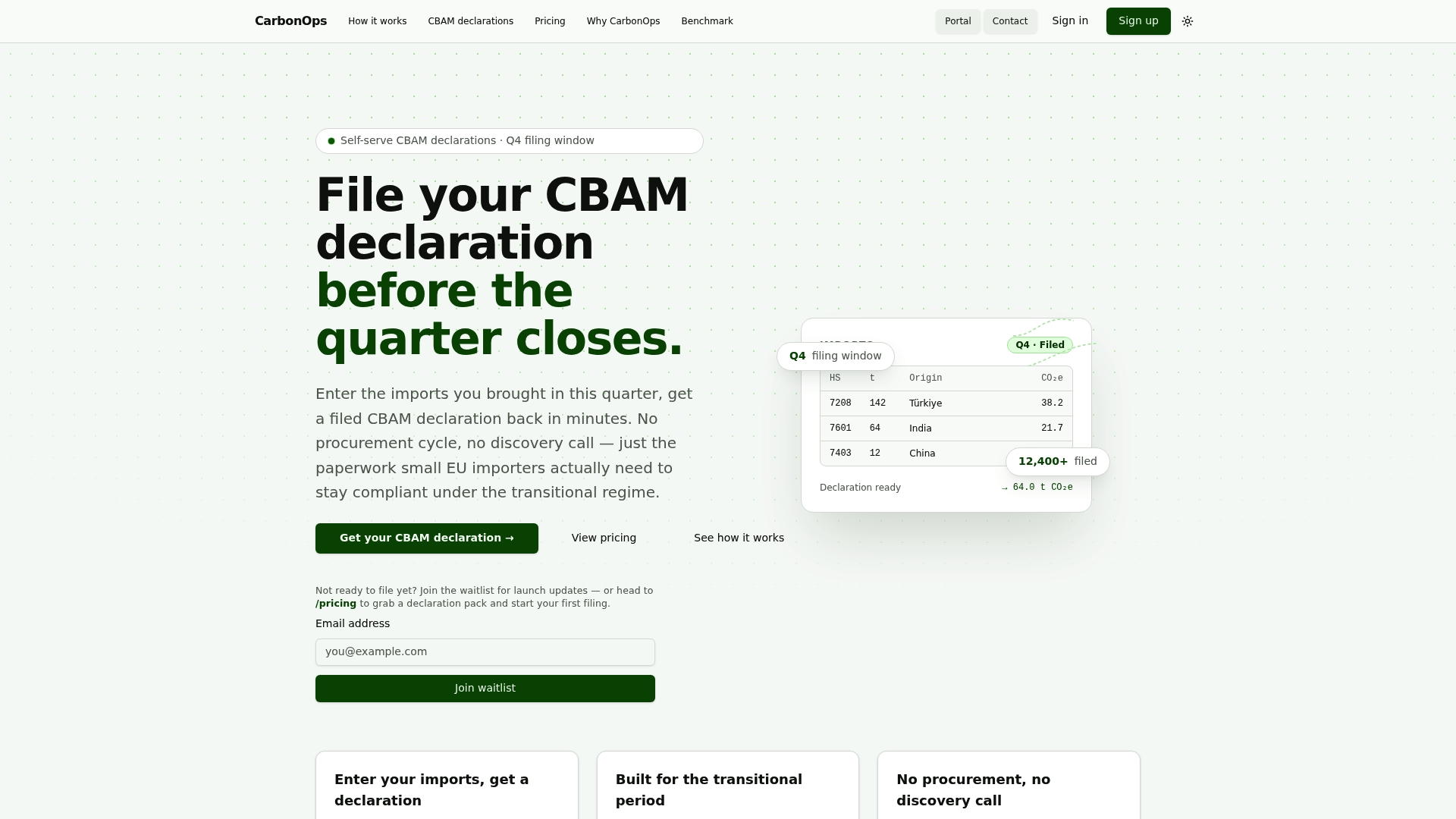
The workflow only needs four inputs: HS/CN code, mass, country of origin, and whatever supplier emissions documentation you already have on hand. Where supplier data is missing, published default values by CN code and country are applied automatically, so no import line sits incomplete while awaiting supplier response. The output is formatted for submission to the CBAM Registry and can be retained with the filing history for audit purposes.
If you have a single shipment batch to declare, you can file your CBAM declaration directly and see the process end to end. Importers handling recurring quarterly volume tend to find the multi-declaration pricing packs a better fit, since they cover several filings without a subscription commitment. Either way, the same underlying CBAM declaration workflow applies, no onboarding call required to start.
Sources
Primary references worth bookmarking: Regulation (EU) 2023/956, the European Commission’s CBAM guidance, the CBAM Registry portal, and the IMF’s working paper WP/25/125 on trade impacts. UK importers should also check Gov for procedural differences.
- Carbon Border Adjustment Mechanism - Taxation and Customs Union (European Commission)
- Regulation (EU) 2023/956 of the European Parliament and of the Council
- The EU’s CBAM: Implications for Member States and Trading Partners, WP/25/125 (IMF)