Importers: Collect Supplier Emissions, Avoid Default Markups

Importers: Collect Supplier Emissions, Avoid Default Markups
Supplier emissions must now be collected, verified, and reported at the installation level for every shipment covered by the EU Carbon Border Adjustment Mechanism, because the definitive regime took effect on 1 January 2026 and importers now carry direct liability for the certificates that follow. Skip verified data and you default to punitive EU markups. Import 50 tonnes or less a year and you’re exempt. Everyone else needs a supplier-data process running now, with the first annual declaration covering 2026 imports due by September 30, 2027.
TL;DR:
- Suppliers must now provide installation-level emissions data, including direct and indirect emissions, for shipments exceeding 50 tonnes to avoid default value markups.
- Collecting accurate data requires mapping each item to its CN/HS code, validating supplier activity data, and establishing a repeatable data pipeline before deadlines.
- Verified emissions must be audited by an accredited third party, with mock audits recommended for top suppliers to identify gaps early.
- Relying on default values incurs increasing costs up to 30% from 2028 and should be a fallback only when verified data is unavailable.
- Prioritizing high-volume, high-emissions suppliers for data collection reduces compliance risks and mitigates potential market access and margin impacts.
Table of Contents
- What CBAM Is and Who It Applies To
- Exactly What Supplier Emissions Data Does CBAM Require?
- How Do You Collect and Map Supplier Emissions Data?
- What Do Verifiers Check, and When Should You Prepare?
- What Do Default Values Actually Cost You?
- What Operational Problems Trip Up Supplier Data Collection?
- How CarbonOps Turns Supplier Data Into a Filing-Ready Declaration
- What Should Supply-Chain Managers Prioritize This Quarter?
- Get a Filing-Ready CBAM Declaration Without the Platform Overhead
- Where to Verify These Rules Yourself
- Sources
What CBAM Is and Who It Applies To
CBAM is the EU’s mechanism for pricing carbon in imported goods the same way it prices carbon for domestic producers under the EU Emissions Trading System. Without it, a European steel mill paying for its carbon emissions would lose ground to an overseas competitor that doesn’t. CBAM closes that gap by requiring importers to buy certificates matching the embedded emissions in what they bring across the border.
The regulation covers a specific list of carbon-intensive sectors, and precursor materials matter as much as the finished product:
- Iron and steel
- Aluminum
- Cement
- Fertilizers
- Electricity
- Hydrogen
If your finished good contains a covered precursor (steel components in a machine, for instance), that precursor’s emissions typically travel with it into your declaration. Liability sits with the EU importer, the authorized declarant, or an indirect customs representative acting on their behalf. Businesses importing no more than 50 tonnes of covered goods annually fall under the de minimis exemption and can skip the reporting burden entirely.
Exactly What Supplier Emissions Data Does CBAM Require?
Annex IV of the CBAM regulation spells out what “verified emissions data” actually means, and it goes deeper than most importers expect on their first pass. The data has to trace back to a specific manufacturing installation, not a generic industry average.
At minimum, suppliers need to provide:
- Installation-level attributed emissions, split into direct emissions from the production process and, for certain sectors like electricity and some fertilizer routes, indirect emissions from purchased power.
- Activity data and qualifying parameters specific to the product, such as clinker content for cement, nitrogen form for fertilizers, or precursor quantities embedded in intermediate goods.
- Carbon price already paid at origin, since a documented domestic carbon cost can reduce the CBAM obligation on that shipment.
- A defined reporting period, ideally the calendar year, or a justified alternative that matches the supplier’s own accounting cycle.
The Commission’s guidance on Annex IV includes a common reporting template. Using it isn’t mandatory, but it saves enormous back-and-forth when a supplier has never filled out anything like this before. A supplier that ships to five different EU importers, each demanding data in a different spreadsheet format, is far more likely to hand you incomplete numbers or push back on the whole request. Standardizing the ask early removes that friction before it starts.
How Do You Collect and Map Supplier Emissions Data?
Building a repeatable supplier-data pipeline beats chasing numbers shipment by shipment. Here’s the sequence that works.
- Map every in-scope item to its CN/HS code and identify which installation actually produced it. This sounds mechanical, but misclassifying CN codes is one of the most common early mistakes importers make, since the wrong code pulls the wrong default value and the wrong reporting obligation entirely.
- Send a standardized data request to each supplier, using the Commission’s template or your own equivalent, listing every mandatory field up front rather than trickling requests over several rounds.
- Validate the activity data you get back. Reconcile reported mass and quantities against your own purchase records, and allocate emissions per unit of output at the activity level, not just at the shipment level.
- Apply Commission default values where supplier actuals are missing, and document exactly why you fell back to a default for that specific line. Verifiers and auditors will ask.
- Assemble an evidence package for each installation and keep an auditable trail ready for the CBAM Registry, including correspondence with the supplier and any underlying certificates.
Pro Tip: Segment your suppliers before you send a single request. A supplier providing 80% of your covered tonnage deserves a phone call and a dedicated point of contact; a supplier shipping you a single pallet a year can probably work off the default value without a fight.
Don’t wait for every supplier to hand back a perfect dataset before you start building the rest of your declaration. PwC’s guidance on industrial manufacturing recommends starting structured data programs and mock audits early, layering in verified actuals as they arrive rather than treating the whole process as a single all-or-nothing submission.

What Do Verifiers Check, and When Should You Prepare?
Actual emissions data has to be verified by an accredited third-party verifier before it counts toward your declaration. This isn’t optional, and Commission guidance on verification makes clear that early verification periods commonly involve an on-site visit to the supplier’s installation, not just a document review.
Verifiers typically check:
- The monitoring methodology used to calculate emissions
- Underlying activity data and how it was measured
- System boundaries, meaning what’s included and excluded from the installation’s emissions count
- How emissions get allocated across different products from the same facility
- Supporting documentation: meter readings, fuel invoices, production logs
Pro Tip: Run a mock audit on your top two or three suppliers before the real verifier shows up. It’s far cheaper to find a gap in your evidence package on your own schedule than on the verifier’s.
Because on-site visits can be a scheduling bottleneck, especially with suppliers spread across multiple countries and time zones, lock in verifier availability months ahead. Build a per-installation evidence package covering monitoring method, activity data, and source documents, and coordinate timing across multiple suppliers so verifications don’t collide with your own filing deadline.
What Do Default Values Actually Cost You?
Using EU default values instead of verified supplier actuals adds a mark-up of 10% in 2026, 20% in 2027, and 30% from 2028 onward.
That markup exists by design. Default values are deliberately set conservative, meaning higher than typical actual emissions, so relying on them is always the more expensive path. And the certificate price you’re paying against is not fixed: it tracks EU ETS auction prices, which have already shown real movement. The first quarterly CBAM certificate price published for 2026, on April 7, came in at €75.36 per tonne of CO2, with quarterly updates through 2026 shifting to weekly from 2027.
Stack a rising default-value markup on top of a fluctuating certificate price, and the math starts pushing importer behavior in predictable directions:
- Preferring suppliers who can already produce verified, installation-level data
- Repricing existing contracts to reflect a supplier’s carbon intensity
- Building carbon performance clauses into new supplier agreements
What Operational Problems Trip Up Supplier Data Collection?
Most importers hit the same handful of walls. Suppliers keep records in units that don’t match your reporting format. Multiple tiers of sub-suppliers make tracing precursor emissions genuinely hard. Language barriers turn a simple data request into weeks of clarification emails. And plenty of smaller installations simply haven’t tracked emissions at this granularity before now.
None of these are fatal, but they need a plan:
- Standardize your data request template and attach it to every new supplier contract as a required annex.
- Add a contractual clause requiring emissions data disclosure as a condition of continued supply.
- Build validation rules that flag mass or unit mismatches automatically instead of catching them at filing time.
- Segment suppliers by volume and carbon intensity so your limited compliance hours go to the highest-impact accounts first.
Pro Tip: When you do fall back to a default value, write down exactly why, in one line, right next to the figure. “Supplier declined to provide data” and “supplier data received but incomplete for indirect emissions” are very different audit stories.
Get procurement, legal, and compliance in the same room early. Procurement usually owns the supplier relationship, legal owns the contract language, and compliance owns the filing deadline. When those three don’t talk until the week before submission, something breaks.
How CarbonOps Turns Supplier Data Into a Filing-Ready Declaration
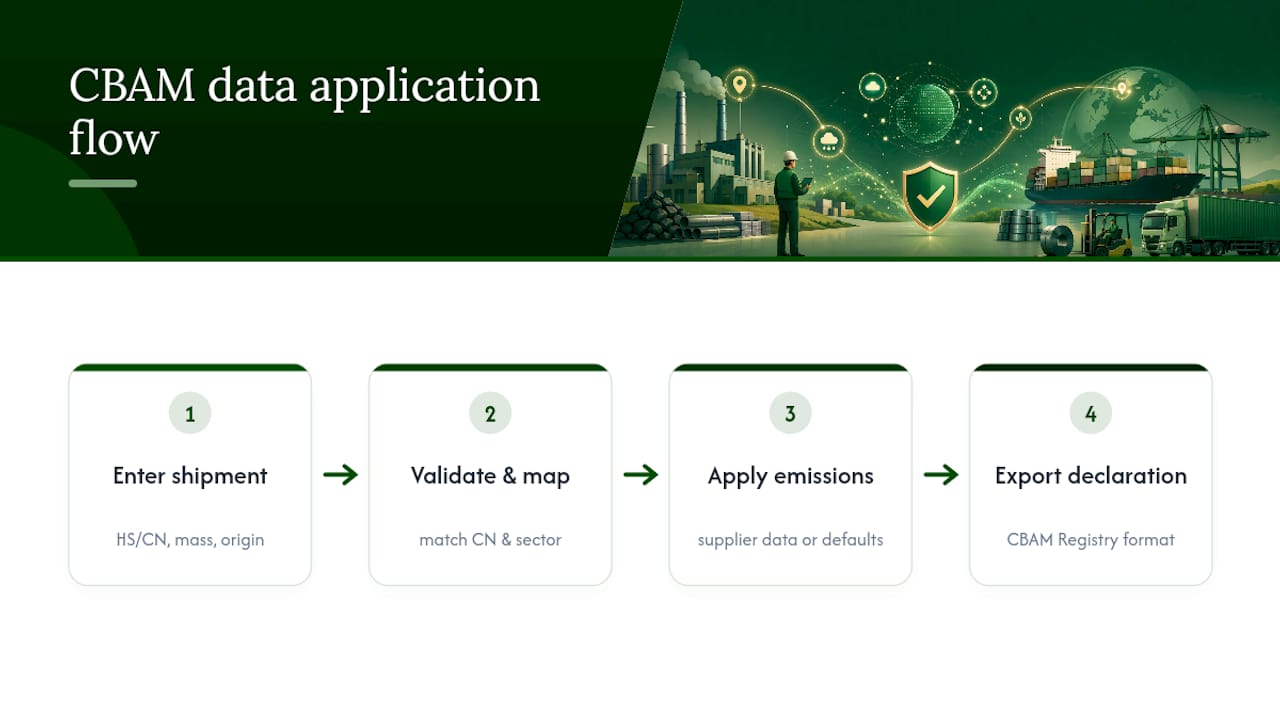
CarbonOps runs the same core workflow described above, without asking you to deploy a platform or run a procurement cycle first. You enter each shipment with its HS/CN code, mass, and country of origin, and the tool validates that data and maps it to the CBAM-covered goods it applies to. Each line gets matched to its correct CN code and sector automatically, so you can see at a glance which imports are in scope and what’s still missing.
Where supplier-specific emissions exist, they’re applied directly. Where they don’t, CarbonOps fills the gap with the Commission’s published default values per CN code and country, so every line resolves to a complete figure. The finished declaration exports in the format the CBAM Registry expects, with a retained filing history ready for verifier review.
What Should Supply-Chain Managers Prioritize This Quarter?
If you’re staring at a supplier list with no idea where to start, start with volume and carbon intensity. Your highest-tonnage, highest-emissions suppliers are where a missing data point costs you the most, so send them a standardized data request this week, not next quarter.
Run a mock audit on two or three of those key accounts before a real verifier ever shows up. Add carbon-data clauses to your next round of supplier contract renewals rather than treating it as a future negotiation. And map your top-moving SKUs to their correct CN codes now, since a wrong code quietly corrupts every default value pulled against it later.
The risk worth escalating to leadership isn’t abstract. It’s market access and margin erosion as verified-data suppliers become the preferred sourcing choice and unverified imports get priced out at the border.
— Jake Stevens
Get a Filing-Ready CBAM Declaration Without the Platform Overhead
CarbonOps skips the sensor rollouts and onboarding calls other compliance tools require. You bring the supplier data you’ve already collected using the steps above, and the software handles CN-code matching, applies default values where actuals are missing, and hands back a declaration formatted for direct submission to the CBAM Registry.
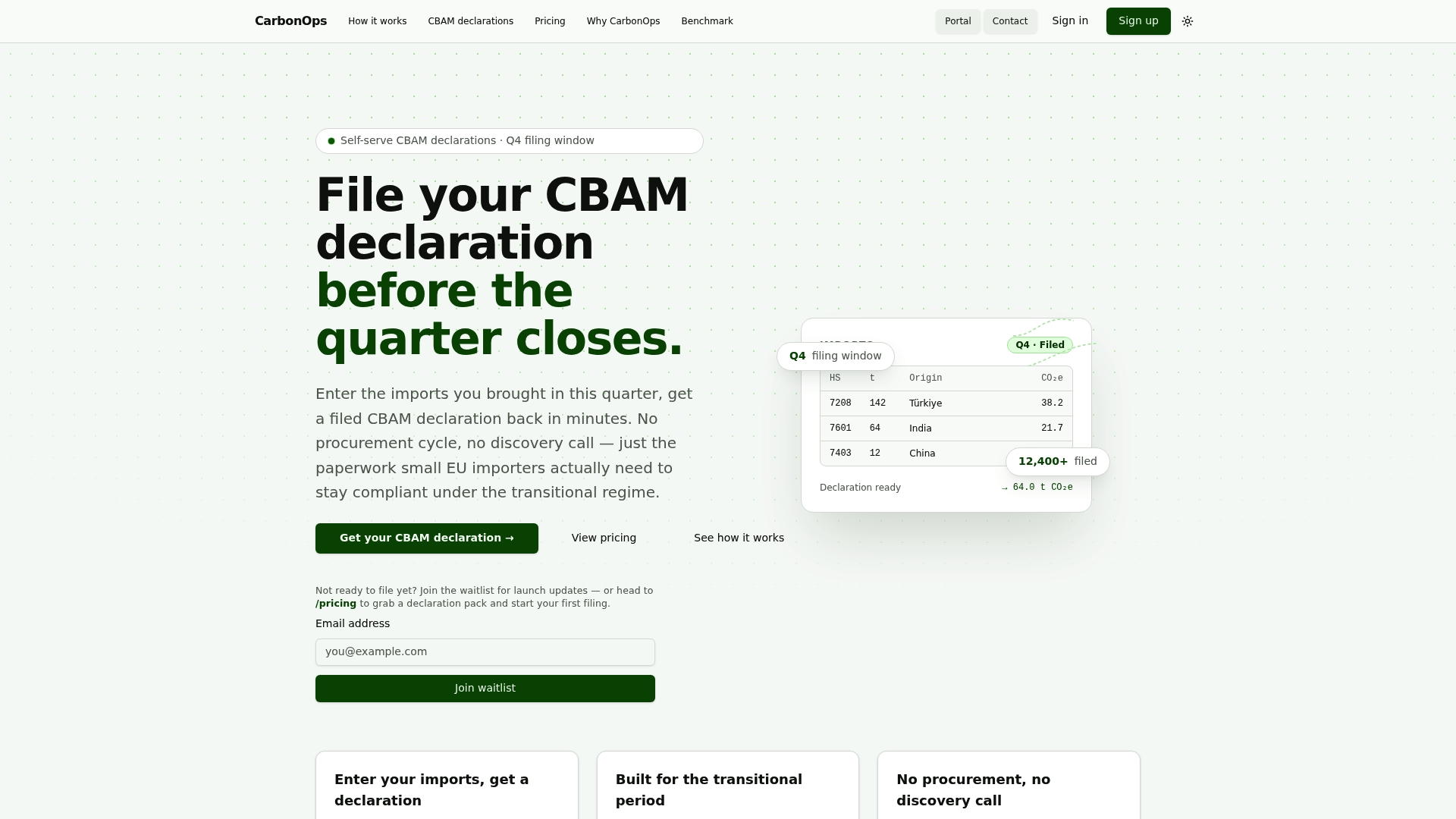
It’s priced per declaration, not as a subscription, so a single import batch or fifteen quarterly filings both work without a long-term commitment. That matters most for compliance teams who file a handful of times a year and don’t want to pay for a platform that sits idle between filings. If your next declaration deadline is approaching, start your CBAM declaration and see how far your existing supplier data gets you before you need a single default value.
Where to Verify These Rules Yourself
Cross-check anything time-sensitive against the primary sources before you file. Start with the Commission’s own CBAM overview page for registry access and deadlines, then pull the default value implementing regulation and the Annex IV guidance document for the exact data fields your suppliers need to fill in.