EU Importers: Four Steps to Secure CBAM Supplier Data
EU Importers: Four Steps to Secure CBAM Supplier Data
Importers must obtain installation-level embedded emissions data and verification evidence for every CBAM-covered shipment, not a generic sustainability report or company-wide average. Skip that step and the European Commission’s default values apply instead, carrying a markup that increases progressively from 2026 through 2028 and beyond. Start requesting installation ID, activity data, direct and indirect specific embedded emissions (SEE), and verification evidence now, because the gap between supplier-specific and default figures compounds every quarter you wait.
TL;DR:
- Importers must request detailed, installation-specific emissions data from suppliers before defaults increase starting in 2026, to avoid higher costs.
- Data collection requires precise installation identification, sector-specific parameters, activity data, embedded emissions, and verification evidence to ensure compliance.
- Suppliers often respond better when importers provide localized templates, clear deadlines, and explain the financial importance of timely data submissions.
- Handling missing supplier data involves understanding default markups, tracking default value costs, and documenting assumptions for audit purposes.
- Organizing a recurring process for data validation, supplier outreach, and recordkeeping minimizes errors and streamlines declaration filings ahead of deadlines.
Table of Contents
- What Cbam Supplier Data Actually Requires
- How to Request Supplier Emissions Data: Templates, Recipients, and Languages
- Verification, Evidence, and Recordkeeping: What Counts and Why
- When Supplier Data Is Missing: Defaults, Assumptions, and the Real Cost
- Mapping Supplier Data to the Correct CN Code and Declaration Line
- Building an Internal Workflow to Collect and Validate Supplier Data
- CBAM Registry, Declarant Status, and Reporting Deadlines
- From Import Line to Filed Declaration: A Four-Step Process
- What Compliance Teams Should Prioritize Heading Into 2026
- Getting From Supplier Data to a Filed Declaration Faster
- Sources
What Cbam Supplier Data Actually Requires
Cbam supplier data is not a single number. It’s a structured data set tied to a specific production installation, mapped to a specific product, calculated under a specific methodology. The Commission’s guidance document for importers lays out exactly what belongs in that data set, and most compliance teams underestimate how granular it gets.
Start with identification. You need the installation’s legal name, full physical address, UN/LOCODE or GPS coordinates, and a named operator contact who can answer follow-up questions. A parent company’s headquarters address doesn’t satisfy this. CBAM tracks emissions to the plant that actually produced the goods.
Next comes the production route. A steel supplier running a blast furnace/basic oxygen furnace (BF-BOF) process reports very differently than one running an electric arc furnace (EAF). Cement producers need to disclose clinker ratio. Fertilizer and aluminum producers each have sector-specific parameters buried in Annex IV that determine which calculation path applies.
Then activity data: fuel consumption in terajoules or gigajoules, electricity use in megawatt-hours, tonnes of product actually produced during the reporting period. These numbers feed directly into the emissions equations, so unit consistency matters more than most teams assume. A supplier reporting fuel use in cubic meters of gas instead of energy content will throw off the entire calculation unless someone converts it correctly.
The core output is specific embedded emissions, expressed in tonnes of CO2-equivalent per tonne (or other unit) of product. You need to know whether that figure was measured directly or calculated from activity data and emission factors, because verifiers treat the two differently.
Finally, don’t overlook precursors. If a supplier’s product incorporates upstream CBAM goods (steel that went into a fabricated part, for instance) those embedded emissions carry forward into the final figure. You’ll also want carbon price evidence if the supplier paid a carbon cost in its home country, the exact reporting period covered, and metadata on who verified the data and under what accreditation.
| Data field | What it captures | Why it matters |
|---|---|---|
| Installation ID | Legal name, address, UN/LOCODE/GPS, contact | Ties emissions to a specific physical site |
| Production route | Process type, sector parameters (e.g., BF-BOF, clinker ratio) | Determines which calculation methodology applies |
| Activity data | Fuel (TJ/GJ), electricity (MWh), output (tonnes) | Feeds the emissions equations directly |
| Specific embedded emissions | tCO2e per unit of product | The core figure used in your declaration |
| Precursor emissions | Embedded emissions of upstream CBAM inputs | Prevents undercounting in processed goods |
| Carbon price evidence | Amount paid in country of origin | May reduce your CBAM certificate obligation |
| Verification metadata | Verifier name, accreditation, report date | Confirms the data has passed independent review |
How to Request Supplier Emissions Data: Templates, Recipients, and Languages
Sending a generic questionnaire to your usual purchasing contact is the fastest way to get silence back. Sustainability, EHS, and site operations staff hold this data. Procurement and sales contacts usually don’t.
- Identify the right contact. Ask your supplier’s commercial rep to redirect you to whoever manages environmental reporting or ISO 14001 compliance at the actual production site.
- Attach the official template. Send the Commission’s CBAM communication template for installations, ideally pre-filled with what you already know (your import volumes, CN codes, reporting period) so the supplier only has to complete the emissions columns.
- Set a firm deadline. Give a specific date tied to your own filing window, not a vague “as soon as possible.”
- Localize where it helps. A template and cover note in the supplier’s own language, plus a short explainer of what CBAM is and why you’re asking, measurably improves response rates over a cold English-only request.
- Escalate in stages. A single reminder first, then offer technical support if the supplier seems confused about methodology, then loop in procurement leadership if silence continues, and finally consider contractual remedies for repeat non-response on high-volume accounts.
Practitioners tracking early definitive-phase filings consistently find that operational friction, not regulatory ambiguity, is the real barrier — suppliers often lack data that maps cleanly to the EU’s Monitoring and Reporting Regulation (MRR) format, and they respond better when importers offer guidance rather than just a form.
Pro Tip: Explain the financial stakes in your outreach email. Suppliers who understand that silence pushes their buyer toward a punitive default value respond faster than suppliers who just see another compliance form in their inbox.
Verification, Evidence, and Recordkeeping: What Counts and Why
A supplier’s self-reported number means little without independent verification behind it. Accredited verification follows the same logic as ISO 14065 accreditation used elsewhere in carbon markets: a named verifier, an accreditation body reference, and a verification statement that specifies scope, methodology, and any findings.
Keep these documents on file, because they’re what an auditor will ask for first:
- The installation’s monitoring plan describing how activity data gets measured and recorded.
- Raw meter readings and fuel or electricity invoices covering the reporting period.
- The calculation workbook showing how activity data converts into specific embedded emissions.
- The verifier’s full report, not just a one-page summary statement.
- Correspondence showing when and how you requested the data, useful if you end up relying on defaults.
Retain everything for at least four years, since that aligns with the retention expectations built into the CBAM implementing regulation. Watch for red flags before you submit: production volumes that don’t match customs declarations, activity data with no supporting meter readings, or emission factors that seem suspiciously round. Any of those should trigger a follow-up question to the supplier before you file, not after.
When Supplier Data Is Missing: Defaults, Assumptions, and the Real Cost
Sometimes a supplier simply won’t respond in time, or can’t produce data in the required format. That’s when EU default values kick in, and the cost of using them is not flat.
The default value markup climbs every year, progressively increasing from 2026 through 2028 and beyond. On high-volume steel, cement, or aluminum imports, that markup translates into real money on your certificate purchases, not just a rounding difference on a spreadsheet.
Before you accept the default, check whether you even need supplier data at all. The de minimis exemption excuses importers who bring in fewer than 50 tonnes of CBAM-covered goods per year, and that threshold is calculated at the importer level across all products and all suppliers combined, not per shipment.
If you’re above that threshold and data still isn’t coming:
- Keep engaging the supplier, but set an internal cutoff date for switching to defaults.
- Add data-sharing clauses to future purchase contracts so this doesn’t repeat next quarter.
- Model the actual certificate cost of the default markup against the cost of re-sourcing from a supplier that can provide verified data.
- Document exactly which supplier, which reporting period, and which default figure you used, so the assumption is traceable if questioned later.
Mapping Supplier Data to the Correct CN Code and Declaration Line
Every default value and every supplier-specific figure is tied to a specific CN8 code. Get the code wrong and you’ve applied the wrong emissions factor, even if the underlying data was correct.
Start by confirming the CN code on your customs entry matches the code the supplier’s data covers. A supplier’s emission factor calculated for one grade of steel doesn’t automatically apply to a different CN-coded grade from the same mill. Processed goods need particular attention, since precursor emissions from an upstream CBAM input have to be carried into the final product’s figure rather than dropped.
Before filing, validate the linkage on each line with a short checklist:
- Shipment ID matches the customs declaration.
- CN code on the shipment matches the CN code the supplier data was calculated against.
- Quantity and unit (tonnes, units, square meters) are consistent between customs paperwork and supplier data.
- Country of origin matches what the supplier’s installation actually reported.
- Reporting period on the supplier data covers the quarter you’re declaring.
A mismatch on any one of these is what typically triggers a registry query later, so catching it before submission saves a correction cycle.
Building an Internal Workflow to Collect and Validate Supplier Data
Treat supplier data collection as a recurring operational task, not a one-time scramble before a deadline. Assign clear ownership: procurement owns supplier relationships and initial outreach, sustainability owns methodology review and validation, operations confirms activity data against internal fuel and production records, and customs or trade compliance owns the final mapping to declaration lines.
- Open a collection window each quarter, timed to close before your reporting deadline with enough buffer for a follow-up round.
- Run a format check on incoming data. Confirm units, confirm the template fields are complete, confirm nothing is missing a signature or verifier reference.
- Run a plausibility check against known fuel and production volumes. A specific embedded emissions figure that’s dramatically lower than a sector benchmark deserves a second look before it goes into a declaration.
- Cross-check against the verification report to confirm the number filed matches the number the verifier actually reviewed.
Smaller importers handling a handful of suppliers can run this in a shared spreadsheet with a checklist. Higher-volume importers benefit from automating the CN code match and default value lookup, since manual mapping across dozens of suppliers is where errors creep in.
Pro Tip: Run your validation checks the same week you receive supplier data, not the week before filing. Catching a unit error in month one gives you time to go back to the supplier; catching it in week four does not.
CBAM Registry, Declarant Status, and Reporting Deadlines
Only an authorized CBAM declarant can submit a declaration through the EU CBAM Registry, and that authorization has to be secured before your first definitive-period filing, not scrambled together at deadline time.
- Reporting runs quarterly, with each quarter’s declaration due by specific deadlines set under the implementing regulation.
- The first annual surrender of CBAM certificates covering 2026 imports falls due in 2027, once the definitive regime’s certificate market is running.
- The registry cross-checks your declared import volumes against customs data automatically, so a mismatch between what you declared and what customs recorded flags for review.
- Keep your underlying records organized by shipment and by supplier so you can answer a registry query within days, not weeks.
From Import Line to Filed Declaration: A Four-Step Process
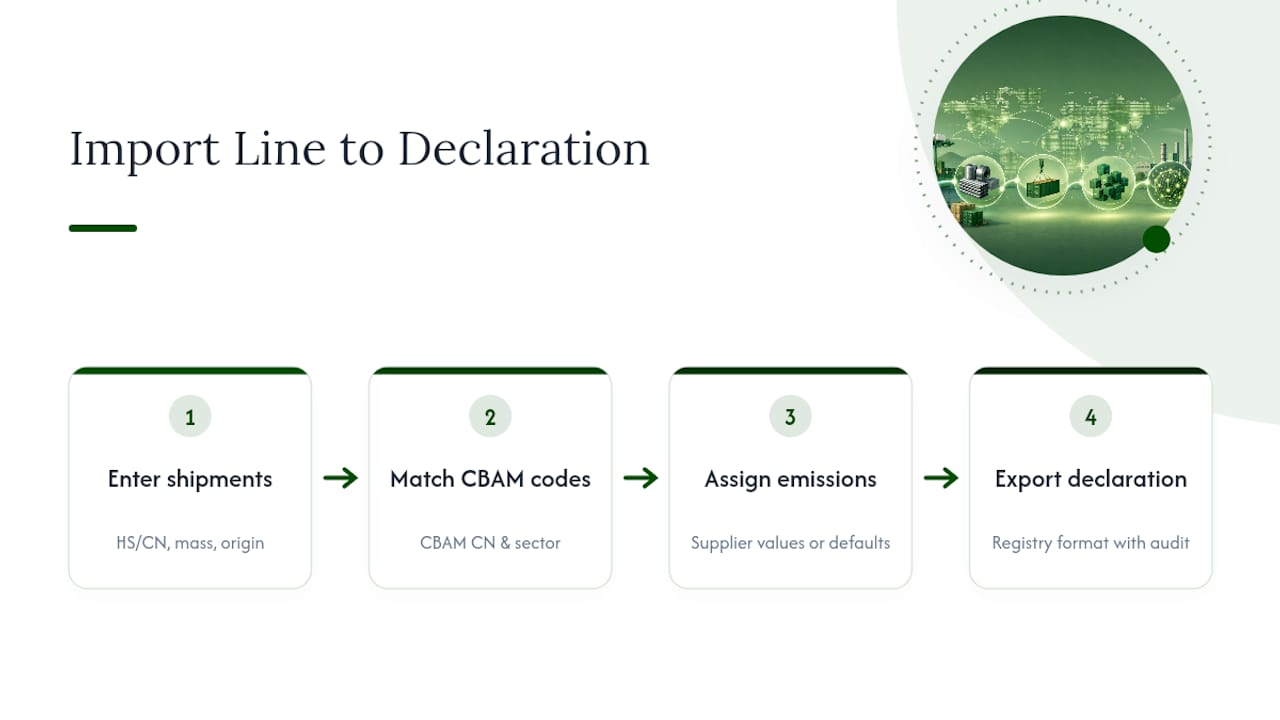
Turning a spreadsheet of shipments into a filing-ready declaration doesn’t require a platform rollout. The process to create a filing-ready declaration involves four steps: entering each shipment with its HS/CN code, mass, and country of origin, then matching it to the applicable CBAM CN code and sector automatically. Where supplier-specific embedded emissions exist, they are mapped to the matching import line; where missing, the Commission’s published default values fill the gap per CN code and country. The final output exports directly in the format the CBAM Registry expects, with an audit trail retained.
What Compliance Teams Should Prioritize Heading Into 2026
The teams doing this well aren’t the ones with the fanciest spreadsheet. They’re the ones who triaged early: identified their five or ten highest-volume, highest-emission suppliers, and put real effort into getting those relationships right before chasing every small account.
Supplier enablement beats supplier policing. A template and a short explainer sent proactively gets you further than a compliance email demanding data by Friday. Build one outreach process, reuse it every quarter, and refine it based on which suppliers respond fast versus slow.
And when defaults are unavoidable, write down why. A one-line note explaining which supplier didn’t respond, by when, and which default value you applied will save you an afternoon of reconstruction if a registry query lands on your desk eighteen months from now.
— Jake Stevens
Getting From Supplier Data to a Filed Declaration Faster
Collecting supplier data is only half the job. Turning it into a compliant declaration without hiring a consultant or deploying a new platform is the harder half, and it’s the half CarbonOps was built for. Enter your shipments, and CarbonOps matches CN codes, applies supplier or Commission default emissions automatically, and exports the completed declaration in registry format, all without a procurement cycle or onboarding project.
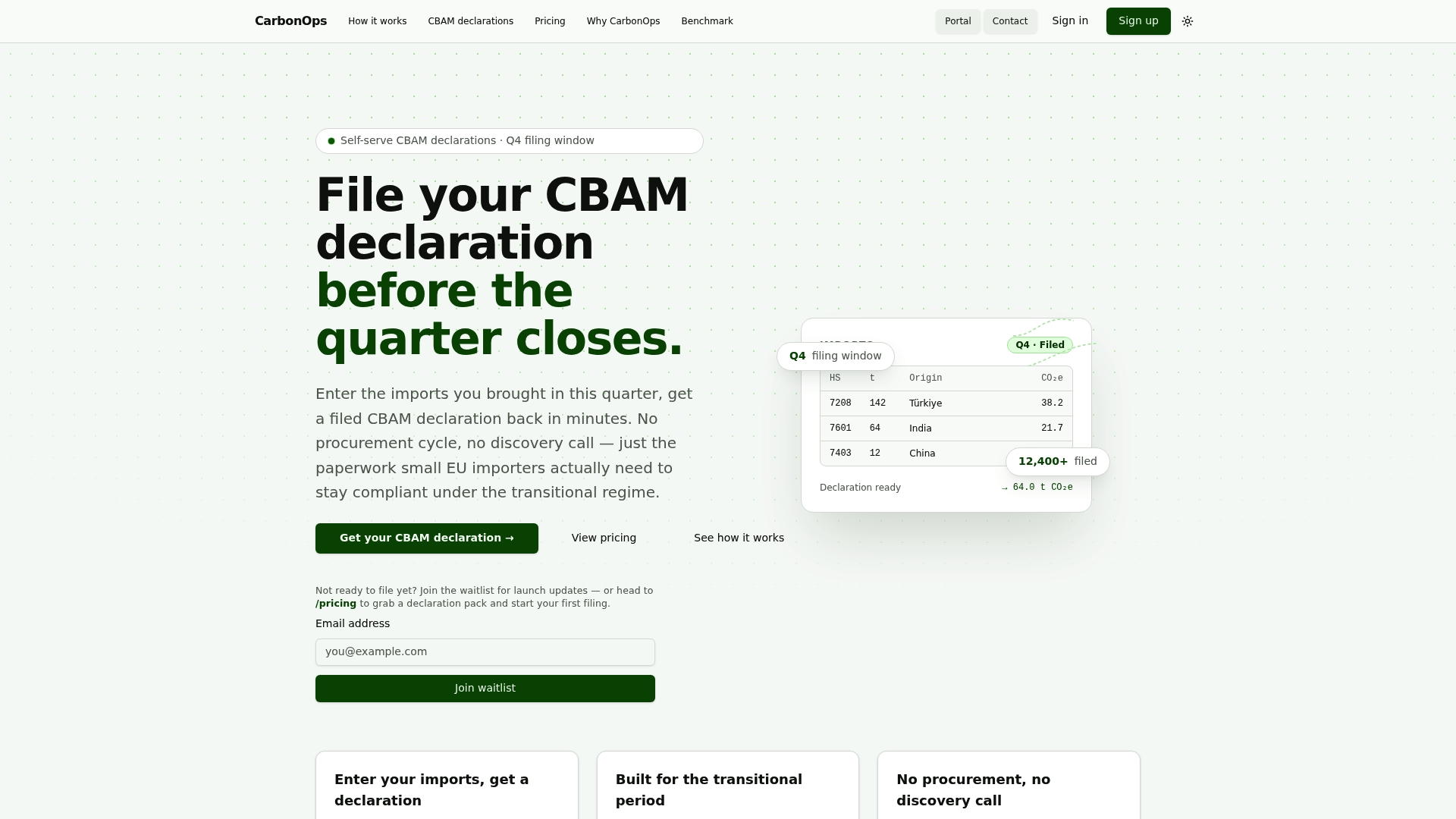
That means less exposure to the rising default markup, because you can see exactly which import lines are still missing supplier data before you file rather than after. It also means a retained audit trail for every declaration, ready if a query comes back from customs. If you’re facing a quarterly deadline right now, file your CBAM declaration directly, or check the pricing page for single and multi-declaration options with no subscription required.
Sources
The requirements described above trace back to a small set of primary EU sources worth bookmarking directly. The European Commission’s CBAM landing page covers the mechanism’s scope, default value schedule, and de minimis rules. The CBAM guidance document for importers is the most detailed reference on required data fields, precursors, and verification. Regulation (EU) 2023/956 sets the legal basis for declarant obligations and the registry. The Commission’s default values publication and the downloadable communication template for installations round out the working reference set most compliance teams keep on hand.
- Carbon Border Adjustment Mechanism — European Commission
- Regulation (EU) 2023/956 — Establishing the Carbon Border Adjustment Mechanism (CBAM)