CBAM Filing for Accountants: Book Liability at Customs, Not Purchase

CBAM Filing for Accountants: Book Liability at Customs, Not Purchase
Any accountant whose client imports more than the EU’s mass-based threshold of covered goods annually must treat that client as an authorised CBAM declarant candidate, full stop. The importer, or its appointed indirect customs representative, files the annual CBAM declaration by September 30 of the year after import, with the first definitive-year filing (covering 2026 imports) due September 30, 2027. Your immediate job: check the client’s tonnage against that threshold, get authorisation moving through the national competent authority, and start pulling supplier emissions data now.
TL;DR:
- Clients importing over 50 tonnes of covered goods annually must register as authorized CBAM declarants and file declarations by September 30 each year.
- Accurate supplier emissions data and precise CN codes, country of origin, and installation details are critical for each shipment line in the declaration process.
- The first official CBAM regime starts on January 1, 2026, with certificates becoming available from February 1, 2027, and the initial declaration deadline on September 30, 2027.
- Accounting for CBAM liabilities requires establishing provisional provisions based on estimated emissions and prices, then updating with verified data and purchases regularly.
- Common filing errors include mismatched CN codes, missing installation coordinates, double-reporting, and using outdated default emission values, which can be mitigated by thorough data validation.
Table of Contents
- Who Needs Accountant CBAM Filing Support and Which Imports Count
- What Are the Key CBAM Filing Deadlines Accountants Should Track?
- What Data Do You Need for Each CBAM Shipment?
- How Does the CBAM Registry and Filing Workflow Actually Work?
- How Do You Account for CBAM Liabilities in Client Ledgers?
- How to Prepare CBAM Financial Liabilities in Client Accounting Systems
- Common CBAM Filing Errors and How to Fix Them
- Integrating CBAM Reporting With VAT and Customs Workflows
- What First-Cycle CBAM Filings Teach Accountants
- Turn Import Records Into a Filing-Ready CBAM Declaration
- Sources
Who Needs Accountant CBAM Filing Support and Which Imports Count
The 50 tonne threshold applies per importer, per calendar year, across all covered CN codes combined, not per shipment. A client bringing in steel brackets in January and aluminum fittings in October add both toward the same annual total. Hydrogen and electricity imports follow different aggregation logic under the regulation, so don’t assume every commodity behaves the same way when you’re running the math for a diversified importer.
Getting authorised isn’t instant. The client applies to their national competent authority (NCA) through the Authorisation Management Module (AMM), which requires UUM&DS access credentials before anyone can log in. Processing timelines vary by member state, and a backlog at the NCA level is common during peak filing seasons, so this is not a task to start in August.
A few things worth flagging to clients early:
- Only one entity, either the importer or its indirect customs representative, can be the reporting declarant for a given tonne of goods. Duplicate reporting isn’t just messy, it’s a compliance failure.
- If your client uses a customs broker who also handles other importers’ goods, confirm in writing who holds CBAM reporting responsibility before the first filing window opens.
- Our guide to authorised CBAM declarant status walks through the NCA application sequence in more detail, and the country of origin rules breakdown is worth bookmarking for threshold edge cases.
What Are the Key CBAM Filing Deadlines Accountants Should Track?
The definitive CBAM regime starts January 1, 2026. That’s the date embedded emissions actually start accruing a financial cost, not just a reporting obligation.
- January 1, 2026 — Definitive regime begins; certificates become the mechanism tying emissions to cost.
- February 1, 2027 — Certificate sales open. This is the purchase window, not the pricing date.
- September 30, 2027 — First annual declaration and certificate surrender deadline for all 2026 imports.
A distinction that trips up a lot of finance teams: the certificate price gets assigned based on the quarter of import, not the quarter you actually buy the certificate. A shipment imported in Q2 2026 carries a Q2 2026 average auction price, even if your client doesn’t purchase the matching certificates until months later. That gap between price assignment and purchase date is exactly where cashflow forecasting goes wrong if you’re not tracking it separately in the ledger.
From 2027, a quarterly holding rule requires declarants to hold a minimum percentage of their estimated annual certificate need at each quarter end. Missing a surrender deadline or holding too few certificates triggers penalties under the CBAM regulation, and declarants are expected to retain supporting records and audit trails for several years after filing, not just through the current cycle.
What Data Do You Need for Each CBAM Shipment?
Every shipment line in the annual declaration needs a specific data set, and missing even one field stalls the whole filing. At minimum, you need:
- CN code for the imported goods
- Net mass in tonnes, or MWh for electricity imports
- Country of origin
- Producing installation name, address, and geographic coordinates
The emissions figure itself comes from one of two sources. When your client has verified supplier-specific data, that’s the number you use. When they don’t, and this is common in the early cycles, the declaration falls back to the Commission’s published default values keyed to CN code and country of origin. Either way, the declarant carries responsibility for accuracy, even when leaning on default figures.
Using actual supplier values instead of defaults requires verification by an accredited body, typically one holding EN ISO/IEC 14065 accreditation or its national equivalent. Verifier capacity for the first mandatory verification cycle is a real constraint. Industry guidance recommends booking accredited verifiers well ahead of deadline season, particularly for clients sourcing from a long list of non-EU installations where site visits take time to schedule.
Pro Tip: Build a standing document request template for suppliers now, listing installation ID, verified emissions figure, verifier accreditation number, and reporting period. Chasing this data shipment by shipment in August is how filings slip past deadline.
How Does the CBAM Registry and Filing Workflow Actually Work?
Once your client holds authorised declarant status and a CBAM account number, the practical filing sequence runs through a handful of registry modules accessed via UUM&DS authentication.
- Log into the AMM to confirm authorisation status and account details.
- Set up operator, installation, and importer records inside the Declarant Portal.
- Populate import tables line by line, matching each shipment to its CN code.
- Attach verifier reports for any lines using actual supplier emissions data.
- Run the built-in data reconciliation and matching checks (DRMC) before submission.
- Export and submit the annual declaration, surrendering certificates at the point of filing.
For emissions data originating outside the EU, the O3CI module lets non-EU installation operators upload their own verified figures directly, which declarants can then retrieve rather than chasing spreadsheets by email. The declarant, meaning the importer or their indirect customs representative, is the party who physically submits inside the portal and where certificate surrender is recorded against the filed declaration.
How Do You Account for CBAM Liabilities in Client Ledgers?
CBAM creates a liability the moment covered goods clear customs, not the moment certificates get purchased. That timing gap is where accounting judgment matters most.
Recognise a provision for expected certificate obligations as import volumes accrue through the year, using a documented price benchmark rather than an ad hoc estimate. Whatever benchmark you pick (a rolling average auction price, a forward curve, a conservative point estimate) write the policy down and apply it consistently, because auditors will ask why the number moved between periods.
Set a clear revaluation cadence, quarterly at minimum given the certificate holding rules, and document how Article 9 deductions for carbon price already paid in the country of origin get treated in the liability calculation. Some practitioners argue this measurable, auditable exposure belongs squarely in finance’s remit rather than sitting as a footnote in a sustainability report, and that framing is gaining traction as the definitive regime approaches.
Practical steps worth locking in now:
- Reconcile customs import declarations against CBAM Registry filings monthly, not annually, to catch mismatches early.
- Tag CBAM-relevant ledger entries separately from general customs duty accounts so the audit trail is clean.
- Prepare a financial statement note addressing the provision methodology before your first year-end close under the regime.
Pro Tip: Treat certificate price assignment and certificate purchase as two separate accounting events in your ledger design. Conflating them is the single most common source of reconciliation headaches during audit review.
How to Prepare CBAM Financial Liabilities in Client Accounting Systems
Setting up the ledger structure before the first filing cycle saves you from a scramble later. Create a dedicated liability account for CBAM certificate obligations, separate from standard customs duties or VAT payable accounts, so the balance is traceable back to specific import periods.
Map each CN code category to its own sub-ledger or cost center where volume is material. This matters because default emissions values differ significantly by CN code and origin country, and lumping everything into one account makes it nearly impossible to explain a swing in the provision to a client or an auditor.
Build the accrual on an estimated-then-trued-up basis. Book a provisional liability each quarter using the best available emissions data and the current price benchmark, then true it up once actual certificate purchases and verified emissions figures are confirmed. Document the assumptions behind each quarter’s provisional number, because the gap between estimate and actual is exactly what an auditor will want to trace.
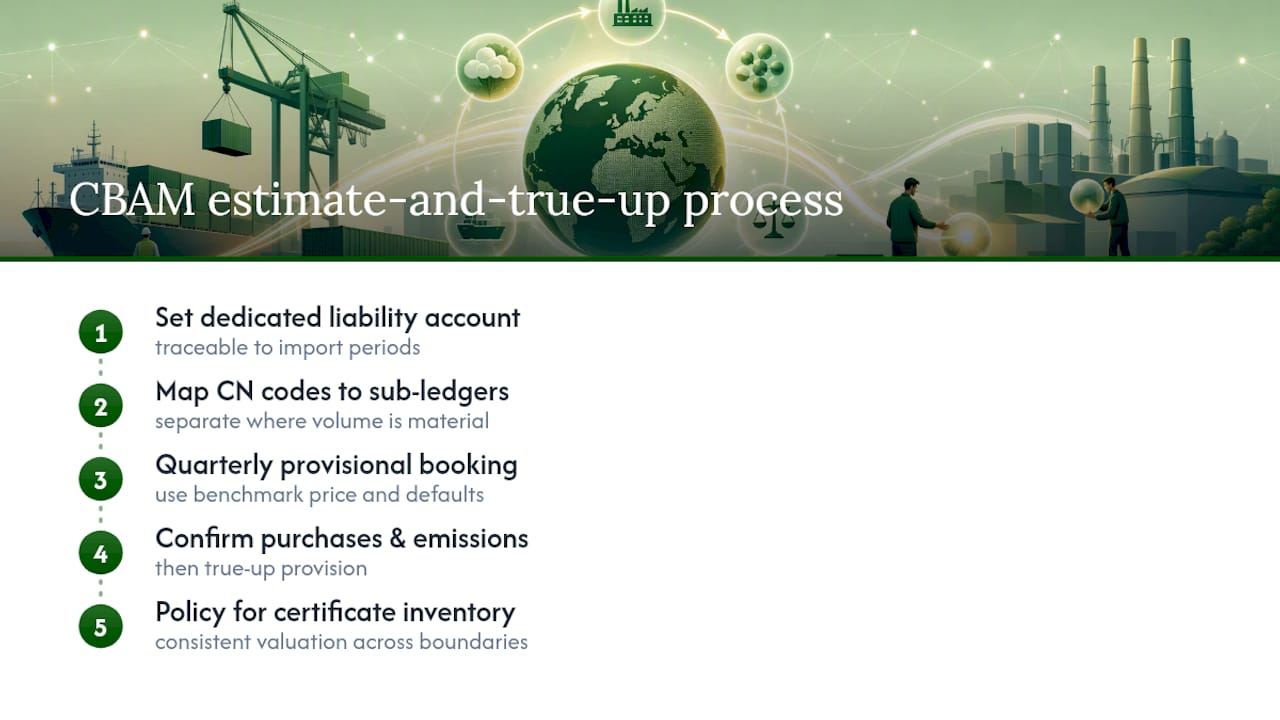
Coordinate with the client’s procurement or supply chain team on data timing. Accountants who wait for finalized supplier emissions data before booking anything end up with a liability that appears from nowhere at year-end. Better to book a defaults-based provision early and revise it downward as verified data arrives than to have no provision at all sitting on the books through most of the year.
Finally, set a policy for how certificate inventory, once purchased, gets carried on the balance sheet between purchase and surrender. Certificates held across a reporting boundary need a consistent valuation approach, matching whatever benchmark you already documented for the liability itself.
Common CBAM Filing Errors and How to Fix Them
The most frequent error accountants report is mismatched CN codes between the customs import declaration and the CBAM Registry entry. A broker might classify a shipment under a slightly different CN code than what ends up in the CBAM filing, and that discrepancy fails the registry’s reconciliation checks. Fix: cross-check every CN code against the original customs entry before submission, not after a rejection.
A second common mistake is submitting shipment lines with missing installation coordinates. The registry requires geographic location data for the producing installation, and suppliers frequently omit precise coordinates in favor of just a city or region. Chase this detail during initial supplier outreach, not during the filing crunch.
Double-reporting is another recurring issue, particularly where a client changes customs representatives mid-year. If both the old and new representative submit data for overlapping shipments, the registry flags a conflict. Confirm handoff dates explicitly in writing whenever representation changes.
Finally, accountants sometimes apply the wrong default value vintage, using an outdated Commission publication instead of the current one for the relevant reporting period. Default values get updated periodically, and using a stale figure understates or overstates the liability. Always pull the current published table directly rather than relying on a cached spreadsheet from a prior filing cycle.
Integrating CBAM Reporting With VAT and Customs Workflows
CBAM data overlaps heavily with information your client already reports for customs and VAT purposes, and the smartest approach treats these as connected workflows rather than separate silos.
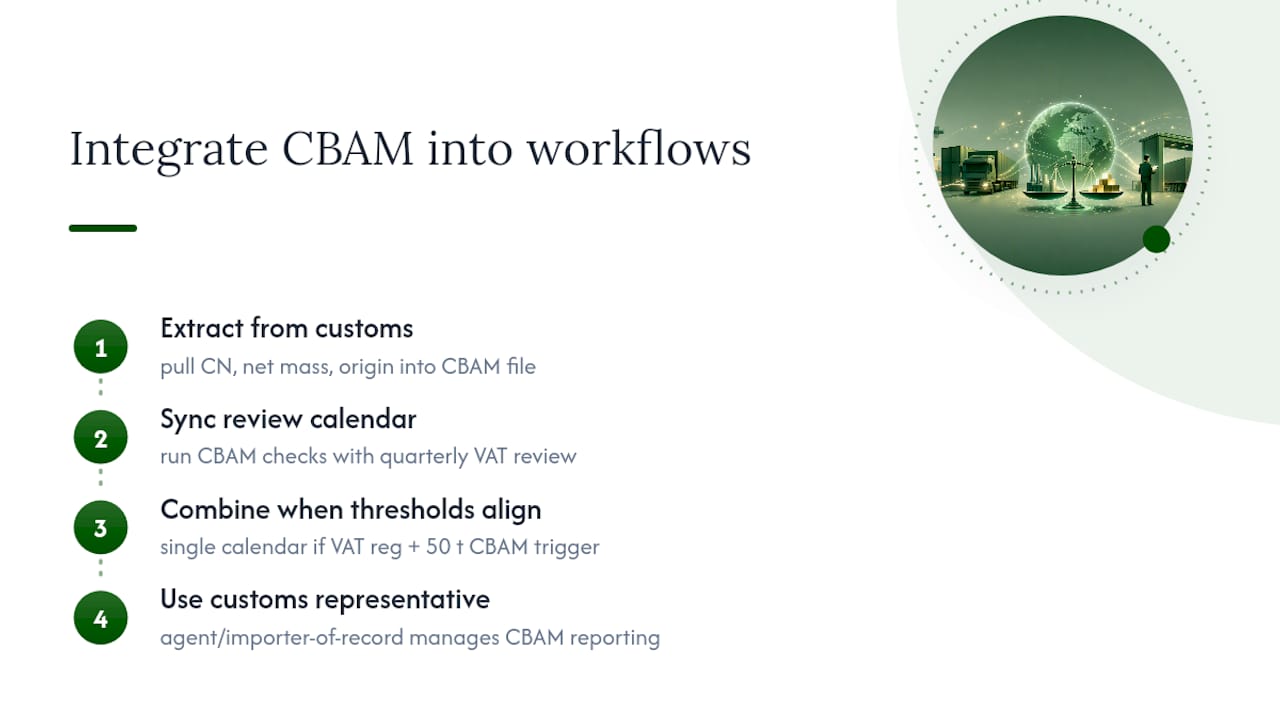
Customs declarations already capture CN code, net mass, and country of origin, which are exactly the fields CBAM needs. Set up a data extraction process that pulls directly from the customs entry system into your CBAM working file, rather than having someone re-key the same fields twice. This cuts transcription errors and speeds up the quarterly reconciliation.
VAT reporting cycles and CBAM’s quarterly holding-rule checkpoints don’t align perfectly, but running them on the same review calendar makes sense operationally. When your team sits down for the VAT return each quarter, that’s a natural moment to also verify CBAM certificate holdings against the running import total. Clients whose import volume triggers both VAT registration thresholds and CBAM’s 50 tonne threshold in the same jurisdiction benefit from one combined compliance calendar rather than two disconnected ones.
Where your client also uses a customs representative for import declarations, loop CBAM data requirements into that existing relationship. If the client cannot act as its own authorised declarant, cross-border compliance specialists such as MoreShores can act as importer of record and manage the CBAM reporting obligation alongside standard customs formalities, which keeps the whole compliance chain under one coordinated process instead of three separate vendors.
What First-Cycle CBAM Filings Teach Accountants
Data quality problems, not certificate purchasing timelines, are what actually derail a first CBAM filing. Clients who wait for “the certificate market to open” before organizing supplier data lose months they can’t recover before September deadlines.
Treat CBAM as a measurable liability sitting on the balance sheet, not a sustainability footnote for the annual report. The accounting team should own the policy decisions, not defer them to a procurement or ESG function that has no reason to think about revaluation cadence or audit evidence.
Get customs, procurement, and finance talking to each other in the same quarter, not the same fiscal year.
— Jake Stevens
Turn Import Records Into a Filing-Ready CBAM Declaration
Most of the delay in a first CBAM filing isn’t the regulation, it’s assembling clean shipment data into a format the registry will accept. The service takes a batch of import lines, matches each one to its CBAM CN code and sector, and applies the Commission’s published default emissions values wherever supplier-specific figures aren’t available yet. What comes back is a completed, reviewable declaration, not a spreadsheet you still have to interpret.
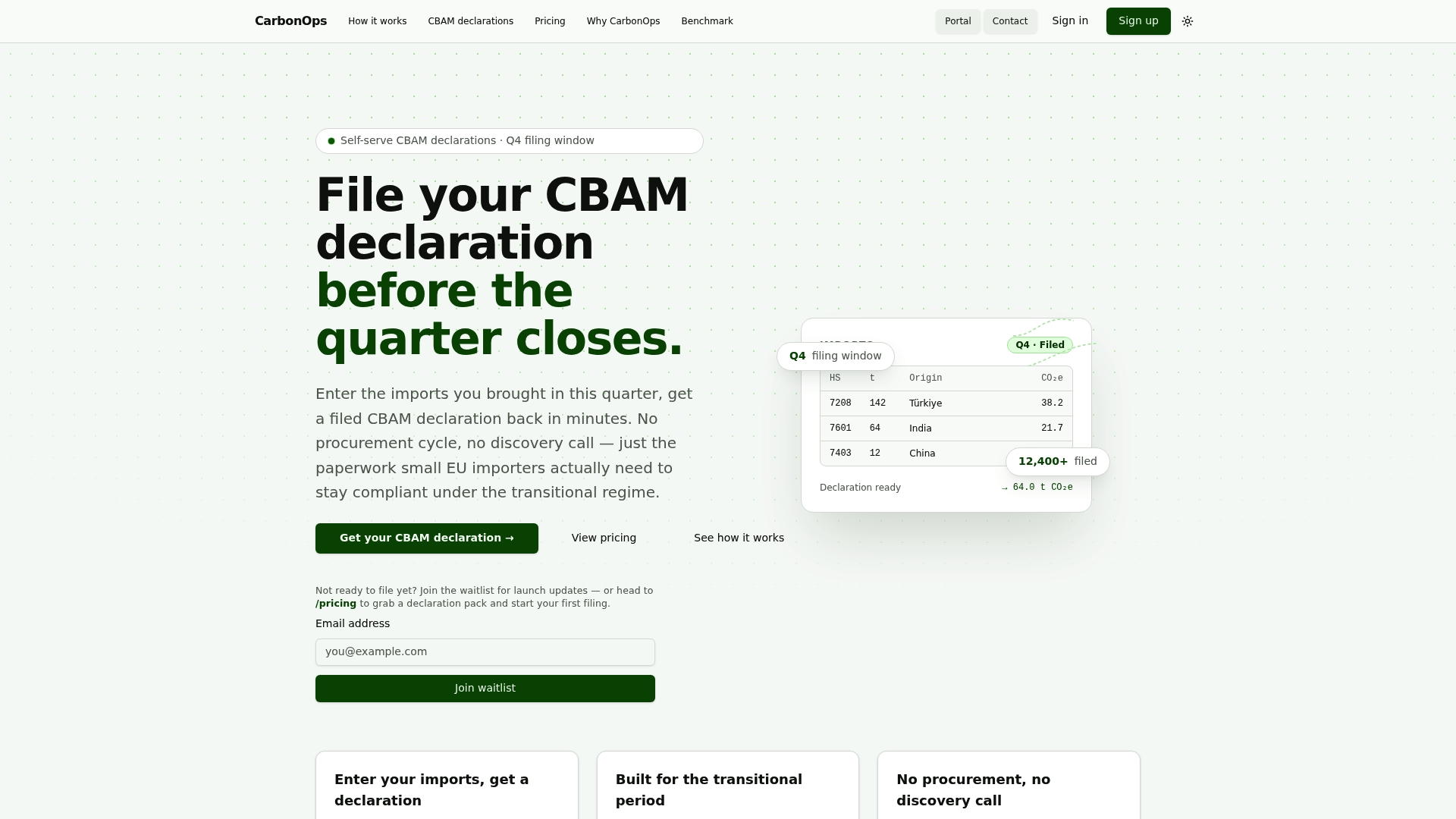
For an accounting practice handling filings for several importer clients, that matching and defaults step is usually where hours disappear. The service validates supplier data against CBAM-covered goods, keeps a retained audit trail for every declaration, and exports directly in the format the CBAM Registry expects, ready to submit. There’s no platform rollout and no subscription commitment. Pricing runs pay-per-declaration, with single or multi-pack options for practices filing across multiple clients. If you have import records ready, you can see how the filing workflow runs end to end and generate a declaration from your next batch of shipments.