Who Pays CBAM: Incoterms and Import Responsibility

Who Pays CBAM: Incoterms and Import Responsibility
Under DDP, the non-EU seller acts as importer of record and inherits the CBAM reporting duty. Under EXW, FOB, CIF, and CFR, that duty sits with the EU buyer. Under DAP and DPU, it’s almost always the buyer too. Whoever holds importer status legally owns the CBAM declaration and the certificate-surrender obligation, and shifting Incoterms doesn’t erase that unless you also confirm who becomes the authorised CBAM declarant and how supplier emissions data actually gets shared.
Key Takeaways
CBAM responsibility follows the legal importer of record under each Incoterm, and no contract clause changes who that is, only who does the work.
| Point | Details |
|---|---|
| DDP shifts legal importer status | The seller becomes importer of record and inherits the CBAM declarant role. |
| EXW, FOB, CIF leave buyer exposed | The EU buyer remains legally responsible for reporting regardless of who arranges freight. |
| Switching terms doesn’t fix data gaps | Changing DDP to DAP moves administrative tasks but not the need for verified supplier emissions data. |
| Default values raise costs | Missing supplier data forces reliance on Commission default values, which usually inflate certificate costs. |
| CarbonOps speeds the filing step | The platform converts supplier data and CN codes into a filing-ready CBAM declaration with default-value fallback built in. |
Table of Contents
- How Incoterms and CBAM Responsibility Actually Line Up
- What Happens When Supplier Emissions Data Is Missing
- Contract Clauses That Actually Secure CBAM Data
- Inward Processing, Thresholds, and When the Clock Starts
- Preventing Default-Value Exposure With Better Supplier Data
- How Do You Decide Which Incoterm To Use Under CBAM?
- Getting Authorised and Filing on Time
- A Four-Step Workflow for Filing-Ready Data
- A Faster Path to a Filing-Ready CBAM Declaration
- Frequently Asked Questions
- Sources
How Incoterms and CBAM Responsibility Actually Line Up
Incoterms 2020 haven’t changed one word since CBAM arrived. What changed is what those words now cost you. The ICC’s Incoterms rules still just describe who arranges shipping, insurance, and customs clearance. CBAM piggybacks on that customs role, because whoever clears the goods into free circulation becomes the party legally on the hook for reporting embedded emissions.
Here’s the practical breakdown:
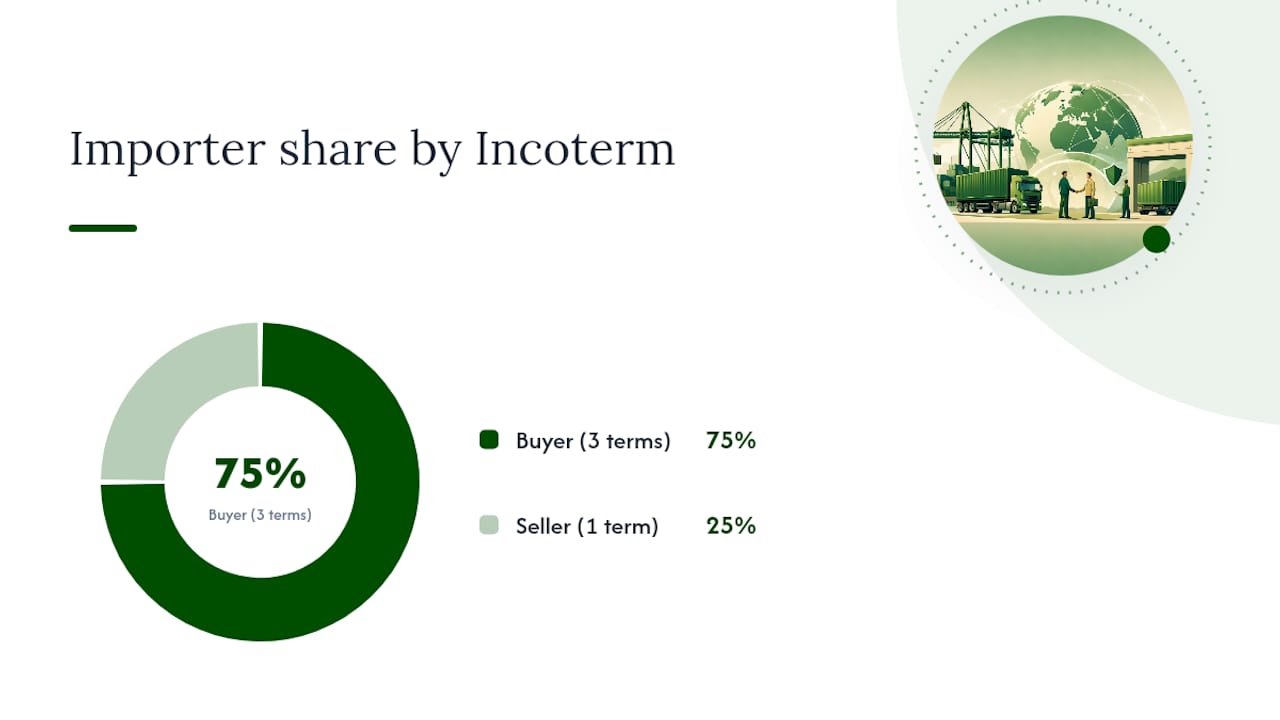
- DDP (Delivered Duty Paid): the seller clears customs and pays duties, so the seller acts as importer of record and takes on the CBAM declarant role, even though the seller may be based outside the EU.
- DAP/DPU (Delivered at Place/Delivered at Place Unloaded): the seller delivers, but the buyer handles import clearance, meaning the buyer is typically the importer.
- EXW (Ex Works): the buyer arranges everything from the seller’s dock onward, so the buyer is unambiguously the importer.
- FOB (Free on Board): the buyer takes responsibility once goods are loaded, and the buyer clears EU customs.
- CIF/CFR (Cost, Insurance and Freight / Cost and Freight): the seller pays freight, but the buyer still handles EU-side import clearance and CBAM reporting.
| Incoterm | Legal importer/declarant | Who chases supplier emissions data | Default-value risk |
|---|---|---|---|
| DDP | Seller | Seller, but often lacks leverage over its own upstream suppliers | Moderate to high |
| DAP/DPU | Buyer | Buyer, must request data from seller post-contract | High if not planned early |
| EXW/FOB | Buyer | Buyer, from day one of sourcing | High without contract clauses |
| CIF/CFR | Buyer | Buyer, despite seller controlling freight | High |
The one constant across every row: the legal importer is the one exposed to default-value inflation when supplier data doesn’t show up on time.
What Happens When Supplier Emissions Data Is Missing
When a supplier can’t or won’t produce installation-level emissions figures, the importer has to fall back on the Commission’s published default values for that CN code and country of origin. Those default values tend to run higher than verified figures, because they’re built to be conservative rather than favorable. Relying on them repeatedly usually means paying more certificates than a supplier’s actual emissions profile would require.
The knock-on risks go beyond the certificate bill. Misclassified CN codes, missing installation IDs, or incomplete precursor data can stall customs clearance entirely, and a blocked shipment during a compliance deadline is a far more expensive problem than a slightly conservative default value.
The first annual CBAM declaration covering 2026 imports is due by September 30, 2027, and that filing deadline applies regardless of whether your suppliers ever sent you usable emissions data.
That timeline gives compliance teams roughly a year of lead time from the close of the reporting year, which sounds generous until you’re chasing data from a dozen suppliers across five countries in three languages.
Contract Clauses That Actually Secure CBAM Data
Incoterms tell you who clears customs. They say nothing about who has to hand over verified emissions numbers on time, in the right format, with someone standing behind their accuracy. That’s a contract problem, not an Incoterms problem, and it needs its own clauses layered on top of whatever delivery term you’ve picked.
Build these into your sales and purchase agreements:
- A data-delivery schedule tied to shipment dates, not vague “reasonable time” language.
- A reference to the Commission’s common communication template so every supplier reports in the same structure.
- Verification or third-party audit rights over submitted emissions figures.
- An indemnity clause covering the extra certificate cost if default values get triggered by the supplier’s failure to deliver data.
- Clear allocation of responsibility for CN code classification, since a wrong code cascades into a wrong emissions category.
- A staged payment or holdback tied to data delivery, giving the supplier a financial reason to respond on time.
Pro Tip: Put the data-delivery clause in the same section of the contract as your quality and delivery terms, not buried in a boilerplate compliance annex. It gets read that way, and it gets enforced that way.
These clauses sit alongside your Incoterms choice. They don’t replace it.
Inward Processing, Thresholds, and When the Clock Starts
Goods held under inward processing don’t trigger CBAM reporting while they stay in that customs procedure. The obligation kicks in the moment goods, or products made from them, are released for free circulation in the EU, and the reporting period is tied to that release date, not the original import date.
Small consignments carry a mass-based exemption threshold, so occasional low-volume importers may fall outside authorization requirements entirely, but crossing that threshold at any point changes your obligations going forward.
- Track release-for-free-circulation events separately from initial customs entry.
- Reassess exemption status every time shipment volumes creep up.
- Remember that transitional-period quarterly reporting and the definitive-period annual declaration run on different clocks, and mixing them up is a common filing error.
Preventing Default-Value Exposure With Better Supplier Data
The fastest way to control CBAM cost is to never need a default value in the first place. That starts with asking suppliers for the right fields before the first shipment ever leaves the dock, not after a customs deadline forces the question.
Request, at minimum: installation ID, production route, activity level, direct and indirect embedded emissions, any carbon price already paid in the country of origin, and the correct CN codes for each product line. Standardizing intake around the Commission’s guidance for non-EU operators means every supplier, regardless of country or language, returns data in a format your team can actually reconcile.
Pro Tip: Write the data format and delivery deadline into a service-level commitment, not a request. Suppliers who see a template as optional will treat the deadline as optional too.
A short verification step, even a basic cross-check against the supplier’s own production records, catches errors before they become a filed declaration you have to amend.
How Do You Decide Which Incoterm To Use Under CBAM?
Run through this sequence before your next contract renewal:
- Does the seller have a legal presence in the EU, or can it appoint a customs representative? If not, DDP creates real friction.
- Who is prepared to register as the authorised CBAM declarant, and does that party already have EU customs registration?
- Can the supplier reliably produce installation-level emissions data on a schedule you control?
- Who is willing to carry the cash-flow burden of certificate purchases?
- How much administrative capacity does your team have for DDP-style import clearance?
From there:
- Keep DDP only if the seller has genuine EU customs capability and a track record of clean data delivery.
- Switch to DAP or DPU if you want the buyer to control CBAM filing directly, but pair the switch with a data clause. Changing the delivery term shifts who clears customs, not who owns getting real emissions numbers out of the producer.
- If the buyer ends up as importer, add supplier-data clauses immediately and line up a customs representative if you don’t already have one in-house.
Getting Authorised and Filing on Time
Becoming an authorised CBAM declarant runs through your national competent authority, and the process needs to start well before your first filing deadline, not the week of it.
- Apply for authorised declarant status through your national competent authority, listed via the Commission’s CBAM landing page.
- Register for CBAM registry access and set up recordkeeping that ties each shipment to its supplier data source.
- File quarterly reports during the transitional period, then shift to the annual definitive declaration once that period ends.
- Track certificate purchase and surrender deadlines as they phase in, since missing a surrender window carries financial penalties.
- Keep every quarterly submission archived. They form the basis for reconciling your annual figures later.
- Assign one internal owner for registry access. Shared logins across a compliance team create audit gaps.
A Four-Step Workflow for Filing-Ready Data
- Request: send suppliers a standardized data request built on the Commission’s template, tied to specific CN codes and production routes.
- Verify: reconcile installation-level emissions and precursor data against what the supplier actually produces, and flag any gaps that will force a default-value fallback.
- Record: log who provided what data and when, for every shipment, so the audit trail holds up under review.
- Declare: convert verified figures into your CBAM registry input, then retain exports and PDFs as your compliance record.
Pro Tip: Run this workflow on a rolling quarterly basis rather than scrambling once a year. The suppliers who resist data requests in January rarely improve by September.
A Practical Note on Incoterms and CBAM
Don’t waste months hunting for a “CBAM-proof” Incoterm. None exists. What actually protects you is standardized data intake and contract clauses that survive a supplier going quiet. Tools like CarbonOps exist precisely to turn whatever data you do collect into a filing-ready declaration fast.
A Faster Path to a Filing-Ready CBAM Declaration
CarbonOps is built for the reality this article just laid out: your legal importer status doesn’t change based on which software you use, but how fast you get from scattered supplier emails to a completed declaration absolutely does.
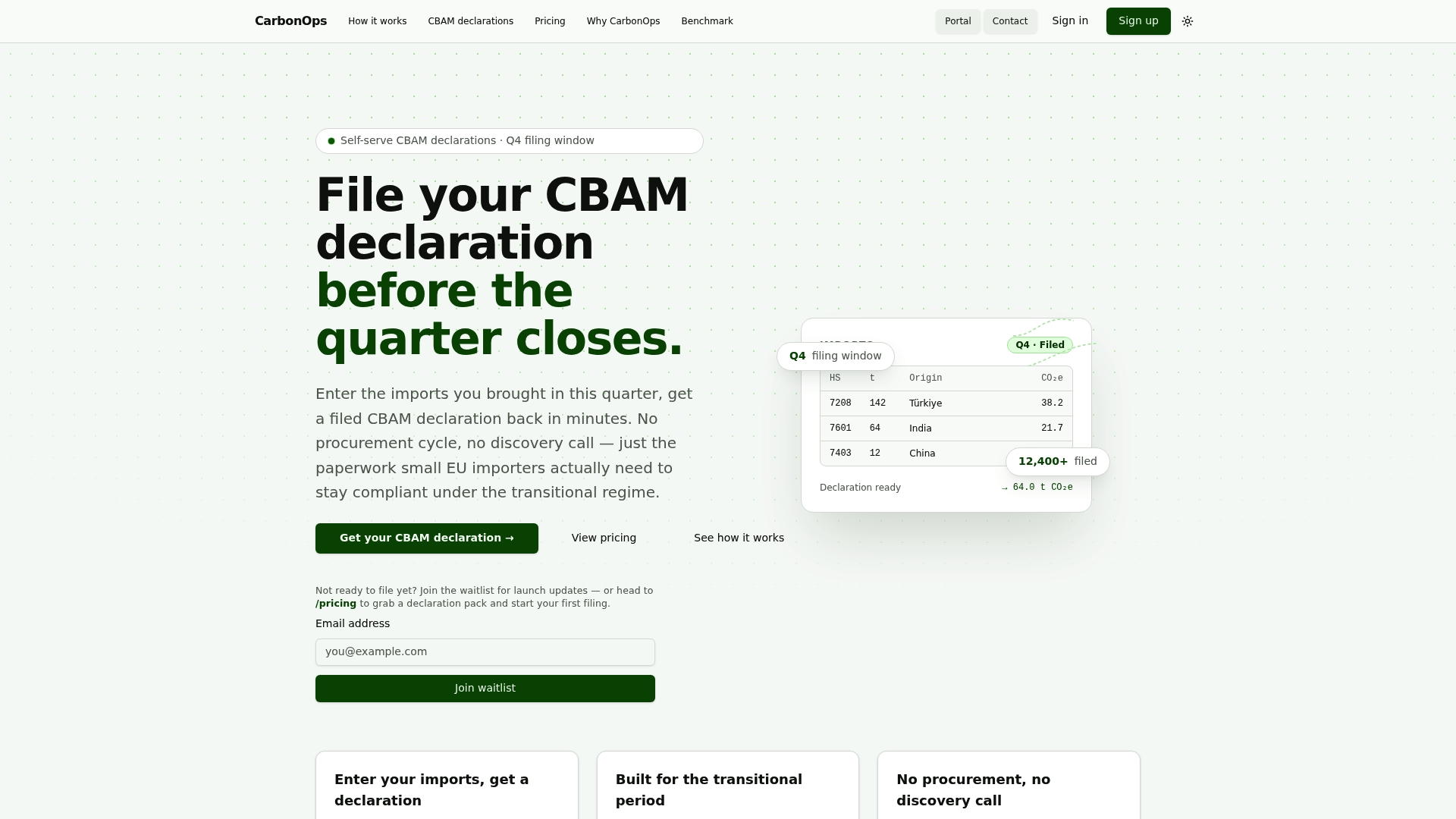
Enter each shipment with its HS/CN code, mass, and country of origin, and the platform matches it to the correct CBAM category automatically. Where supplier data hasn’t arrived, it applies the Commission’s published default values so every line still resolves to a complete figure instead of a stalled filing. That fits small and mid-sized EU importers and the accountants or compliance officers who file on their behalf, without a procurement cycle or platform rollout eating into your deadline. Once your data is in, export the declaration in registry-ready format and keep the audit trail on hand. Start your first declaration on CarbonOps and see how quickly your import data turns into a filed submission.
Frequently Asked Questions
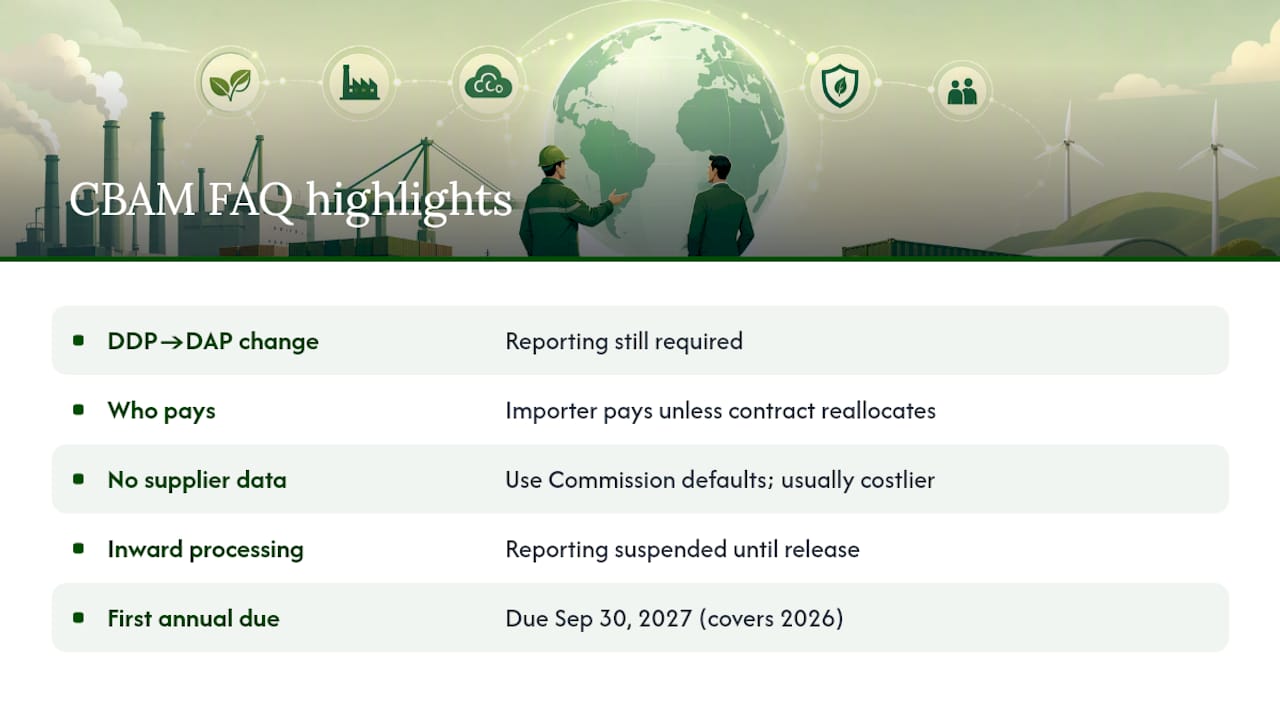
Does changing from DDP to DAP remove our CBAM reporting burden? No. It shifts who handles customs clearance and who registers as importer, but the buyer still needs verified supplier emissions data either way.
Who actually pays for CBAM certificates? The importer of record pays, unless a contract explicitly reallocates that cost. Under DDP, that’s the seller; under most other common terms, it’s the buyer.
What happens if our supplier never sends emissions data? The importer must use the Commission’s published default values for that CN code and country, which typically cost more in certificates than verified figures would.
Is inward processing exempt from CBAM entirely? Not automatically. Reporting is suspended while goods stay under inward processing, but it activates the moment goods or their derivatives are released for free circulation.
When is the first CBAM annual declaration due? The first annual declaration, covering 2026 imports, is due by September 30, 2027, under the definitive period rules.
This article is general information, not a substitute for advice from a qualified lawyer. Consult a qualified legal professional about your own circumstances before acting on anything here.