Avoid Up to 30% CBAM Markup by Requesting CBAM Data, EU Importers

Avoid Up to 30% CBAM Markup by Requesting CBAM Data, EU Importers
Request the Annex IV data packet (installation ID, direct and indirect specific embedded emissions, activity data, and production route) from every supplying installation, plus proof of accredited third-party verification. If a supplier can’t produce verified numbers, plan now to fall back on Commission default values, but document every outreach attempt. Send an Annex IV template with a firm deadline today and log it in your tracker.
TL;DR:
- Collect verified Annex IV data from suppliers, including installation details, embedded emissions, activity data, and sector-specific production routes, before the deadline.
- Confirm third-party verification with accredited verifiers, including accreditation reference numbers and proof of upload to the CBAM Registry, to avoid default markups and overpayment risks.
- Use structured, localized outreach with pre-filled templates and clear deadlines to improve response rates and ensure suppliers provide complete, auditable data.
- Be prepared to fall back on default values, which increase in markup from 10% in 2026 to 30% by 2028, if suppliers refuse or fail to provide verified data.
- Automate the data import and declaration process with tools like CarbonOps to reduce manual effort and ensure submissions meet CBAM filing standards.
Table of Contents
- How Do You Request CBAM Data From Suppliers?
- Why Does Verification Matter So Much Now?
- Building an Outreach Workflow That Actually Gets Replies
- What Happens When Suppliers Can’t Provide Verified Data?
- Retrieving Supplier Data Through the CBAM Registry and O3CI
- Turning Supplier Responses Into a Filing-Ready Declaration
- Your Quarterly Filing Checklist, Start to Finish
- Who Sees What: Managing Confidentiality in Supplier Data Requests
- When Suppliers Go Quiet or Refuse to Cooperate
- Why Most Importers Overbuild Their Data Requests
- Skip the Spreadsheet Wrangling and File Directly
- Sources
How Do You Request CBAM Data From Suppliers?
Requesting CBAM data isn’t a single email. It’s a structured intake process that mirrors what the CBAM Registry itself expects to receive, and getting the fields right the first time saves you weeks of follow-up. The standard industry term for this process is “CBAM data collection,” though most compliance teams just call it chasing suppliers for numbers.
The core document is Annex IV of the CBAM regulation, a communication template the European Commission built specifically so non-EU installation operators can report emissions in a format the whole supply chain recognizes. Sending it instead of a custom spreadsheet cuts translation errors and speeds up replies, because the supplier’s technical staff have likely seen this exact layout before.
Here’s what a complete request needs to cover:
- Installation identity: legal name, physical address, UN/LOCODE, and GPS coordinates for the specific plant, not the parent company.
- Operator contact: a named technical or environmental contact, not a sales inbox.
- Specific embedded emissions (SEE): expressed as tCO2e per tonne of product or tCO2e per MWh, split into direct emissions and the indirect component required for certain sectors like aluminum and fertilizers.
- Activity data: fuel consumption, electricity draw, and raw material inputs tied to the reporting period.
- Production route code: the sector-specific method used to make the good, since CBAM’s guidance document ties emissions factors to specific routes rather than generic product categories.
- Precursor data: clinker ratio for cement, PFC emissions for aluminum, feedstock composition for fertilizers, or scrap share for steel, wherever the sector rules require it.
- Monitoring method: whether the figures are measured, calculated from stoichiometry, or modeled, since verifiers weight these differently.
A supplier who sends back a number without the monitoring method behind it hasn’t given you a usable figure. You’ll spend more time chasing the missing context than you would have spent asking for it up front.
Why Does Verification Matter So Much Now?
Because it’s no longer optional. As of January 1, 2026, any actual emissions data used in a CBAM declaration must carry accredited third-party verification. Unverified figures, no matter how precise they look on paper, cannot be accepted, and the declaration defaults to Commission fallback values instead.
That single rule reshapes what “requesting data” means. You’re not just asking a supplier for a spreadsheet, you’re asking them to produce an auditable chain of custody behind that spreadsheet. Build your request checklist around it:
- Verifier’s full legal name and the accreditation body that certified them (national accreditation body or an EA mutual-recognition partner).
- Accreditation reference number, ideally cross-checked against the accrediting body’s public register.
- The verifier’s statement or report, dated and referencing the specific installation and reporting period.
- Confirmation of whether the verified data has already been uploaded to the CBAM Registry, which can save your team a manual retrieval step.
- Explicit reference to EN ISO/IEC 14065, the standard accreditation bodies use to qualify greenhouse gas verifiers.
Validating accreditation takes five minutes if you know where to look. Most national accreditation bodies publish searchable registers, and the European co-operation for Accreditation maintains mutual recognition listings so a verifier accredited in one EU country is valid across the bloc.
Pro Tip: Name every verifier document with the installation ID, reporting quarter, and verifier name in the filename itself (e.g., “DE0234_Q1-2026_TUV.pdf”). When an auditor asks for evidence six months later, you won’t be reopening forty email threads to find it.
Building an Outreach Workflow That Actually Gets Replies
Sending a blank Annex IV template to a generic sales contact is the single most common reason importers get incomplete data back. Fix both problems at once.
- Attach the template and a filled-in sample. A pre-filled example, even a fictional one, shows the plant’s environmental team exactly what a complete answer looks like and reduces the back-and-forth that comes from vague instructions.
- Route it to the plant, not procurement. Send the request to the EHS manager or plant technical lead, since commercial contacts rarely have emissions figures on hand and will just forward the email anyway, adding days of delay.
- Localize the request. A request written in the supplier’s own language, even a rough one, gets read faster and taken more seriously than an English form letter buried in an inbox.
- Explain the commercial stakes plainly. Default values carry punitive markups that make the supplier’s goods look more carbon-intensive than they probably are, which can push you toward a competitor. That’s a strong incentive for the supplier to cooperate, and saying so directly tends to work.
- Set one deadline, one reminder, and a named escalation contact. Give a firm date, follow up once a week before it, and if there’s still no response, route it to procurement or legal with a short note explaining the compliance and cost exposure.
- Log everything centrally. Every request, reply, and reminder gets logged against the HS/CN code and installation ID it relates to, so you can prove due diligence if a supplier never responds at all.
Pro Tip: If you buy through a trader rather than directly from the producing installation, say so in your first email and ask the trader to forward the request to the actual plant. Traders frequently don’t have installation-level data themselves, and importers who skip this step often discover months later that their “supplier data” never reached the people who could actually provide it.
What Happens When Suppliers Can’t Provide Verified Data?
You fall back to Commission default values, and that fallback has a price tag attached. The markup schedule adds 10% to default emissions figures in 2026, 20% in 2027, and 30% from 2028 onward. Those markups exist specifically to make defaults less attractive than real, verified data, and they succeed at that.
Default value markups climb from 10% in 2026 to 30% by 2028, meaning the financial penalty for relying on fallback figures nearly triples over three years.
Think through the math qualitatively for a moment. If a supplier’s actual specific embedded emissions sit meaningfully below the sector default, and you’re forced to use the inflated default figure instead, you buy more CBAM certificates than the shipment’s real carbon footprint justifies. Multiply that gap across a full quarter of shipments and the overpayment adds up fast, all because a plant’s technical team never answered an email.
A few mitigations reduce that exposure:
- Offer to help the supplier complete Annex IV, sometimes a short call clears up more confusion than three rounds of email.
- Write emissions data requirements into new supply contracts as a standing obligation, not a one-time favor.
- Where a supplier consistently refuses, start evaluating alternate sources for that CN code.
- Time inventory purchases conservatively around reporting deadlines so a late reply doesn’t force a rushed default-value filing.
- Keep dated records of every request, reminder, and non-response. Auditors and national authorities care as much about demonstrated effort as about the final number.
Retrieving Supplier Data Through the CBAM Registry and O3CI
Non-EU installation operators don’t have to send the same emissions file to every importer they supply. The CBAM Registry includes a module called O3CI that lets an operator upload verified data once, after which multiple authorized declarants can retrieve it directly. That single feature can eliminate a huge share of your manual chasing, provided your supplier actually uses it.
Getting your side of that connection working takes a few concrete steps:
- Share your EORI number with the supplier or operator so they can grant your business registry access to their uploaded data.
- Log into the Declarant Portal through EU Login, which requires two-factor authentication, so make sure whoever manages this account has their authentication method set up well before a filing deadline.
- Use the Registry’s emissions tab to search for the specific installation by name or ID once access is granted, rather than waiting on a separate email confirmation.
- Check “My Installations” and “My Quarterly Reports” inside the Declarant Portal regularly, since operator uploads can appear without a separate notification.
- Track outstanding “Requests” in the portal itself, treating each one like an open ticket until the data comes through or you escalate.
Build this into your onboarding checklist for every new supplier relationship: get the EORI exchange done in the first outreach email, not as an afterthought three weeks later when a deadline is looming.
Turning Supplier Responses Into a Filing-Ready Declaration
Getting the numbers back from a supplier is only half the job. The other half is mapping those numbers correctly against your own import lines, and this is where inconsistent units and mismatched reporting periods quietly create compliance headaches.
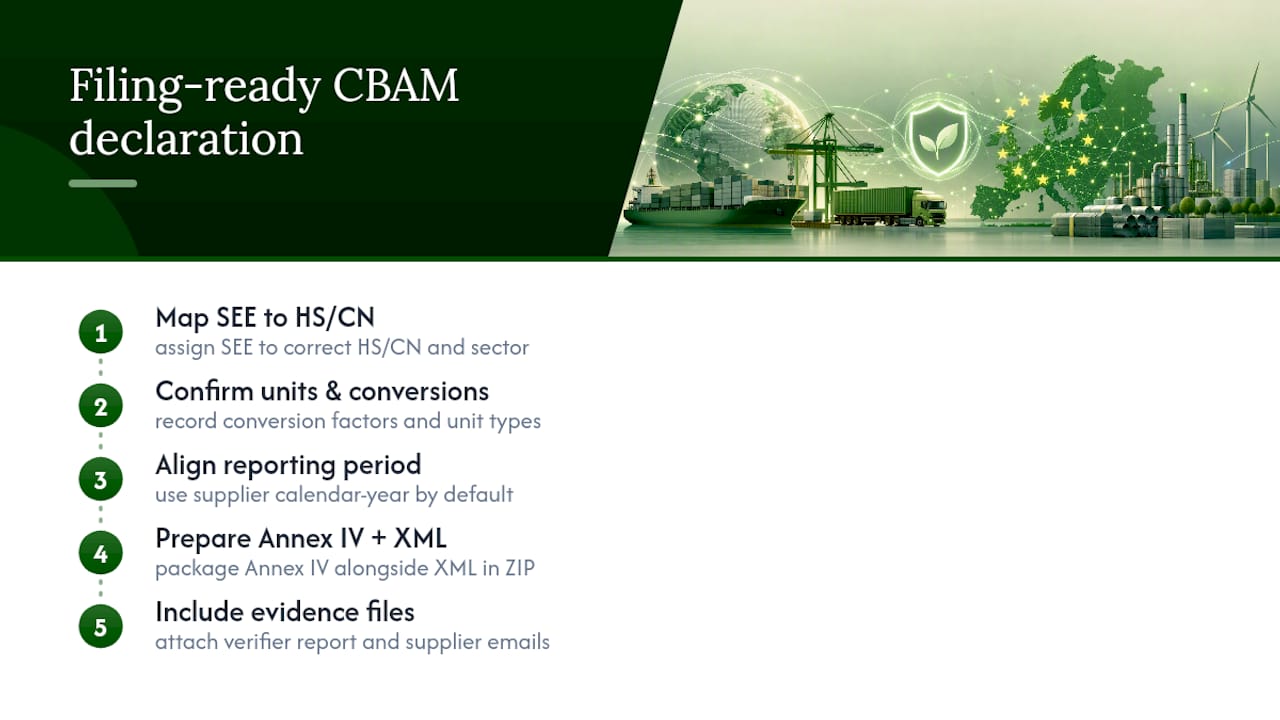
Start by matching every supplier’s SEE figure to the correct HS/CN code and CBAM sector before you try to connect it to a shipment quantity. A single supplier can produce goods under several CN codes, each carrying different sector rules, so don’t assume one emissions figure covers everything they ship you.
Confirm units before you do any math. A figure quoted in tCO2e per MWh means something completely different from one quoted in tCO2e per tonne, and mixing them up produces a certificate calculation that’s wrong by an order of magnitude. Whatever conversion factors you apply to reconcile activity data, record them, because a verifier or auditor will ask where a converted number came from.
Reporting period alignment matters just as much. Use the supplier’s calendar-year monitoring period as your default assumption unless you have documented evidence supporting a different alignment. Mismatched periods are a common, avoidable source of rejected submissions.
For file format, Annex IV data packaged alongside an XML file in a ZIP is what the Declarant Portal expects for upload. Keep the verifier’s report and your email correspondence with the supplier bundled into that same submission package, so the full evidence trail travels with the filing rather than sitting in a separate folder nobody remembers to check.
Your Quarterly Filing Checklist, Start to Finish
Run this sequence every reporting cycle rather than improvising it each time:
- Assemble import lines with HS/CN codes and quantities.
- Identify the producing installation behind each line.
- Send the Annex IV request with a firm deadline.
- Collect the supplier’s verifier credentials and report.
- Map SEE figures to import lines and confirm units.
- Prepare the XML/ZIP package.
- Submit through the Declarant Portal or export via CarbonOps.
| Stage | Owner | Target Timing |
|---|---|---|
| Import line assembly | Customs/logistics | Week 1 of quarter |
| Supplier outreach | Procurement | Week 1-2 |
| Verifier evidence collection | Compliance | Week 3-5 |
| Mapping and file prep | Compliance | Week 6 |
| Submission | Compliance/customs | Before quarterly deadline |
Keep every request email, verifier document, and conversion-factor note on file. That paper trail is what turns a stressful audit into a routine one.
Who Sees What: Managing Confidentiality in Supplier Data Requests
Emissions data is competitively sensitive for a lot of suppliers, and treating that concern seriously often improves your response rate rather than slowing it down. A plant manager asked to hand over fuel mix and production route details is effectively disclosing process information a competitor could use, so expect some hesitation, especially from first-time suppliers.
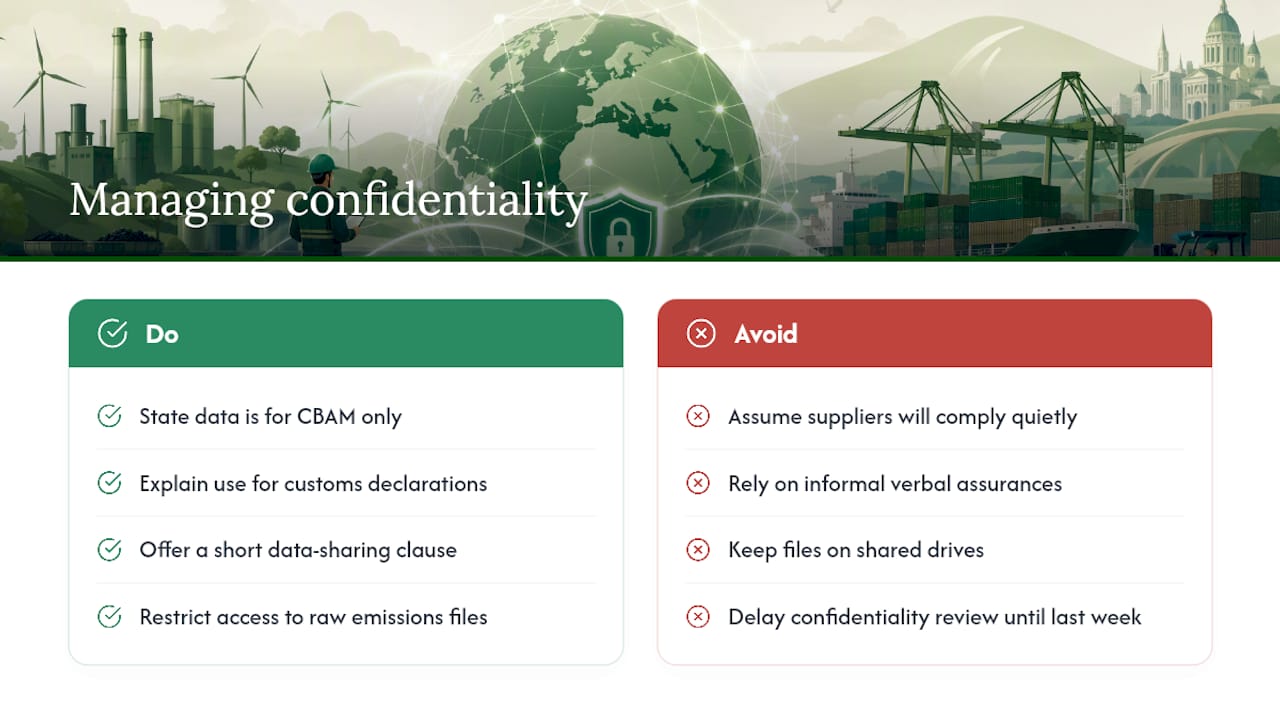
Address it directly rather than hoping it doesn’t come up. State plainly that the data is being collected solely for CBAM compliance purposes and will be used to calculate embedded emissions for customs declarations, not shared with commercial teams or used in supplier negotiations. Where a supplier asks for it, a short data-sharing agreement or a confidentiality clause added to an existing supply contract usually resolves the concern faster than an informal verbal assurance.
Practically, that means separating who inside your organization has access to raw supplier emissions files from who works on supplier pricing and sourcing decisions. If procurement and compliance sit in the same small team, at minimum keep the emissions data in a restricted folder rather than a shared drive everyone can browse.
Some suppliers, particularly larger ones already dealing with multiple EU importers, will have their own standard confidentiality terms they want you to sign before releasing anything. Read those terms before your deadline is a week away. A confidentiality agreement that takes legal three weeks to review defeats the purpose of a fast turnaround request, so build that review time into your outreach calendar from the start rather than treating it as a surprise delay.
When Suppliers Go Quiet or Refuse to Cooperate
Not every supplier responds, and some respond with an outright refusal to share emissions data at all. Neither situation is unusual, and neither one excuses you from filing, so plan for it rather than treating it as an emergency each time it happens.
For partial or incomplete responses, go back with specific, narrow follow-up questions rather than resending the entire Annex IV template. A supplier who sent activity data but skipped the production route code needs one clarifying email, not a repeat of the original request. That precision usually gets a faster answer than a generic “please complete the attached form” reminder.
For outright silence, your escalation path matters more than persistence alone. After one reminder past the deadline, loop in whoever owns the commercial relationship, since a supplier who ignores a compliance officer will often respond within a day to their own account manager. Document the date of each attempt regardless of outcome.
For flat refusals, ask why, sometimes it’s a genuine confidentiality concern you can resolve with an agreement, and sometimes the plant simply hasn’t set up emissions monitoring yet. Either answer tells you something useful: whether this is a relationship you can fix with better communication, or a supplier you need to start replacing for CBAM-covered goods specifically.
Whatever the outcome, the fallback is the same: apply default values, note the markup impact on your certificate liability, and file on time. A late declaration built around a supplier’s silence creates far more risk than an on-time one built on documented defaults.
Why Most Importers Overbuild Their Data Requests
The instinct with a new regulatory obligation is to ask for everything, every field Annex IV mentions, every possible precursor, every unit conversion, on the first email to every supplier. That instinct is usually wrong. Smaller suppliers, especially ones outside heavy industry, get overwhelmed by a maximalist request and often just don’t reply at all. A tighter, sector-specific ask, built around exactly what your CN codes require, gets better response rates than a generic checklist copied from the regulation’s full text.
The bigger blind spot I see is treating supplier outreach as a one-time task instead of a recurring operational process. Suppliers change monitoring methods, verifiers rotate, and production routes shift when a plant retools a line. A request template that worked for Q1 needs re-validation by Q3, not blind reuse.
This is exactly the gap CarbonOps is built to close on the output side. Once supplier data comes in, whether verified or defaulted, CarbonOps’ four-step process takes a batch of imported goods through CN code matching, applies Commission default values wherever supplier data is missing, and exports a declaration in the format the CBAM Registry expects. There’s no procurement cycle to run and no platform to deploy, which matters most for smaller importers without a dedicated compliance function. The collection side still takes real, human follow-up. The filing side doesn’t have to.
— Jake Stevens
Skip the Spreadsheet Wrangling and File Directly
Chasing supplier emissions data is only step one. Turning what comes back, verified or defaulted, into a declaration the CBAM Registry will actually accept is where most in-house teams lose days they don’t have. CarbonOps is built for exactly that second half of the job: enter your shipments, let CN code matching sort what’s in scope, and let default values fill any gap your supplier outreach couldn’t close.
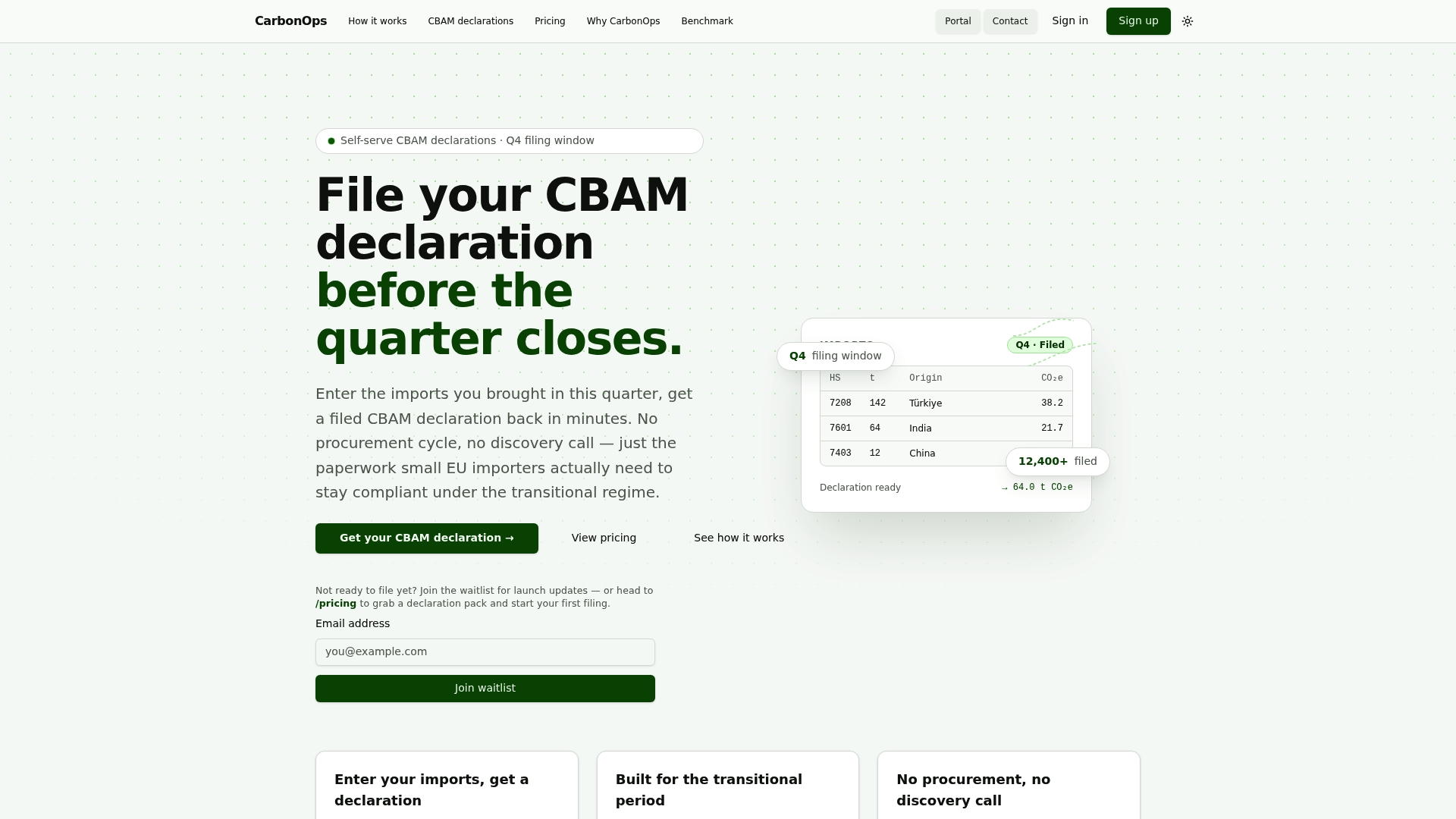
There’s no subscription to commit to and no onboarding project to schedule. You pay per declaration, whether that’s a single filing or a multi-pack for several quarters, and the output comes back in the exact format the Registry expects, with your filing history retained for the next audit. If your supplier data collection is solid but your export process is eating your quarter, file your CBAM declaration and see how much of that manual work disappears.