Avoid Sept 30, 2027 Cash Shock: Pay as You Go CBAM for Importers
Avoid Sept 30, 2027 Cash Shock: Pay as You Go CBAM for Importers
Your carbon liability is recorded the moment goods clear EU customs, but you don’t pay for it until much later, when you buy and surrender certificates. That gap between the accounting event and the cash event is the entire point of pay-as-you-go CBAM, and it’s also the biggest risk to your treasury if nobody’s modeling it. Certificate sales open February 1, 2027, and the first surrender for 2026 imports is due September 30, 2027. Start collecting supplier emissions data now, because waiting until the surrender deadline to figure out your exposure is how companies end up paying default-value markups and penalty rates instead of real numbers.
TL;DR:
- Companies must model their import liability based on quarterly averages tied to EU ETS auction prices, as certificate costs are fixed retroactively after import.
- Authorized declarant status is mandatory for importers surpassing 50 tonnes per year, requiring early application and thorough recordkeeping to avoid penalties and compliance gaps.
- Supplier-specific emissions data can significantly lower certificate costs compared to default values, but gathering accurate information before shipment is crucial.
- Certificate purchases can be spread quarterly, front-loaded, or proportionally monthly, but treasury exposure persists until certificates are surrendered in September 2027.
- Accurate quarterly records, verified emissions, and timely filings will prevent costly penalties and streamline CBAM compliance processes.
Table of Contents
- How Pay-As-You-Go CBAM Actually Works, Step by Step
- Key Dates, Thresholds, and Where to Watch Certificate Prices
- Who Needs Authorized CBAM Declarant Status
- Calculating Embedded Emissions: Supplier Data vs. Default Values
- Buying, Holding, and Surrendering Certificates Without Getting Squeezed
- Compliance Checklist: Records, Verification, and What Happens If You Miss a Deadline
- From Shipment Data to a Filing-Ready Declaration
- Why the Timing Mismatch Is the Real Story, Not the Paperwork
- Get Your CBAM Filing Done Without the Procurement Cycle
- Sources
How Pay-As-You-Go CBAM Actually Works, Step by Step
CBAM doesn’t charge you at the border. It creates an obligation at the border and lets you settle it on a delayed schedule, which is exactly what makes it “pay as you go” rather than pay-on-arrival.
The sequence runs in four distinct legal steps:
- Import happens. The moment covered goods enter the EU, your liability is created, tied to that shipment’s mass, CN code, and country of origin.
- A price gets assigned by import quarter. Each shipment’s carbon cost is calculated using the certificate price tied to the quarter it was imported in.
- The certificate sale window opens. You can’t buy certificates the day you import. Sales don’t begin until February 1, 2027, so early 2026 imports sit on the books unpaid for months.
- You surrender certificates matching your verified emissions. This is the actual cash event, and it lands well after the goods have already been sold, used, or built into something else.
Here’s the number that catches most finance teams off guard: certificate prices for 2026 imports are set using quarterly averages tied to EU ETS auction closing prices, shifting to weekly averages starting in 2027. That means the price you owe isn’t fixed at the moment of import. It’s fixed retroactively, based on a quarterly or weekly benchmark you won’t see published until after the fact.
The practical impact: your accounting liability shows up on the books earlier than any cash leaves your account, sometimes by well over a year. Model your exposure by import quarter now, not by calendar year, because that’s the unit CBAM actually uses to price your goods.
Key Dates, Thresholds, and Where to Watch Certificate Prices
Three dates matter more than any others in the entire regime. The definitive CBAM regime started January 1, 2026. Certificate sales open February 1, 2027. First surrender, covering everything imported in 2026, falls on September 30, 2027.
There’s also a volume threshold that determines whether you’re even in scope: importers bringing in 50 tonnes or less of covered goods annually are exempt, a threshold that aggregates across all your CBAM-covered CN codes, not per shipment or per product line. If you’re importing steel under three different CN codes at 20 tonnes each, you’re over the line even though no single line item looks alarming.
Once you’re in, the holding rule kicks in:
- From 2027 onward, you must hold certificates covering at least 50% of your quarter’s estimated emissions by each quarter’s end.
- Certificate prices are published by the Commission on a set schedule, quarterly through 2026 and weekly starting in 2027, both tied to the EU ETS auction closing price.
- Buyback windows let you offload excess certificates, but only within defined limits and deadlines, not on demand.
Miss the quarterly check and you’re not immediately fined, but you’re flagged, and flagged accounts draw more scrutiny at annual surrender.
Who Needs Authorized CBAM Declarant Status
If you’re importing covered goods above the 50-tonne threshold, you need authorized declarant status before you can buy a single certificate. This isn’t optional paperwork. It’s the gate that determines whether you can participate in the system at all.
Getting there involves a few concrete steps:
- Apply through your national competent authority, since Regulation (EU) 2023/956 sets the legal framework but individual member states process applications.
- Submit importer or representative identification data, including EORI numbers and details on the goods categories you expect to import.
- Build in lead time. Applications aren’t instant, and importing without authorization once you’re over threshold leaves you exposed to penalty rates with no certificate purchase option to offset them.
- Set up recordkeeping systems before you need them, since Regulation (EU) 2023/956 requires verifier-ready records and approved verifiers to sign off on your declared totals.
Skip authorization and you lose the ability to buy certificates at all, which pushes you straight into penalty territory with no legal path to catch up. Our guide to becoming an authorized CBAM declarant walks through the application mechanics in more depth if you’re starting from zero.
Calculating Embedded Emissions: Supplier Data vs. Default Values
Embedded emissions cover two things: direct emissions from making the goods, and indirect emissions from the electricity used in production. Regulation (EU) 2023/956 requires Annex V level of detail, meaning transaction-specific records, not aggregated estimates.
You have two ways to get these numbers. Supplier-specific data, verified and documented, or the Commission’s default values assigned per CN code and country of origin. The Commission’s own guidance is direct on this point: supplier-specific data materially reduces your exposure compared with defaults, because defaults are set conservatively and carry a built-in markup precisely because they assume the worst case.
If your supplier already pays a carbon price in their home country, you can deduct that amount, but only with proper documentation and verifier proof tying the payment to the specific shipment.
Here’s what to actually request from suppliers:
- Direct emissions figures per unit of product, broken down by production process where possible
- Electricity consumption data tied to the specific production run, not a plant-wide annual average
- Documentation of any carbon price already paid in the country of origin
- Third-party verification or audit trail supporting their numbers
Pro Tip: Ask suppliers for this data before you place the order, not after the shipment lands. Suppliers unfamiliar with CBAM often need weeks to pull production-level emissions figures, and you don’t want that clock running against your surrender deadline.
Expect gaps. Smaller suppliers, especially outside the EU, frequently don’t track emissions at the level of detail Annex V wants, which is exactly when default values step in and your certificate bill goes up. Our breakdown of default values by CN code covers what those markups look like in practice.
Buying, Holding, and Surrendering Certificates Without Getting Squeezed
You have three realistic approaches to buying certificates, and each trades off differently between price risk and administrative load.
- Quarterly rolling purchases. Buy just enough each quarter to satisfy the 50% holding minimum, adjusting as actual import volumes firm up. This keeps cash outlay tight but means you’re exposed to price swings quarter over quarter.
- Front-loaded buying. Purchase a larger batch early in the year at a known price, then draw down against it. This locks in price certainty but ties up capital you might need elsewhere.
- Proportional monthly buying. Spread purchases evenly across the year in smaller batches. This smooths cash flow but adds more transactions to track and reconcile against the quarterly holding check.
Coordinating purchases with quarter-end dates matters more than most finance teams expect. The 50% quarterly holding rule applies from 2027 onward and checks your certificate balance against estimated emissions at that specific moment, not your annual average.
If you overbuy, a buyback right lets you sell certificates back, though within strict limits and deadlines, and the price you recover depends on the market rate at the time of the buyback, not what you originally paid. Overbuying to be safe isn’t free insurance. It’s a bet that the buyback price will be close enough to your purchase price to avoid a real loss.
Run a quick scenario: if you import 200 tonnes of covered steel in Q1 2026, your liability is booked in Q1. But you can’t buy a single certificate until February 2027, and the cash doesn’t leave your account until closer to the September 2027 surrender. That’s a treasury exposure window stretching well over a year on goods you’ve likely already sold. Treating CBAM as a working capital problem rather than a compliance checkbox is the difference between a manageable line item and a cash-flow surprise.
Compliance Checklist: Records, Verification, and What Happens If You Miss a Deadline
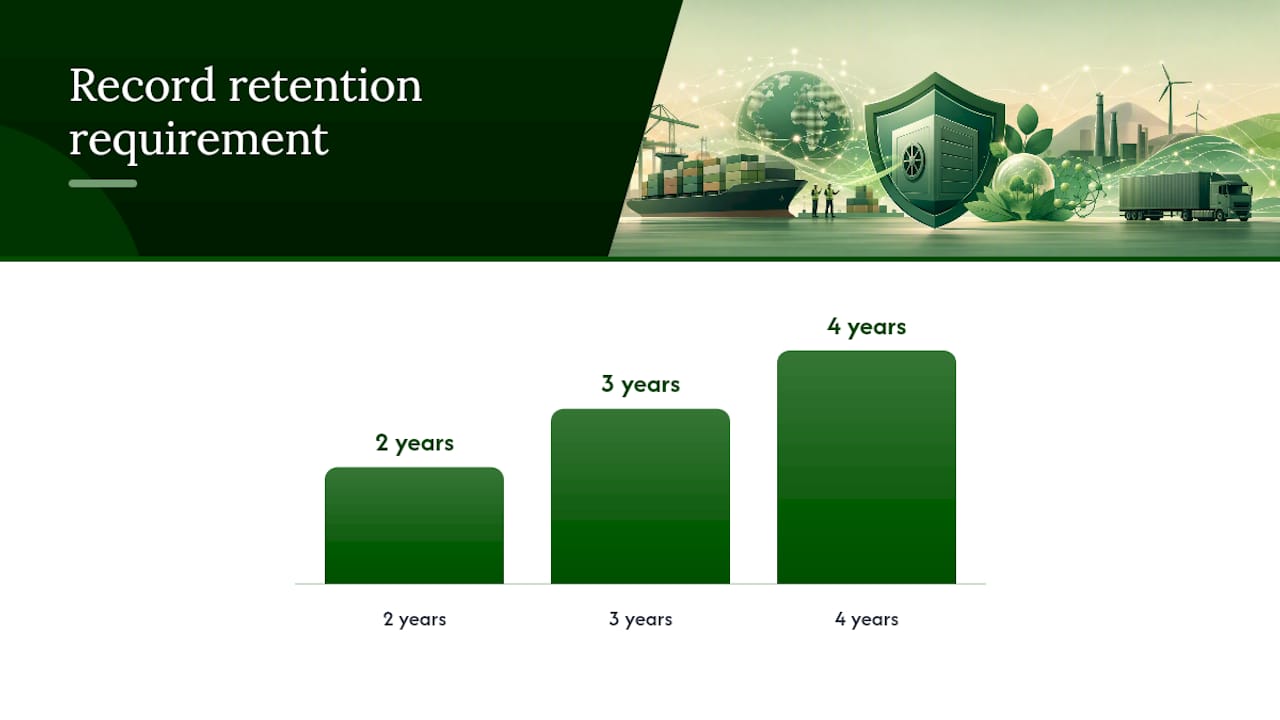
Keep records for four years. Not two, not three. Annex V under Regulation (EU) 2023/956 requires transaction-level detail, meaning per-shipment supplier evidence, not summary totals you reconstruct after the fact.
Before you can surrender against your declared totals, an accredited verifier has to sign off on your emissions figures. This isn’t a rubber stamp. Verifiers check your supporting documentation against the numbers you’ve declared, and gaps here are what push companies toward default values by default, literally, because there’s no verified alternative on file.
Miss your surrender obligation and the penalty is steep: €100 per tonne of CO2 shortfall, and critically, that penalty doesn’t replace your obligation to buy and surrender the missing certificates. You pay the fine and still owe the certificates. Our detailed breakdown of penalty calculations covers how shortfalls compound across reporting periods.
If you miss a quarterly holding check specifically:
- Correct the shortfall in your next purchase cycle as quickly as possible, since repeated misses draw closer regulatory attention.
- Document why the shortfall happened, whether it was a data delay, a supplier gap, or a purchasing timing issue.
- Don’t wait for the annual surrender to fix a quarterly gap. Catching it early costs less than catching it at year end.
Pro Tip: Build your recordkeeping system around CN code and shipment date from day one. Reconstructing four years of transaction-level detail after a verifier flags a gap is far more expensive than logging it correctly the first time.
From Shipment Data to a Filing-Ready Declaration
Every step above, timing, thresholds, authorization, emissions calculation, buying strategy, ultimately has to produce one thing: a declaration you can actually file with the EU CBAM Registry. That’s where the regulatory detail meets an operational workflow.
CarbonOps handles that translation in four steps. You enter each shipment with its HS/CN code, mass, and country of origin. The system matches each line to its CBAM CN code and sector, flagging exactly which imports are in scope. Where supplier-specific emissions data isn’t available, it applies the Commission’s published default values per CN code and country, so every line resolves to a complete figure instead of a gap. The finished declaration exports in the format the Registry expects, with your filing history retained for the audit trail a verifier will eventually want to see.
- No procurement cycle or platform rollout before you can file
- No sensor installation or IoT deployment requirement
- Works whether you’re filing one quarter’s shipments or reconciling several quarters at once
Pro Tip: Even if you’re months from your first surrender, running your 2026 import data through a filing workflow now surfaces which suppliers have usable emissions data and which don’t, giving you a full year to close those gaps instead of discovering them in August 2027.
Why the Timing Mismatch Is the Real Story, Not the Paperwork
Most CBAM coverage treats this as a reporting exercise. Fill out the form, submit the declaration, done. That framing misses what actually trips up importers, which is the gap between when the liability lands on your books and when the cash actually leaves your account.
Conventional compliance advice tells you to focus on getting your emissions numbers right. That’s necessary, but it’s not sufficient. A company with perfect emissions data and no treasury plan for a certificate purchase eighteen months out is still going to get surprised by the bill. The finance side of this deserves at least as much attention as the environmental data side, and right now most guidance skews heavily toward the latter.
If you take one thing from this, prioritize building a quarter-by-quarter exposure model before you perfect your supplier data pipeline. You can refine emissions accuracy over several filing cycles. You can’t retroactively fix a cash-flow crunch that hits because nobody flagged the September 2027 surrender date until August.
— Jake Stevens
Get Your CBAM Filing Done Without the Procurement Cycle
Every strategy in this article, quarterly rolling purchases, supplier data collection, verifier coordination, still ends at the same finish line: a declaration that has to go into the EU CBAM Registry in the exact format it expects. CarbonOps skips the parts that usually slow that down. There’s no platform deployment, no sensor rollout, and no long onboarding process standing between your shipment data and a filed declaration.
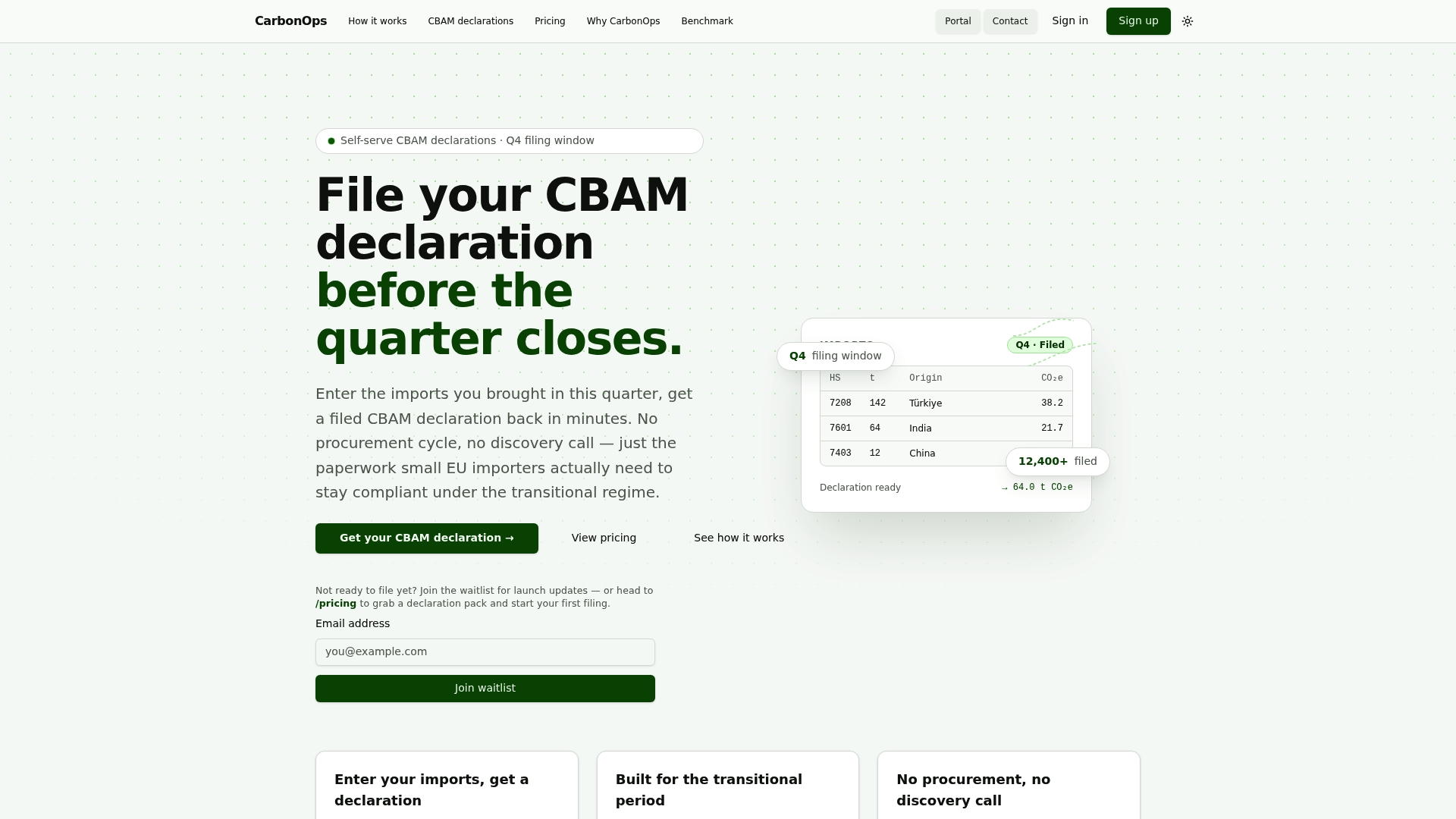
You bring the HS/CN codes, mass, and country of origin for each shipment. CarbonOps matches those lines to CBAM CN codes, applies the Commission’s default values wherever supplier data is missing, and exports a filing-ready declaration with your history retained for the audit trail. Pricing is available per declaration, with options for multiple filings, without subscription commitment. If you’re staring down your first surrender window and need a real number instead of a spreadsheet guess, check current pricing and file your next declaration directly through CarbonOps.
This article is general information, not a substitute for advice from a qualified financial advisor. Consult a qualified financial professional about your own circumstances before acting on anything here.
Sources
- Regulation (EU) 2023/956
- Carbon Border Adjustment Mechanism (CBAM) — European Commission (Taxation and Customs Union)
- The State of CBAM 2026: law, data and impact · CBAM Pulse