CBAM Reporting Timeline for Importers: 2026 Deadlines

CBAM Reporting Timeline for Importers: 2026 Deadlines
The CBAM transitional period ran from October 1, 2023 through December 31, 2025, and the definitive regime took over on January 1, 2026, moving importers from quarterly reporting into a system with real financial stakes: buying and surrendering carbon certificates, holding authorized declarant status, and submitting to third-party verification. Three regulatory anchors matter here: the European Commission’s CBAM overview, Implementing Regulation (EU) 2023/1773 governing the transitional reporting rules, and March 31, 2026, the deadline to apply for authorized declarant status.
If you’re an importer who hasn’t acted yet, three things need to happen now:
- Confirm your registration and authorization status in the CBAM Registry before the March 31, 2026 cutoff.
- Chase down supplier-specific embedded emissions data rather than defaulting to Commission fallback values by default.
- Start modeling certificate costs against EU ETS pricing so a Q3 2027 surrender doesn’t become a budget surprise.
Key Takeaways
The CBAM reporting timeline shifts decisively on January 1, 2026, when reporting-only obligations give way to certificate purchases, mandatory authorization, and third-party verification.
| Point | Details |
|---|---|
| Transitional period closed | Quarterly reporting ran October 2023 through December 2025, with the final report due January 31, 2026. |
| Authorization deadline | Importers had until March 31, 2026 to apply for authorized declarant status and preserve import continuity. |
| First financial deadline | Certificate sales start February 1, 2027; the first annual declaration and surrender is due September 30, 2027. |
| Coverage keeps expanding | Embedded emissions coverage rises annually toward 100% by 2034, increasing certificate costs over time. |
| Tools reduce manual risk | CarbonOps maps CN codes and applies default emissions values to produce a Registry-ready declaration without a platform rollout. |
Where to Verify These Dates Officially
- The European Commission’s CBAM pages cover regulatory updates and general guidance.
- Implementing Regulation (EU) 2023/1773 contains the binding transitional reporting text.
- The CBAM Registry handles authorizations and submissions directly.
Check the Official Journal for the latest implementing acts before finalizing any filing.
Table of Contents
- What Is the Full CBAM Reporting Timeline?
- What Does the Definitive Regime Require Starting in 2026?
- Which Sectors and Emissions Does CBAM Cover?
- How Should Importers Prepare for Each Compliance Phase?
- Frequently Asked Questions
- Sources
What Is the Full CBAM Reporting Timeline?
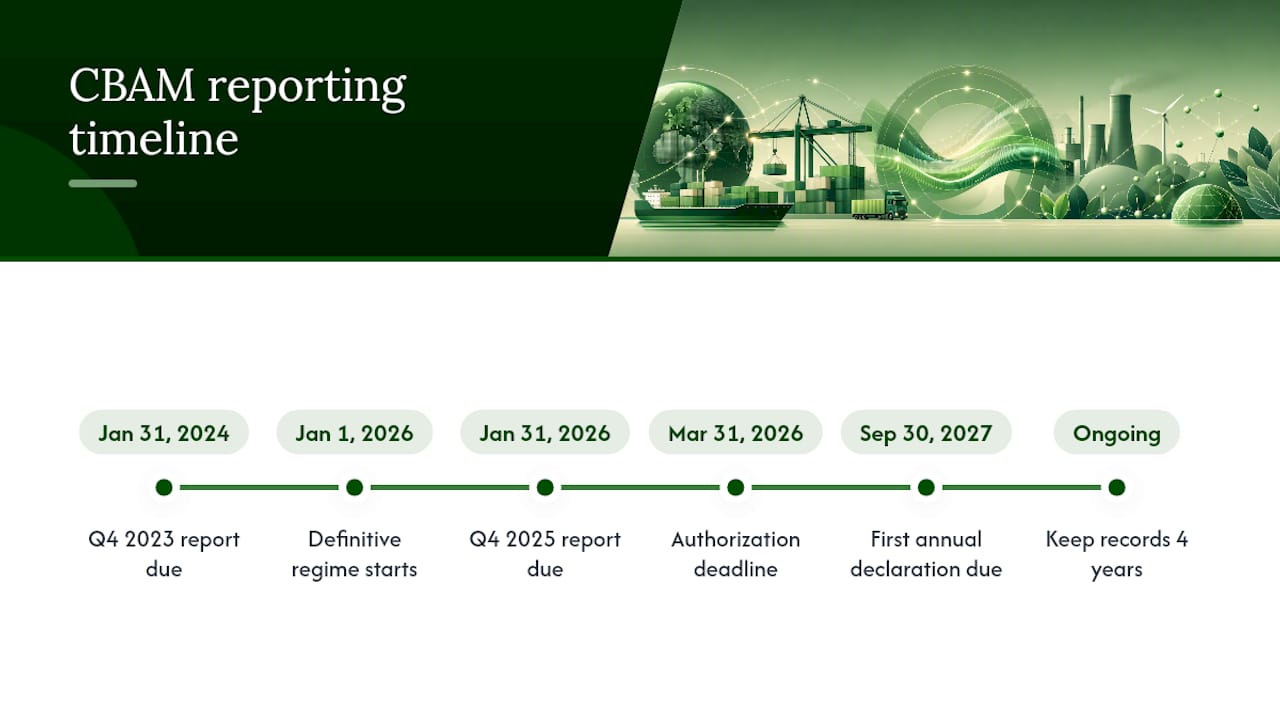
The transitional phase required quarterly reports, each due within one month of the quarter’s end, covering imports of iron and steel, cement, aluminum, fertilizers, electricity, and hydrogen. The first report covered Q4 2023 and was due January 31, 2024. The last transitional report, covering Q4 2025, was due January 31, 2026, closing out more than two years of reporting-only obligations.
That transitional stretch had its own internal shift. Implementing Regulation (EU) 2023/1773 allowed importers to lean on equivalent third-country carbon schemes or estimation methods through the end of 2024. From January 2025 onward, the EU’s own calculation methodology and default values became the primary reference, tightening what counted as an acceptable report.
Definitive regime milestones, at a glance:
| Date | Milestone |
|---|---|
| January 1, 2026 | Definitive regime begins; authorization and certificate obligations take effect |
| March 31, 2026 | Deadline to apply for authorized CBAM declarant status |
| February 1, 2027 | Certificate sales open via the Common Central Platform |
| September 30, 2027 | First annual declaration and certificate surrender, covering 2026 imports |
| October to November 2027 | Buyback and cancellation window for surplus certificates |
The phase-in schedule stretches out even further. Embedded emissions coverage starts at a small fraction of the total in 2026 and climbs toward full coverage by January 1, 2034, meaning your certificate exposure grows every year even if your import volume stays flat.
Pro Tip: Mark March 31, 2026, June 30, and September 30, 2027 on separate calendar reminders, not one. Each deadline touches a different team, authorization for compliance, data collection for procurement, and certificate purchasing for finance, and treating them as one event is how businesses miss the smaller ones.
Regulatory context shifted again in late 2025: the Omnibus simplification package, which entered into force on October 20, 2025, clarified authorization handling and gave some transitional relief right before the definitive regime launched. Worth knowing if you’re cross-referencing older guidance documents that predate the amendment.
What Does the Definitive Regime Require Starting in 2026?
Being an authorized CBAM declarant now comes with an annual rhythm: submit a CBAM declaration, calculate embedded emissions, purchase certificates priced on the weekly EU ETS average, and surrender enough certificates to cover your reported emissions. A quarterly holding rule requires declarants to keep at least 50% of the certificates needed for the prior year’s imports on hand at any given time, a reconciliation mechanism designed to stop last-minute buying sprees.

Authorization itself isn’t instant. You had until March 31, 2026 to file, and the good news is that a valid application submitted by that date lets you keep importing while the competent authority reviews it, even though that review can take up to 120 days. Miss the window entirely, though, and you risk a gap between when you need to import and when you’re legally cleared to do so.
Verification adds a new layer most importers didn’t face during the transitional period. Embedded emissions must now be checked by an accredited third-party verifier, and the first verification period requires a mandatory site visit to the producing installation. That’s a real operational shift: it means your supplier relationships now need to accommodate an outside auditor showing up, not just a data request over email.
The CBAM Registry centralizes authorizations, emissions submissions, and data reconciliation through its DRMC function, letting declarants monitor imports and certificate balances while protecting sensitive third-country operator data from disclosure to competitors.
The CBAM Registry is where all of this happens operationally:
- Authorization applications and status tracking
- Annual emissions submissions and declaration filing
- Certificate balance monitoring against the 50% holding rule
- Correction requests for previously submitted data
Which Sectors and Emissions Does CBAM Cover?
CBAM’s Annex I currently covers six sectors: iron and steel, cement, aluminum, fertilizers, electricity, and hydrogen. Additional sectors have been discussed for future inclusion, but nothing beyond these six is legislated yet.
The phase-in mechanics matter more than the sector list for cost planning:
- Coverage starts at a small percentage of embedded emissions in 2026 and rises annually until it hits 100% by 2034.
- Direct emissions (from the production process itself) were reportable from the start of the transitional period.
- Indirect emissions (from the electricity used in production) became mandatory reporting territory for specific sectors on a delayed schedule, so check your sector’s specific requirement rather than assuming uniform treatment.
Every added percentage point of coverage translates directly into more certificates you’ll need to buy, which is why forecasting shouldn’t stop at your current import volume.
How Should Importers Prepare for Each Compliance Phase?
Right now:
- Confirm registration status in the CBAM Registry and check whether your import volume already crosses relevant thresholds.
- If you haven’t applied for authorized declarant status, do it immediately, don’t wait for the deadline pressure.
- Map every SKU to its CN code and confirm which lines actually fall under CBAM scope.
Before March 31, 2026:
- Submit a complete authorization application even if some supporting data is still incomplete; a valid application preserves your ability to keep importing.
- Begin outreach to suppliers for installation-specific emissions data rather than relying solely on Commission default values.
Through September 30, 2027:
- Arrange third-party verification well ahead of your first annual declaration, including scheduling the required site visit.
- Build a certificate-purchasing process tied to EU ETS pricing trends, starting when sales open February 1, 2027.
Supplier data quality is where most avoidable cost creeps in. Practitioner guidance from KPMG notes that accurate supplier-level emissions figures reduce the risk of over-purchasing certificates against volatile ETS pricing, turning verification into a cost-control measure rather than pure compliance overhead.
Pro Tip: Keep every quarterly report, correction request, and supplier data exchange on file for at least four years. Competent authorities can audit back through your transitional-period filings even after the definitive regime is well underway.
How Does Declaration Software Handle the 2026 Transition?
Picture an importer with forty shipment lines across three CN codes and two supplier countries. Instead of manually cross-referencing each line against CBAM sector rules, a declaration tool ingests the shipment data, matches CN codes automatically, and applies default emissions values wherever supplier figures are missing, producing a declaration ready for Registry-format export.
Look for these features in any tool you evaluate:
- Supplier and shipment data intake with validation
- Automatic CN/HS code matching to CBAM sectors
- Default-value application when supplier data is incomplete
- Audit trail covering every declaration version
- Export formatted for direct CBAM Registry submission
CarbonOps builds its four-step workflow, enter imports, match CN codes, apply emissions, export and file, around exactly this gap, though every declaration should still get a human review before submission regardless of which tool produced it.
A Practical Note From the Editorial Desk
Get supplier-specific emissions data and verification lined up now. Businesses that wait until certificate sales open in 2027 tend to over-purchase out of pure uncertainty, and that’s an avoidable cost. Use the checklist above and the regulatory links below.
A Faster Path Through the 2026 Filing Requirements
Every item on that preparation checklist, mapping CN codes, applying default values, producing a Registry-ready export, is exactly what CarbonOps was built to shorten from weeks of spreadsheet work into a single pass through your import data.
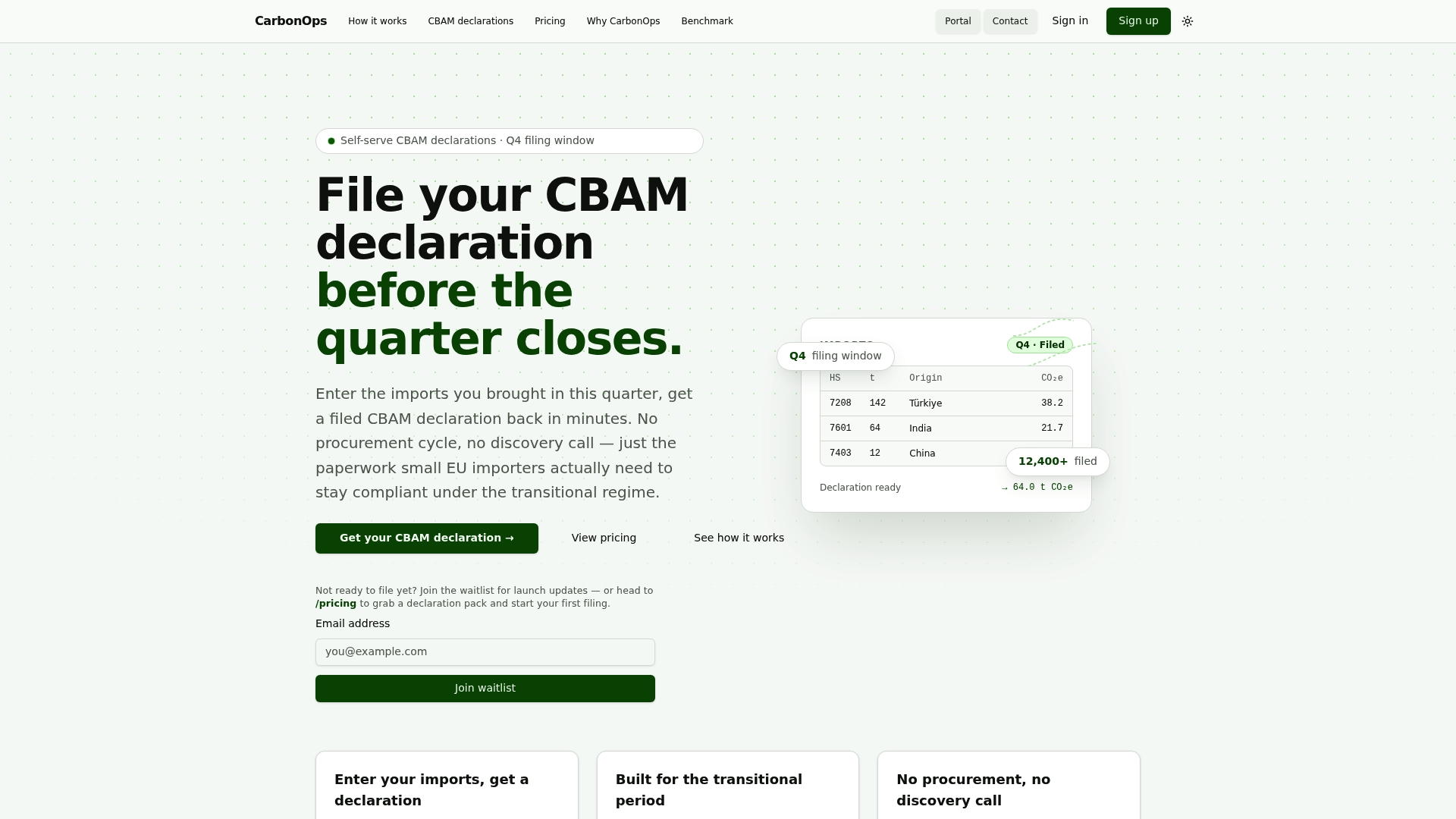
There’s no procurement cycle, no platform rollout, and no subscription commitment: you enter shipment data, the tool matches it to CBAM CN codes and sectors, applies Commission default values where supplier data is missing, and hands back a filing-ready declaration in the format the CBAM Registry expects. That matters most right now, with the first annual declaration due September 30, 2027, and authorization decisions pending for importers who filed by the March deadline. If your team is still tracking shipments in spreadsheets, start a declaration with CarbonOps and see how much of that manual matching disappears.
Frequently Asked Questions
When is CBAM reporting due for the definitive regime? The first annual declaration under the definitive regime is due September 30, 2027, covering emissions embedded in goods imported during 2026.
What was the CBAM reporting schedule during the transitional period? Reports were due quarterly, within one month after each quarter ended, starting with Q4 2023 (due January 31, 2024) and ending with Q4 2025 (due January 31, 2026).
What happens if an importer misses the March 31, 2026 authorization deadline? Importers who filed a valid application by that date could continue importing while the competent authority reviewed it, a process that can take up to 120 days. Importers without a submitted application risk losing the ability to import CBAM-covered goods legally.
Do CBAM certificates apply retroactively to transitional-period imports? No. Certificate purchase and surrender obligations apply only from the definitive regime’s start on January 1, 2026 onward; transitional-period imports required reporting only, with no financial obligation attached.
How long should importers keep CBAM records? Retain quarterly reports, correction requests, and supplier emissions documentation for at least four years, since competent authorities can audit transitional-period filings well after the definitive regime is underway.
Sources
- Carbon Border Adjustment Mechanism (CBAM)
- Implementing Regulation (EU) 2023/1773
- Preparing for EU CBAM: The 2026–2027 Transition Explained | BSI
- Carbon Border Adjustment Mechanism (CBAM) — KPMG