4 Checks EU Importers Must Run on CN 2026 to Avoid CBAM Errors

4 Checks EU Importers Must Run on CN 2026 to Avoid CBAM Errors
The European Commission published the 2026 Combined Nomenclature and it applies from January 1, 2026, issued as an EU Implementing Regulation in the Official Journal. Every business importing into the EU needs to re-verify its product catalog against the new CN codes and the correlation tables, because those eight digits now drive your customs duties, TARIC measures, Intrastat reporting, and CBAM scope.
TL;DR:
- Using correlation tables is the fastest way to identify SKU classification changes compared to manually reading legal texts or relying solely on the annex.
- Misclassification risks arise if HS and CN codes are confused or if outdated codes are used without logging updates, risking errors in duty and emissions reporting.
- Continuous TARIC monitoring is necessary throughout the year, as measures can shift outside the annual CN update cycle, impacting compliance.
- Automating batch processing with tools like CarbonOps can drastically reduce reclassification time and ensure accurate, audit-ready CBAM declarations.
Table of Contents
- What Changed in the CN 2026 Code Updates
- How Is CN Different From the HS Code System?
- Where Do You Check If Your CN Codes Changed?
- Your Compliance Checklist for the 2026 CN Updates
- Turning Updated CN Codes Into a Filing-Ready CBAM Declaration
- What Most Compliance Teams Get Wrong
- Get Your CN 2026 Reclassification Filing-Ready Faster
- Sources
What Changed in the CN 2026 Code Updates
The Commission doesn’t rewrite the Combined Nomenclature from scratch each year. It amends it, and the amendments fall into a few recognizable buckets that determine how much work your team faces.
- New 8-digit subheadings created to track goods that regulators now want visibility into, often in response to trade shifts or new environmental rules.
- Technical corrections that fix wording, units of measure, or classification notes without changing the underlying scope.
- Merges and splits, where two old codes combine into one, or a single code breaks into several more specific ones.
Categories that commonly see churn include chemicals, base metals, electronics, and agricultural products with shifting subheading detail. The full annex, published as an Excel and PDF file, lives on the Commission’s Combined Nomenclature pages, and national trade agencies mirror the same files for easier download.
Two documents matter more than the annex itself for triage purposes:
| Document | What it tells you |
|---|---|
| Self-explanatory text | Plain-language description of what a new or amended code actually covers |
| Correlation table | Direct mapping from every retired code to its 2026 replacement |
Skip the correlation table and you’re manually re-reading legal text for thousands of SKUs. Use it and most lines resolve in seconds.
How Is CN Different From the HS Code System?
The Harmonized System (HS) is the World Customs Organization’s global six-digit standard, and it’s the same everywhere from Rotterdam to Los Angeles. The Combined Nomenclature is the EU’s own eight-digit extension of that same system, built on top of the HS but adding the extra precision Brussels needs for duty rates, supplementary units, and statistical reporting.
That gap between six and eight digits is where compliance risk hides. One HS heading can split into several CN codes, each carrying a different duty rate or CBAM status.
- A shipment classified correctly at HS level can still land on the wrong CN code and trigger the wrong duty rate.
- The wrong CN code can pull a product into or out of CBAM scope entirely.
- Intrastat filings built on outdated CN codes will mismatch customs records at audit time.
Our CN vs HS code breakdown walks through this mapping in more detail if your catalog spans multiple HS families.
Where Do You Check If Your CN Codes Changed?
Four sources cover this, and each does a different job. Skipping one leaves a gap.
- Official Journal / EUR-Lex. This carries the legal text and annexes for the CN 2026 implementing regulation — the definitive source if a classification dispute ever reaches a tribunal.
- TARIC. The EU’s integrated tariff database layers live measures, quotas, and anti-dumping duties on top of the CN. It can change mid-year, so a TARIC reference-date query tied to your shipment date matters more than the annual CN annex alone.
- CLASS. The Commission’s classification lookup tool for confirming rulings and precedent on borderline goods.
- Correlation tables. The fastest way to batch-process a large SKU list against the new code set.
For a single SKU, national customs guidance recommends starting from the HS code, mapping it through the correlation table to the current CN subdivision, then confirming the live duty rate in TARIC. For a full catalog, run the same sequence in bulk: export your SKU list, join it against the correlation table in a spreadsheet, and flag every row where the old and new code differ.
Pro Tip: Keep a dated change log every time a code updates on a SKU. If an auditor questions a duty rate eighteen months from now, “we followed the October correlation table” is a much stronger answer than “we think it was still fine.”
Your Compliance Checklist for the 2026 CN Updates
Not every SKU deserves the same urgency. Triage first, using trade value, CBAM relevance, shipment volume, and regulatory sensitivity as your filters.
- Extract your full SKU list with current CN codes attached.
- Run it against the Commission’s correlation table to flag every changed code.
- Update master data in your ERP and Intrastat templates once codes are confirmed.
- Request updated supplier declarations for any SKU where classification is genuinely ambiguous.
- Log the decision date and source for every reclassification.
Failing to re-verify codes after an annual update risks misidentifying which imports fall inside CBAM scope, which can mean under-reporting or over-reporting embedded emissions on a filing you’ve already submitted. High-value and CBAM-relevant SKUs deserve same-week attention; everything else can follow over the next month. TARIC watch, though, is a year-round habit, not a January task, since measures shift outside the annual CN cycle. For recordkeeping, Eurostat’s ITGS code lists give you a template for structuring the audit trail: dated decisions, supplier declarations, and a snapshot of the correlation table as it existed the day you used it.
Turning Updated CN Codes Into a Filing-Ready CBAM Declaration
CarbonOps built its workflow around exactly this problem: a catalog full of CN codes that need mapping to CBAM scope, fast, without a platform rollout eating your quarter.
The process runs in four steps. You enter each shipment with its CN code, mass, and country of origin. CarbonOps matches each line to its CBAM sector so you see immediately which imports are in scope under the current code set. Where supplier-specific embedded emissions data is missing, the system applies the Commission’s published default values by CN code and country. The declaration then exports in the format the EU CBAM Registry expects.
Because CBAM scope determination depends entirely on accurate CN mapping, that second step is where a reclassification error would otherwise surface, usually too late. You get back:
- A mapped SKU list showing which imports are CBAM in scope under 2026 codes.
- Flagged gaps where emissions data is still missing.
- A registry-ready export with the filing history retained for your audit trail.
Related reading on how CN codes tie to CBAM sectors: CBAM covered products and codes.
What Most Compliance Teams Get Wrong
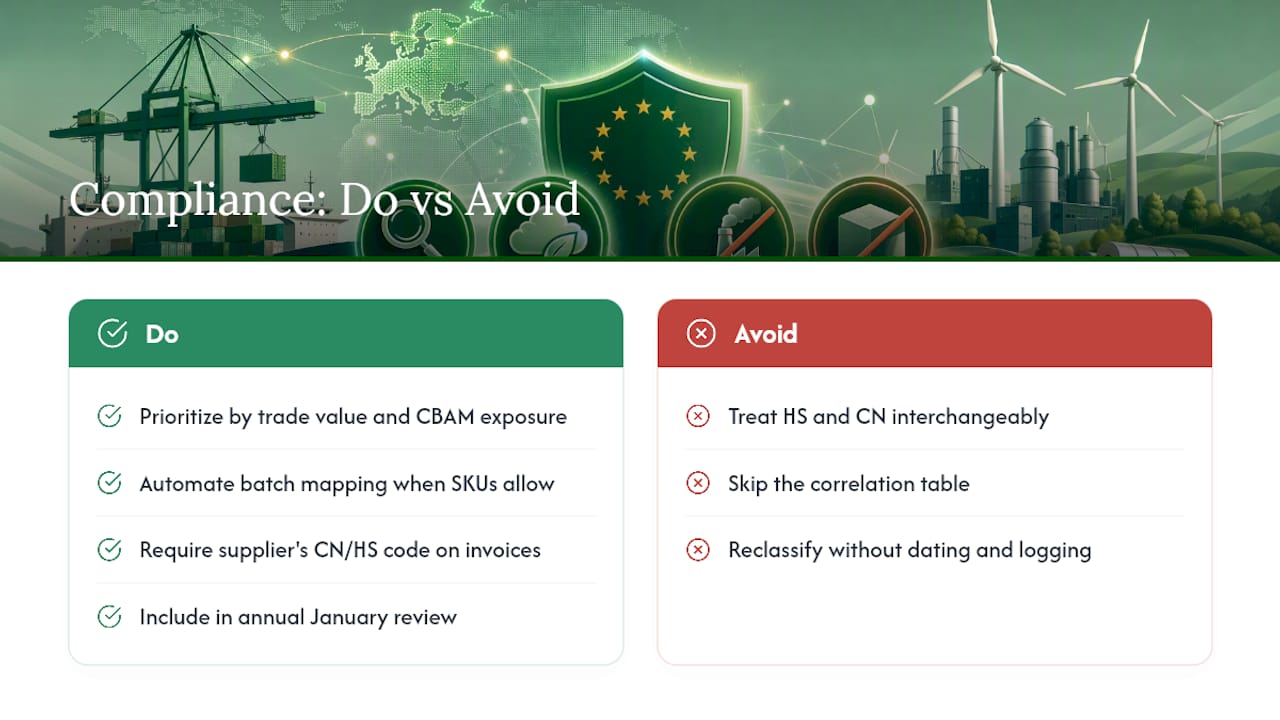
The mistake I see most often is treating HS and CN as interchangeable. They’re not, and that shortcut is exactly how a shipment ends up on the wrong duty rate. Second most common: skipping the correlation table and re-reading legal text line by line, which is slow and invites transcription errors. Third: making a reclassification call without dating and logging it, so nobody can reconstruct the reasoning a year later.
The fix isn’t complicated. Prioritize by trade value and CBAM exposure first, automate the batch mapping wherever your SKU count allows it, and require the supplier’s own code on every invoice so you’re not guessing. Build this into an annual January review and it stops being a fire drill.
— Jake Stevens
Get Your CN 2026 Reclassification Filing-Ready Faster
Manually cross-referencing correlation tables against a full import catalog is slow work, and CarbonOps was built to cut that step down to four screens instead of a spreadsheet marathon. You enter the shipment data you already have, CarbonOps matches each line to its current CBAM CN code, applies the Commission’s default emissions values wherever supplier data is missing, and hands you back a registry-ready export with the audit trail intact.
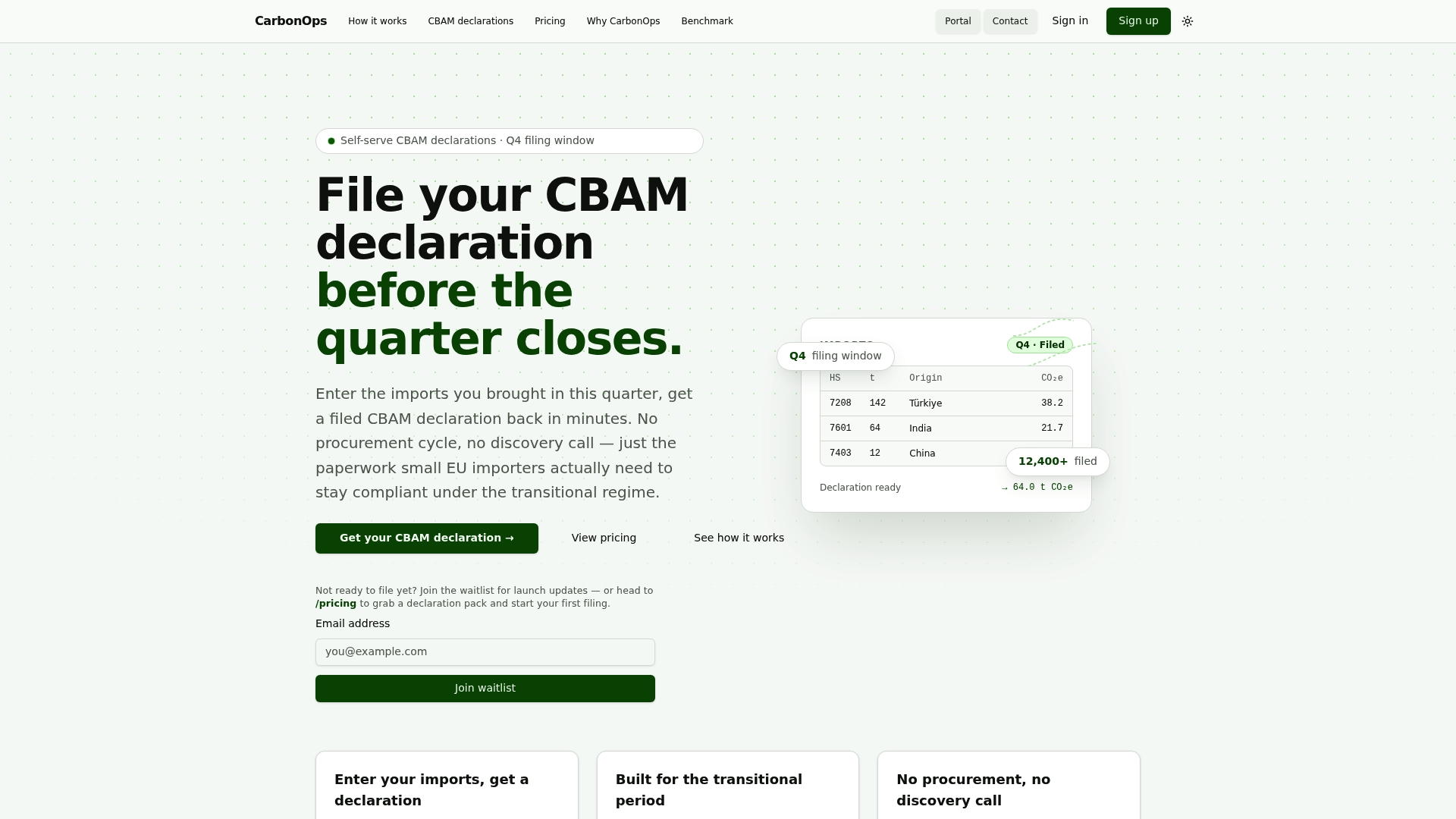
There’s no procurement cycle and no platform to deploy. You pay per declaration, with single or multi-pack options for teams filing across several quarters, detailed on the pricing page. If your catalog just got touched by the 2026 code changes, see how the CarbonOps workflow handles your import batch before your next filing deadline.
Sources
- Commission publishes the 2026 version of the Combined Nomenclature
- EUR-Lex — Implementing Regulation (example)
- The Combined Nomenclature for 2026 is now available - UK Trade Info
- Combined Nomenclature CN — Tulli (Finnish Customs)