EU Importers: Make CBAM Filing History Audit Ready for 2026

EU Importers: Make CBAM Filing History Audit Ready for 2026
Your CBAM filing history is no longer a compliance archive. Under the definitive regime that started January 1, 2026, it’s the raw data the CBAM Registry uses to calculate how many certificates you owe and when you must surrender them. The immediate move: log into your CBAM Registry account, confirm your authorized-declarant status with your National Competent Authority, and pull your Declarant Portal “History” tab to download and back up everything filed so far.
TL;DR:
- From 2026 onward, CBAM filings shift to an annual declaration due by September 30, with verified emissions data becoming crucial for calculating required certificates.
- Accessing your filing history now requires an EU Login with two-factor authentication, registration approval from your National Competent Authority, and careful management of XML and ZIP files.
- Retain all transitional records from 2023 to 2025, including quarterly reports and guidance documents, to support future audits and verify emissions evolution.
- Responsible for more than 50 tonnes of CBAM goods annually, importers must obtain authorized declarant status, linking their EORI, goods, and CN codes to comply with stricter obligations.
- Building an audit-ready filing history involves detailed record-keeping of shipments, default values used, verification reports, and consistent reconciliation between registry data and internal ledgers.
Table of Contents
- What Does CBAM Filing History Mean Under the Definitive Regime?
- How Do You Access Your CBAM Filing Records in the Declarant Portal?
- What Transitional Records From 2023 to 2025 Should You Keep?
- Do You Need Authorized CBAM Declarant Status?
- Why Do Verification Reports and Certificate Timing Matter for Your Records?
- How Do You Build an Audit-Ready CBAM Filing History?
- Why Filing History Deserves the Same Rigor as Financial Records
- Turning Your Import Records Into a Filing-Ready Declaration
- Sources
What Does CBAM Filing History Mean Under the Definitive Regime?
The transitional phase asked for quarterly reports and treated most of it as practice. That ended December 31, 2025. Starting with the 2026 import year, authorized CBAM declarants file one annual declaration by September 30 of the following year, covering every shipment from the prior calendar year. That’s a fundamentally different cadence, and it changes what your filing history has to do.
Under transitional reporting, a quarterly submission during the transitional period demonstrated progress in understanding supply chains and estimating embedded emissions. Under the definitive regime, the same kind of record becomes financial input. The tonnage you declared last year, the CN codes you assigned, the default values you leaned on when supplier data was thin. All of it now flows into how many certificates you need to buy and surrender.
The legal foundation for all of this sits in Regulation (EU) 2023/956, which established CBAM, along with the implementing acts that followed it. Worth bookmarking if you ever need to check a deadline against the primary source rather than a summary.
Here’s what shifted between the two phases:
- Reporting frequency: quarterly (2023 to 2025) became annual (2026 onward).
- Purpose: transitional reports were informational; definitive declarations carry financial weight tied to certificate obligations.
- Deadline structure: one annual filing due September 30, rather than four separate quarterly windows.
- Data expectations: verified emissions data now matters more than estimates, since it determines certificate quantities.
If your 2023 to 2025 quarterly reports were rough around the edges, that’s not necessarily fatal. But any gaps or inconsistencies in that history can surface later when regulators or your own finance team try to reconcile early declarations against current certificate purchases.
How Do You Access Your CBAM Filing Records in the Declarant Portal?
Getting into your filing history starts with account setup, and the process trips up more importers than it should.
You need an EU Login account with two-factor authentication enabled before you can touch the CBAM Registry. From there, access to the Declarant Portal itself runs through the O3CI system, where you submit an access request with your company details, a registration certificate, and proof that you’re authorized to represent the importing business. Your National Competent Authority reviews and approves that request. Without NCA sign-off, you can create an account but you won’t see your filing data.
Once you’re in, here’s how to find and manage your history:
- Log into the Declarant Portal with your EU Login credentials and confirm 2FA is active.
- Navigate to the “History” section, where the portal lists past reports along with report issue dates and submission timestamps.
- Open “My Quarterly Reports” (for transitional-period filings) or the equivalent annual declaration view to see report-level metadata.
- Download the XML file and any ZIP attachments, including verification reports, for each submission you need on record.
- Cross-check the CN codes and import tables shown against your own internal shipment ledger.
The portal’s user manual documents these fields in detail, and it’s worth keeping a PDF copy rather than relying on the live version, since Commission guidance updates periodically.
Pro Tip: Before you re-upload anything, check that your XML file matches the portal’s current XSD schema version. Reusing an old export without updating it against the latest schema is one of the most common reasons submissions get rejected, and the error messages rarely explain why.
What Transitional Records From 2023 to 2025 Should You Keep?
The transitional period ran from October 1, 2023 through December 31, 2025, with the final quarterly reports covering that last window. Those records don’t disappear in relevance just because the reporting cadence changed.
Reconciliation is the reason to hold onto them. If an auditor or your NCA ever wants to see how your embedded emissions estimates evolved, or how a supplier’s default-value reliance changed once verified data became available, your transitional-era reports are the baseline.
A few things worth doing now:
- Download every transitional quarterly report before the Commission’s live portal reorganizes around definitive-regime workflows.
- Save the archived XSD files and guidance documents the Commission maintains, since archived materials may not reflect current rules.
- Keep local copies even if registry access remains stable. Systems get migrated, and portal outages happen.
Organizations that kept clean records through the transitional learning phase are in noticeably better shape for the verified-data demands the definitive regime now imposes.
Do You Need Authorized CBAM Declarant Status?
If you import more than 50 tonnes of CBAM-covered goods in a calendar year, you need authorized CBAM declarant status. That threshold is mass-based and applies across most CBAM sectors, with hydrogen and electricity handled under separate rules rather than the tonnage cutoff.
Getting authorized runs through the same AMM process tied to your Registry access. Your NCA will typically want:
- Proof of your EORI number and its link to the importing entity.
- A registration certificate or equivalent business documentation.
- Confirmation of financial standing, in some jurisdictions.
- Details on the CBAM goods you import and their CN codes.
Authorization isn’t a one-time formality. Once granted, it changes what your filing history is expected to show. You’re now the party responsible for the annual declaration, the certificate surrender that follows it, and for holding up under stricter verification if your reported figures get questioned. Your past filings become the evidence trail regulators will pull first.
Why Do Verification Reports and Certificate Timing Matter for Your Records?
Accredited verifiers are the link between raw emissions data and what actually lands in your declaration. When a verifier signs off on embedded emissions figures, that verified number becomes the basis for your reported tonnage, and by extension, the basis for how many certificates you owe.
Commission guidance indicates certificate sales will begin February 1, 2027, with surrender obligations tied to the embedded emissions declared for the corresponding import year. That’s a tight sequence: your annual declaration determines the quantity, the quantity determines how many certificates you need, and any mismatch between what you filed and what you can actually document becomes an audit finding.
A mismatch between declared and verified figures is the single most common trigger for follow-up review, since it’s the one discrepancy that directly affects certificate math rather than just paperwork accuracy.
A few things that determine your exposure here:
- Whether your embedded emissions figures came from supplier data, EU default values, or a mix, and whether you documented which applied to which shipment.
- How well your CN/HS code mapping holds up against customs records for the same shipments.
- Whether your verification reports are stored alongside the declarations they support, not filed separately where they’re easy to lose.
Preserve the reasoning behind every default value you used, not just the final number. NCAs conducting audits ask for provenance on how a figure was reached, not just the tonnage that ended up in the declaration.
How Do You Build an Audit-Ready CBAM Filing History?
An audit-ready filing history isn’t complicated, but it does require deciding, in advance, what you’re keeping and where.
At minimum, retain: supplier emissions statements in their original form, verification reports tied to each declaration, customs release dates for every shipment, your EORI-to-import mapping, and a written note on why a default value was used wherever supplier data was missing. Losing the “why” behind a default value is more damaging in an audit than the number itself.
Here’s a practical sequence for keeping this manageable:
- Log each shipment with its HS/CN code, mass, and country of origin as soon as customs clears it, rather than batching everything before a filing deadline.
- Map each line to its CBAM CN code and sector, flagging which imports still need supplier-specific emissions data.
- Apply default values only where genuinely necessary, and record the reason inline rather than in a separate note that can get lost.
- Export the completed set in registry-ready format and store it, alongside its supporting documents, before you submit.
- Reconcile quarterly: compare your Registry-stored history against your internal ledger and your certificate balance, rather than waiting until the September 30 deadline to notice a gap.
Pro Tip: Name your local backup files with the import year and submission date up front (e.g., “2026_Q_annual_filed_2026-09-15”), not just “final” or “latest.” A folder full of files named “final_v2” is unreadable eighteen months later when an auditor asks for a specific quarter.
This is essentially the workflow CarbonOps was built around: enter imports with their HS/CN code and mass, match each line to its CBAM CN code automatically, apply the Commission’s published default values where supplier data is missing, and export a completed declaration in registry-ready format, retained alongside your filing history for whenever an audit request comes in.
Why Filing History Deserves the Same Rigor as Financial Records
Most importers still treat CBAM paperwork as a customs task. That’s the wrong mental model now. Filing history determines certificate spend, and certificate spend is a real cost line, which means the record-keeping around it belongs with your finance controls, not buried in a compliance folder nobody reopens until a deadline forces it.
The governance gaps I keep seeing are small and fixable: no single person owns the filing history, no fixed cadence for reconciling registry data against internal ledgers, and no backup strategy beyond “it’s in the portal somewhere.” Assign an owner, set a quarterly reconciliation habit even under annual filing, and back up every submission locally the day it goes in. None of that is sophisticated. It’s the same discipline GRC teams apply to any regulatory obligation with financial teeth, and CBAM has earned that treatment.
Businesses that skip this now won’t feel it until certificate sales open in 2027, at which point a sloppy 2026 filing becomes a much more expensive problem to unwind.
— Jake Stevens
Turning Your Import Records Into a Filing-Ready Declaration
Some service providers exist to bridge the gap between having import records and having a declaration the CBAM Registry will actually accept. These services take your shipment data, supplier statements, and emissions figures, then process them in steps: entering each shipment with its HS/CN code, mass, and origin; matching every line to its CBAM CN code and sector; applying the Commission’s published default values where supplier-specific data is missing; and exporting a completed declaration formatted for the registry.
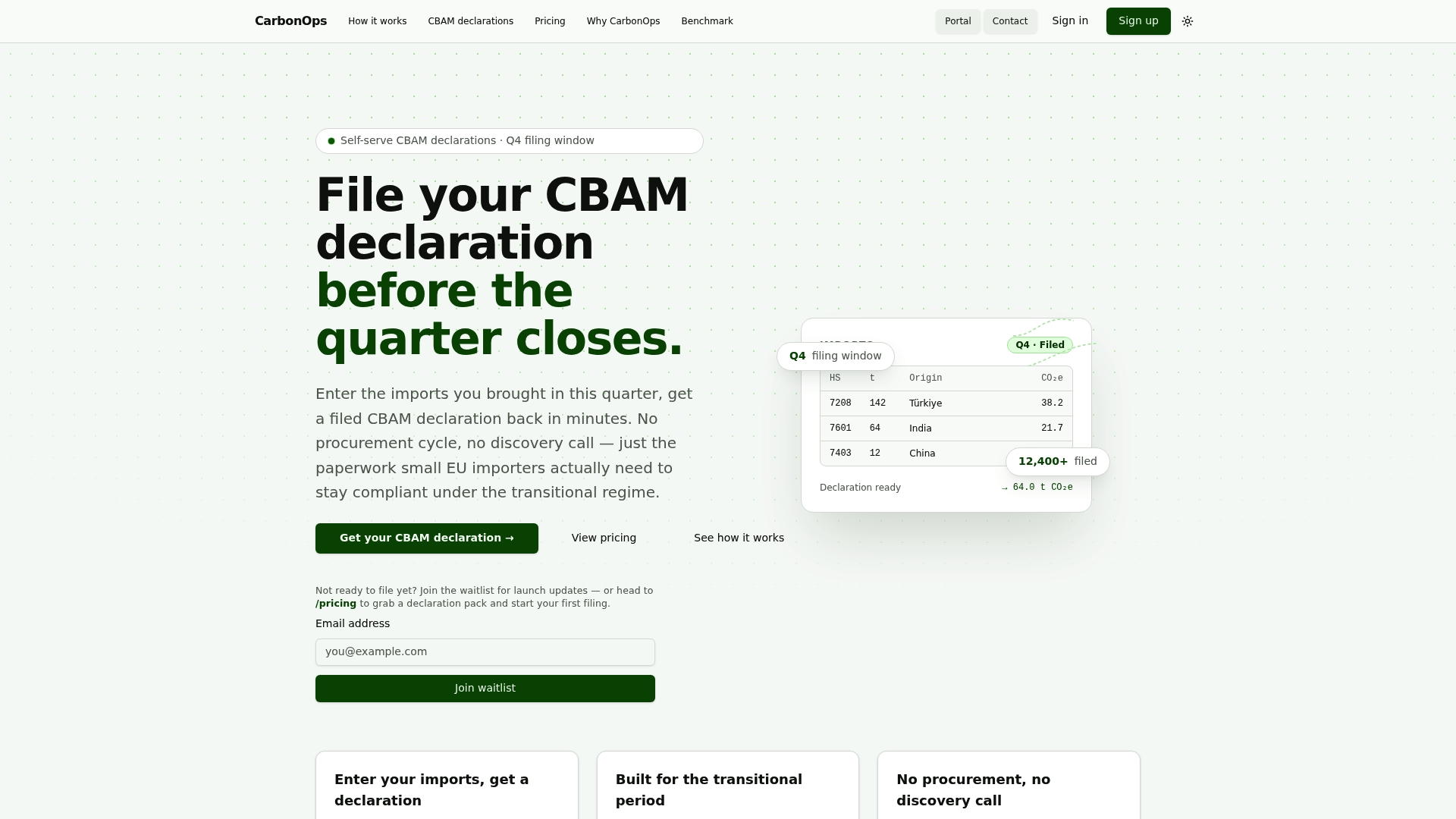
Such workflows build your filing history as a byproduct, not an afterthought. Every default value applied gets tied to the CN code and country it came from, so the provenance an auditor asks for can be documented rather than reconstructed under deadline pressure. Typically, these services operate on a pay-per-declaration basis, with multi-pack options for businesses filing across several import batches a year.
If you’re staring down a September 30 deadline with a spreadsheet full of unmatched CN codes, see how the workflow handles a real batch of imports or check current pricing before you commit staff time to building this by hand.