What to Ask Suppliers for CBAM: The Briefing That Prevents Penalty Costs

What to Ask Suppliers for CBAM: The Briefing That Prevents Penalty Costs
Ask suppliers for verified installation-level embedded emissions in the operator’s emissions report format, or through the CBAM Registry’s O3CI module, so you can calculate exposure accurately and avoid punitive default values. That is the whole job. Everything else in a supplier briefing for CBAM is detail supporting that one request.
Two things need to happen immediately. First, map every CN/HS code on your import lines to its CBAM category so you know which suppliers actually need briefing. Second, send a copy-ready data request that tells each supplier exactly what to submit and how, whether that means uploading directly to O3CI or completing the operator’s emissions report template.
Skip this and you inherit default values calculated from the higher-emissions segment of EU installations in that product category. That gap shows up directly in the number of CBAM certificates you owe.
- Request verified embedded emissions, not estimates or company-wide averages.
- Specify the delivery route: O3CI upload or operator’s emissions report (Annex IV / Article 10).
- Confirm a verifier statement accompanies the data, or flag it as pending verification.
- Build in a deadline buffer, because supplier onboarding rarely moves at your speed.
Key Takeaways
A CBAM-ready supplier briefing succeeds when it requests verified installation-level data through the operator’s emissions report or O3CI, backed by realistic timelines and internal QA.
| Point | Details |
|---|---|
| Lead with the ask | Request verified embedded emissions via the operator’s emissions report or O3CI upload, not estimates. |
| Brief the right people | Include installation operators, precursor suppliers, and traders; assign procurement, compliance, legal, and finance internally. |
| Budget real time | Plan 6 to 10 months for first-time supplier onboarding, data collection, and verification combined. |
| Prioritize by risk | Rank suppliers by import volume, emissions intensity, and verification complexity, not alphabetically. |
| Default values cost money | Defaults use the higher-emissions segment of EU installations, so missing data drives up certificate costs. |
Table of Contents
- Who Needs a Supplier Briefing CBAM Request and Who Owns the Risk
- Exactly What Data to Request From Suppliers
- Building a Supplier Data Template That Suppliers Actually Complete
- Why Suppliers Resist and How O3CI Solves the Confidentiality Problem
- How Long Supplier Onboarding, Data Collection, and Verification Actually Take
- What Missing Supplier Data Actually Costs You
- Getting Suppliers Ready for an Accredited Verifier
- A Copy-Ready Checklist for Your Next Supplier Request
- From Supplier Response to Filed Declaration With CarbonOps
- Primary EU and Official Guidance to Consult
- Where Most Supplier Briefings Go Wrong
- Sources
Who Needs a Supplier Briefing CBAM Request and Who Owns the Risk
A supplier briefing for CBAM has to reach three types of external parties: non-EU installation operators (the actual manufacturers), suppliers of CBAM goods and precursor materials, and any trader reselling into the EU on your behalf. Miss the precursor suppliers and you’ll find gaps in your emissions calculation months later, usually right before a filing deadline.
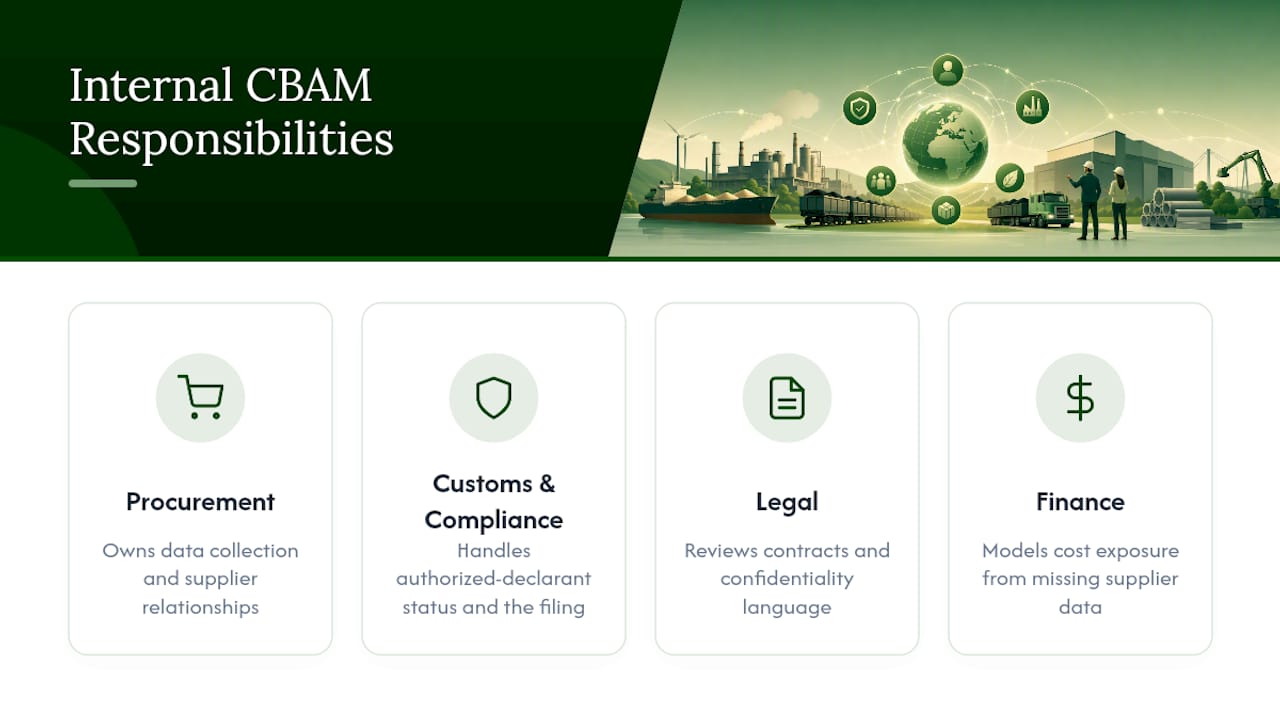
Internally, four teams need a seat at the table. Procurement owns the actual data collection and supplier relationship. Customs and compliance handle authorized declarant status and the filing itself. Legal reviews contracts and confidentiality language, since suppliers routinely balk at sharing production data. Finance models the cost exposure so leadership understands what a missing data field actually costs in certificates.
Here’s the part that catches people off guard: as the importer, you remain fully responsible for declaration accuracy even when a supplier hands you flawed or incomplete numbers. Legal analysis of CBAM reporting obligations confirms this liability sits with you, not the supplier, which means an internal QA step checking supplier submissions against the monitoring plan isn’t optional.
Exactly What Data to Request From Suppliers
A vague request produces vague answers. Structure the ask around five categories, each mapped to what the operator’s emissions report template actually requires.
- Identification fields: installation name, operator ID, physical location, product CN/HS codes, and the specific production process used at that site.
- Activity and allocation data: production volumes by product line, the allocation method used when one installation produces multiple outputs, and the functional unit applied (per tonne, per unit, etc.).
- Emissions data: direct emissions broken out by fuel type and quantity consumed, indirect emissions from purchased electricity (kWh plus the grid emission factor used), and any other relevant GHG sources with their emission factors.
- Documentation and traceability: the calculation steps behind the numbers, primary records like meter logs and fuel invoices, a stated measurement uncertainty, a reference to the monitoring plan, and verifier contact details.
- File and format conventions: metric units throughout, a clearly stated reporting period, English language for the report itself (per Commission guidance for non-EU operators), and a preferred file type of XLSX, CSV, or PDF.
| Field Category | What to Request | Why It Matters |
|---|---|---|
| Identification | Installation ID, location, CN/HS codes | Confirms the data matches your import line |
| Activity levels | Volumes, allocation rules, functional unit | Converts raw emissions into per-unit figures |
| Direct emissions | Fuel type, quantity, emission factor | Core input for embedded emissions calculation |
| Indirect emissions | Electricity kWh, grid factor | Required for electricity-intensive processes |
| Evidence trail | Meter logs, invoices, monitoring plan ref | What a verifier will check first |
Pro Tip: Send a filled-in example row alongside your blank template. Suppliers unfamiliar with CBAM terminology will mirror your example far more accurately than they’ll interpret a column header alone.
Building a Supplier Data Template That Suppliers Actually Complete
Structure the request so the supplier does less thinking, not more. An email or portal message should open with a one-line subject stating the deadline, followed by a short summary of what’s needed, the deliverables list, a confidentiality note, and a single point of contact for questions.
Order your template fields in the same sequence as the operator’s emissions report template itself. When a supplier can complete your form and their regulatory report side by side, the number of back-and-forth clarification emails drops sharply.
- State preferred units up front (metric only, no exceptions).
- Confirm the CN/HS codes you’re requesting data against, rather than asking the supplier to guess.
- Specify a file naming convention if you’re managing more than a handful of suppliers.
- Ask explicitly whether the supplier will upload to O3CI or send the report directly to you.
For suppliers who can’t deliver a complete package immediately, accept a provisional submission: meter logs plus a plain-language summary, with assumptions documented in writing. That paper trail matters later when a verifier asks how you arrived at an interim figure.
Pro Tip: Never accept “we don’t track that” as a final answer on direct emissions data. Ask instead what the supplier’s fuel invoices show for the reporting period. Most installations have the raw records; they just haven’t organized them into a monitoring-plan format yet.
Why Suppliers Resist and How O3CI Solves the Confidentiality Problem
Most supplier pushback on CBAM data requests isn’t about the effort. It’s about handing a competitor’s customer detailed production data. The CBAM Registry’s O3CI module exists specifically to solve that: operators upload their full emissions report once, and authorized declarants see a controlled summary rather than the raw underlying detail.

That single-upload structure also means a supplier serving multiple EU importers doesn’t have to rebuild the same submission five different ways in five different spreadsheets.
When you brief a supplier, say this plainly: registering in O3CI lets them retain full data ownership while sharing only what’s necessary with you as the declarant. For suppliers still hesitant, a few fallback routes work:
- Route the transfer through their accredited verifier instead of directly to you.
- Offer a secure portal upload rather than email attachments.
- Add a non-disclosure addendum to the existing supply contract covering emissions data specifically.
- Accept an aggregated summary initially, with a written commitment to pursue full verification before the filing deadline.
How Long Supplier Onboarding, Data Collection, and Verification Actually Take
Plan backward from your filing deadline, not forward from today. First-time supplier onboarding typically runs 2 to 4 weeks just to establish contact, explain the request, and confirm who on the supplier side owns the response.
Data collection itself takes longer than most teams budget: 4 to 8 weeks is typical, especially where the supplier has to pull historical meter data or coordinate across multiple production lines. Verification adds another 4 to 8 weeks on top of that, driven largely by verifier scheduling constraints and the possibility of a site visit.
- Add those stages together and a first-time supplier relationship needs 6 to 10 months minimum from initial outreach to a verified figure in hand.
- Map that timeline against your quarterly reporting cadence. Data collected in one quarter feeds the calculations behind your annual declaration, so a supplier who misses the window pushes your entire filing to defaults for that period.
- Prioritize ruthlessly: rank suppliers by import volume first, emissions intensity risk second, and verification complexity third. A high-volume supplier in a carbon-intensive sector deserves attention months before a low-volume precursor supplier does.
What Missing Supplier Data Actually Costs You
Default values aren’t a neutral placeholder. They’re deliberately set using the average emissions intensity of the higher-emissions segment of EU installations in each product category, which means an efficient overseas producer can end up paying certificates calculated against a far dirtier benchmark.
That gap between verified and default figures translates directly into certificate costs, and it scales with import volume. A supplier you never briefed properly doesn’t just cost you paperwork. It costs you money, quarter after quarter, until someone fixes the data.
- Request data in stages rather than all at once, starting with your highest-volume suppliers.
- Apply conservative interim allocations when full data isn’t ready, and document the assumption in writing.
- Fast-track verification scheduling for suppliers whose product category carries the steepest default-to-verified gap.
- Treat every default-value line as a flag for next quarter’s priority list, not a permanent fixture.
Getting Suppliers Ready for an Accredited Verifier
A supplier who can produce numbers isn’t automatically ready for verification. Verifiers, recognized under ISO 14065 accreditation standards, need a reasonable-assurance level of confidence, and that requires documentation, not just totals.
The monitoring plan should read like a recipe book: calculation steps, data sources, sampling methods, quality assurance procedures, and version control, written clearly enough that a technically literate outsider could reproduce the numbers independently. Guidance for non-EU operators is explicit that even where the operational version lives in a local language, an English summary needs to exist for the verifier.
- Primary evidence: meter logs, fuel invoices, calibration and maintenance records.
- Allocation documentation: how emissions get split when one installation runs multiple product lines.
- A verifier report referencing the specific reporting period under review.
Pro Tip: Ask suppliers to version-date their monitoring plan documents. A verifier who can see the plan evolved between reporting periods, with a clear change log, moves through a desk audit far faster than one facing an undated document that might be six months or six years old.
A Copy-Ready Checklist for Your Next Supplier Request
Paste this structure directly into an email or portal message when you’re ready to send the actual request.
- Installation details: name, operator ID, physical location.
- Reporting period covered by the submission.
- CN/HS code mapping confirming which product lines the data applies to.
- Production volumes for the period, by product.
- Emissions data: fuel consumption by type, plus electricity kWh and grid factor.
- Allocation method used across multiple outputs, if applicable.
- Monitoring plan reference and version.
- Verifier name and contact, or a note that verification is pending.
- Preferred file format (XLSX, CSV, or PDF) and a firm deadline.
If a supplier misses the deadline, escalate in writing within a week rather than letting silence drift into a missed quarter. A short paragraph combining items 1 through 6 into a single request paragraph, with the deadline stated twice (subject line and body), tends to get the fastest response from procurement contacts unfamiliar with CBAM terminology.
From Supplier Response to Filed Declaration With CarbonOps
Once supplier data starts coming in, someone still has to turn it into a declaration the CBAM Registry will accept. CarbonOps handles that conversion in four steps: enter each import with its HS/CN code, mass, and country of origin; match each line to its CBAM category automatically; apply embedded emissions using whatever supplier data you’ve collected; and export a completed declaration.
Where a supplier hasn’t delivered verified numbers by your filing deadline, CarbonOps fills the gap with the Commission’s published default values for that specific CN code and country, so no line sits incomplete.
- No procurement cycle or platform deployment required to start.
- Every declaration exports in the format the EU CBAM Registry expects, ready for review.
- Audit trail and filing history retained for verifier reference later.
Primary EU and Official Guidance to Consult
For direct reference, consult the CBAM Registry for O3CI access, the quick guide for non-EU operators for template and monitoring plan details, and the full CBAM Guidance document for verification requirements. The CBAM legislation and guidance hub centralizes legal texts and implementing acts.
Where Most Supplier Briefings Go Wrong
Most guidance on CBAM supplier engagement treats it as a legal compliance exercise: send the request, wait for a response, file what arrives. That framing misses the actual bottleneck, which is operational, not legal. Suppliers aren’t refusing to comply out of defiance. They’re often organizationally unequipped to translate their own production records into the format a European regulation demands, and nobody has explained O3CI to them in language that addresses their actual worry, which is competitive exposure, not paperwork.
The conventional advice to “request data early” is true but useless without specifics. Early by how much? Requesting data 6 to 10 months before a filing deadline, mapped field by field to the operator’s emissions report template, beats a vague early nudge every time.
If there’s one priority to fix first, it’s this: stop treating every supplier the same. A high-volume supplier in a carbon-intensive category deserves a phone call and a dedicated timeline, not the same templated email you send to a marginal precursor supplier. Default values punish inattention proportionally to volume, so your attention should scale the same way.
— Jake Stevens
Sources
- CBAM Registry - Taxation and Customs Union - European Commission
- The penalty gap between verified and default CBAM values (CarbonSig)