Steel Products Under CBAM: A Guide for Importers
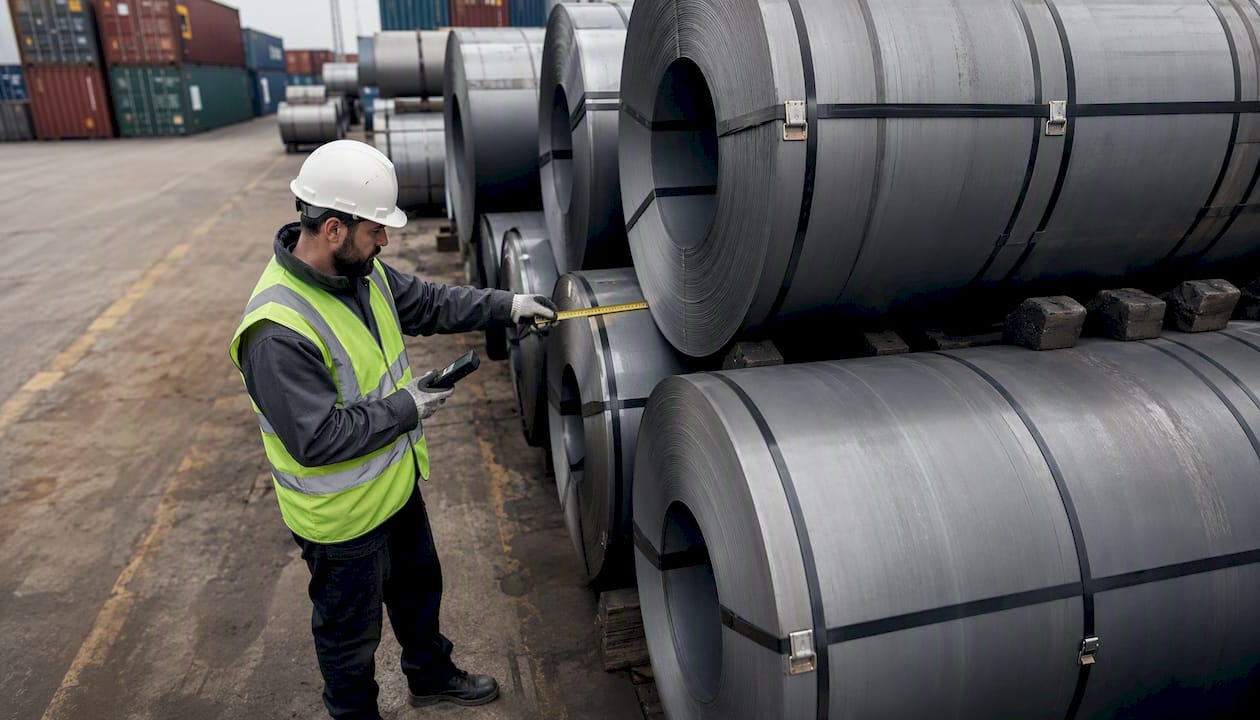
Steel Products Under CBAM: A Guide for Importers
Yes, most iron and steel goods listed in Chapters 72 and 73 of the Combined Nomenclature are in scope of EU CBAM. That single fact triggers a chain of obligations: confirm the 8-digit CN code for each import line, record net mass, classify the production route, and begin requesting supplier emissions data or monitoring-plan references before your first annual declaration is due.
Your three immediate actions:
- Confirm CN code at the 8-digit level. CBAM coverage is determined by the exact sub-heading in Annex I, not the 4-digit heading alone.
- Record net mass and country of origin per shipment. Both are required data fields in the CBAM Registry declaration.
- Flag production route. Whether your supplier uses blast furnace/basic oxygen furnace (BF-BOF), direct reduced iron/electric arc furnace (DRI-EAF), or scrap-EAF changes your certificate cost by an order of magnitude.
Priority check: If your total annual imports of covered steel goods fall below 50 tonnes, you may qualify for the de minimis exemption. Verify this before investing in a full verification workflow.
Key Takeaways
Steel products under CBAM span Chapters 72 and 73 of the Combined Nomenclature, with production route determining certificate cost more than any other single variable.
| Point | Details |
|---|---|
| Scope: Chapters 72 and 73 | Most iron and steel CN codes are covered; verify each import line at the 8-digit sub-heading level against Annex I. |
| Three production-route benchmarks | BF-BOF, DRI-EAF, and Scrap-EAF drive certificate cost by a factor of nearly 19. |
| 50-tonne de minimis | Annual imports below 50 tonnes of covered steel goods may qualify for exemption; verify before building a full verification workflow. |
| First declaration due September 30, 2027 | Covering 2026 imports; verifier registration opens September 1, 2026 and certificate sales open February 1, 2027. |
| CarbonOps for filing | CarbonOps maps shipments to CN codes, applies default values where supplier data is missing, and exports a registry-ready declaration with audit trail. |
Table of Contents
- Which steel products fall under EU CBAM?
- What is excluded today, and where is scope heading?
- How does CBAM change costs and obligations for importers?
- How does a product carbon footprint differ from CBAM embedded emissions?
- How to convert import lines into a filing-ready declaration
- How do you verify CN codes and avoid classification errors?
- Your 30/60/90-day CBAM readiness checklist
- How are semi-finished steel products and alloys treated under CBAM?
- What are the penalties for CBAM non-compliance?
- How does CBAM interact with the EU ETS for steel producers?
- Key compliance dates for steel importers and manufacturers
- CarbonOps turns your steel shipment data into a filed declaration
- Sources
Which steel products fall under EU CBAM?
Steel products under CBAM are drawn from two Combined Nomenclature chapters: Chapter 72 (iron and steel) and Chapter 73 (articles of iron or steel), spanning more than 50 CN code positions at the 8-digit level. The regulation covers both primary and semi-finished forms as well as a range of finished steel articles.
The table below maps the principal CN headings to product groups and their typical CBAM status.
| CN Heading | Product Description | CBAM Status |
|---|---|---|
| — | Pig iron and spiegeleisen | Covered |
| 7206 | Iron and non-alloy steel in ingots | Covered |
| 7207 | Semi-finished products, non-alloy steel | Covered |
| 7208–7210 | Flat-rolled products, non-alloy steel (HR coil, CR strip, coated) | Covered |
| 7214–7216 | Bars, rods, wire of non-alloy steel | Covered |
| 7218–7229 | Stainless and alloy steel (semis, flat-rolled, bars, wire) | Covered |
| 7301–7310 | Steel tubes, pipes, hollow profiles, fittings | Covered (selected sub-headings) |
| 7318 | Screws, bolts, nuts, and similar fasteners | Covered (selected sub-headings) |
| 7326 | Other articles of iron or steel | Covered (selected sub-headings) |
| 7204 | Ferrous waste and scrap | Excluded |
| 7312–7317 | Stranded wire, barbed wire, cloth, chain, nails | Excluded |
| 7319–7325 | Needles, pins, springs, anchors, and similar | Excluded |
A common misclassification: hot-rolled coil (7208) and cold-rolled strip (7209) look similar on a commercial invoice but carry different sub-headings and sometimes different default emission values. Coated products (7210) are downstream of hot-rolled coil in the production chain, so an importer buying coated sheet is buying embedded emissions from the entire upstream process. That precursor relationship is exactly why CBAM captures these forms rather than waiting for the finished article.
What is excluded today, and where is scope heading?
The most significant exclusion is heading 7204 (ferrous waste and scrap). Scrap is a raw material input, not a manufactured steel product, and its exclusion is deliberate: CBAM targets the carbon embedded in production, not the recycled feedstock itself.
Beyond scrap, several Chapter 73 sub-headings are currently out of scope:
- 7312–7317: Stranded wire, barbed wire, fencing, cloth, grating, chain, and nails.
- 7319–7325: Needles, sewing pins, safety pins, springs, stove parts, sanitary ware, and anchors.
- Partial coverage applies to headings 7202 (ferro-alloys), 7301 (sheet piling and welded angles), 7318 (fasteners), and 7326 (other steel articles), where only specific 8-digit sub-headings are listed in Annex I.
On the regulatory horizon, the European Commission has been examining whether to extend CBAM to downstream steel-intensive goods: auto components, household appliances, and complex fabricated assemblies. No formal legislative proposal has been adopted as of mid-2026, but the Commission’s review work is ongoing. For importers, the practical implication is straightforward: build the data infrastructure now for what is already in scope, and design it to accommodate additional CN codes without a full rebuild. The finalized benchmarks and default values signal that the Commission is moving toward full implementation, not scaling back.
How does CBAM change costs and obligations for importers?
The financial exposure from CBAM steel imports is driven by one formula: embedded emissions (tCO₂e per tonne of steel) multiplied by the CBAM certificate price, which tracks the EU ETS allowance price. Production route is the single largest variable.
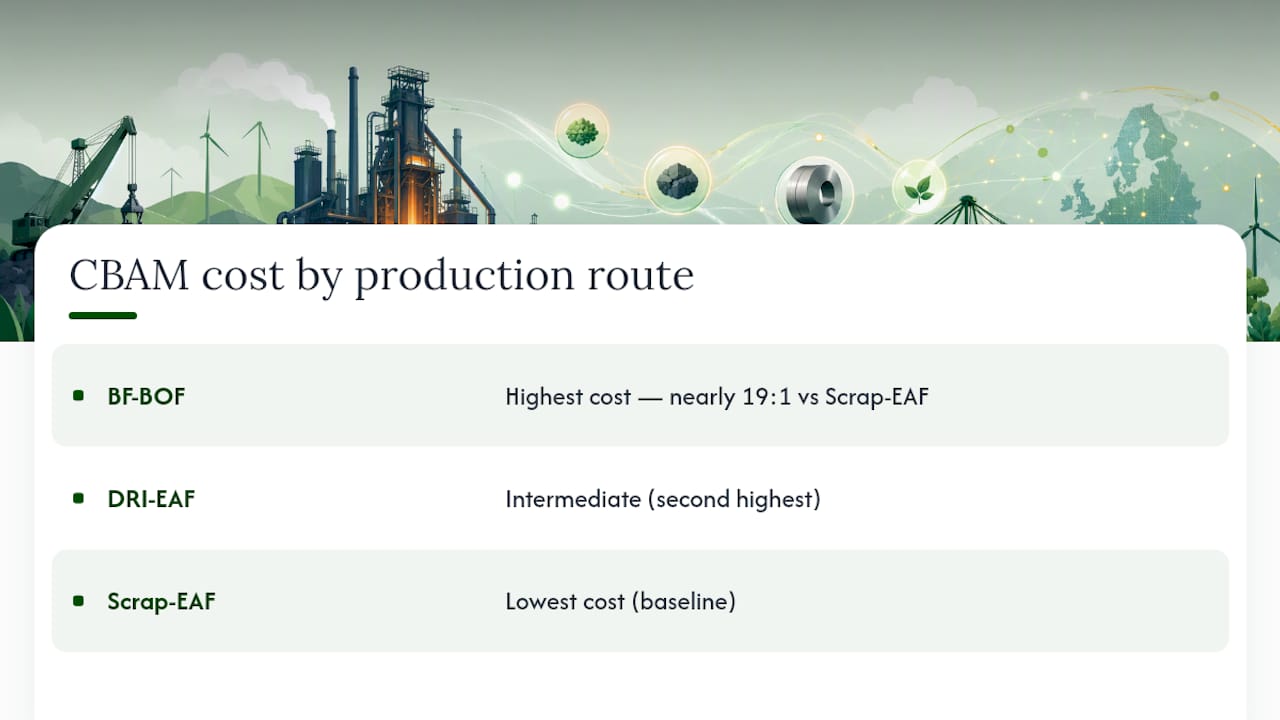
At an illustrative EU ETS price, the three official benchmarks produce dramatically different gross costs according to production route, with BF-BOF generating the highest cost, followed by DRI-EAF, and Scrap-EAF the lowest.
These are gross figures before applying the CBAM factor (the fraction of full ETS cost that applies in a given year) and before any credit for carbon prices already paid in the country of export. The spread between BF-BOF and Scrap-EAF is nearly 19:1, which means production-route classification is not a paperwork formality.
Registration and authorization are mandatory for any EU importer above the 50-tonne annual de minimis threshold. Importers must register as authorized declarants in the CBAM Registry before importing covered goods. The first annual declaration covering 2026 imports is due September 30, 2027, with certificate sales opening February 1, 2027 and verifier registration opening September 1, 2026.
Obligations checklist: register as authorized declarant; collect CN code, net mass, country of origin, and production-route classification per shipment; obtain verifier reports for actual emissions; purchase CBAM certificates; surrender certificates by the annual deadline; retain records for five years.
How does a product carbon footprint differ from CBAM embedded emissions?
These two concepts are often conflated, and the confusion costs importers time and money.
A product carbon footprint (PCF) typically covers the full lifecycle of a product: raw material extraction, manufacturing, transport, use, and end-of-life. It follows standards like ISO 14067 or the GHG Protocol Product Standard and is used for sustainability reporting, eco-labeling, and supply chain disclosure.
CBAM embedded emissions are narrower and legally defined. They cover direct process emissions from the production installation (Scope 1) and, for certain goods including steel, indirect emissions from electricity consumption (Scope 2), calculated per the rules in Annex II and Annex IV of the CBAM Regulation. A PCF figure from a supplier’s sustainability report will not satisfy CBAM requirements unless it was calculated under the specific methodology the regulation requires.
The practical decision for importers comes down to whether to use supplier-specific verified actuals or the Commission’s published default values.
| Factor | Supplier Verified Actuals | Commission Default Values |
|---|---|---|
| Data source | Supplier monitoring plan + verifier report | Commission implementing regulation |
| Verification required | Yes, EN ISO/IEC 14065 accredited verifier | No |
| Cost to obtain | Verifier fees + supplier cooperation | None |
| Financial outcome (EAF/DRI) | Likely lower liability | May be higher than actuals |
| Financial outcome (BF-BOF, high-carbon origins) | Depends on installation | Often lower than defaults for some origins |
| Transitional mark-up | Not applicable | the CBAM factor increases over time |
The mark-up structure on default values is significant. The Commission’s default value framework includes annual escalators specifically designed to make defaults progressively more expensive, pushing importers toward verified supplier data. For steel from high-carbon origins such as China, India, or Indonesia, defaults have been set substantially above earlier draft figures, which makes the cost of not obtaining verified actuals material from year one.
The decision rule: if your supplier uses EAF or DRI-EAF and can provide a monitoring plan, pursue verified actuals. If your supplier uses BF-BOF and is in a country with a functioning carbon pricing scheme, check whether the default or the actual is lower before committing to verification costs.
How to convert import lines into a filing-ready declaration
This is the operational sequence that takes you from a stack of commercial invoices to a submitted CBAM declaration.
- Register as an authorized declarant in the CBAM Registry before importing covered goods. Authorization is a prerequisite, not a post-import formality.
- Map each shipment to its 8-digit CN code. Pull the CN code from the customs declaration and cross-check it against the Annex I list. Flag any partially covered headings for sub-heading verification.
- Record net mass and country of origin per line item. These fields are mandatory in the declaration and must match the customs entry.
- Classify the production route for each supplier installation. BF-BOF, DRI-EAF, and Scrap-EAF each carry different default values and different verification requirements.
- Request supplier monitoring-plan references. The monitoring plan reference is a required element of the verifier report. Collect it now, not after the verifier asks for it.
- Decide: default values or verified actuals. Apply the decision rule from the previous section. For installations where actuals are worth pursuing, initiate verifier outreach immediately.
- Engage an EN ISO/IEC 14065 accredited verifier. For 2026 import data, a physical site visit to the non-EU installation is required. Verifier schedules fill quickly; booking in Q3 2026 for a Q1 2027 site visit is not early.
- Calculate embedded emissions and certificate needs. Multiply net mass by the applicable emission factor (actual or default), then apply the CBAM factor and subtract any carbon price paid in the country of export.
- Export the declaration in CBAM Registry format and retain all supporting documentation: invoices, transport documents, supplier monitoring-plan references, and verifier reports.
Documentation to retain for the audit trail: customs import declarations, commercial invoices, supplier monitoring-plan references, verifier accreditation certificates, verifier reports, and the final submitted declaration with certificate surrender confirmation.
Pro Tip: Schedule verifier site visits before you finalize your supplier list for the year. Changing suppliers after a verifier has already scoped a site visit means rebooking and potentially missing the declaration window.
How do you verify CN codes and avoid classification errors?
CBAM coverage is determined at the 8-digit CN sub-heading level, not the 4-digit heading. This distinction catches importers off guard more often than any other classification issue. Heading 7318 (screws and bolts) is a good example: some sub-headings are in Annex I, others are not. Checking only “7318” and assuming full coverage is wrong.
The two resources to use:
- EU Annex I (CBAM Regulation): The definitive list of covered CN codes. Verify each 8-digit sub-heading against this list, not a secondary summary.
- EU Customs Tariff (TARIC): The Commission’s online tariff database allows you to look up the full 8-digit CN code with its description, which helps resolve ambiguous product descriptions on commercial invoices.
Common misclassification scenarios for steel importers:
- Bundled goods: A shipment containing both covered and non-covered steel articles must be split by CN code. Declaring the whole shipment under the covered heading overstates liability; declaring it under the non-covered heading creates an unreported obligation.
- Multi-material articles: A steel assembly with significant non-steel components may fall outside Chapters 72–73 entirely, depending on the essential character rule applied at customs.
- Assemblies vs. components: A steel bracket imported as part of a larger assembly may be classified differently than the same bracket imported separately.
For customs teams: maintain a CN check log per shipment that records the 8-digit code, the Annex I verification result, and the customs classification reference. That log is your first line of defense in an audit.
Your 30/60/90-day CBAM readiness checklist
30 days
- Pull the Annex I CN code list and cross-check every steel import line from the past 12 months.
- Tally annual net mass by CN code and check against the 50-tonne de minimis threshold.
- Send initial supplier questionnaires requesting production-route classification and monitoring-plan references.
- Confirm registration status in the CBAM Registry (or initiate authorization if not yet registered).
60 days
- Classify each supplier installation as BF-BOF, DRI-EAF, or Scrap-EAF and apply the corresponding default value to estimate certificate exposure.
- Identify which suppliers are candidates for verified actuals (primarily EAF/DRI suppliers and those in countries with carbon pricing).
- Begin verifier outreach: request quotes, check EN ISO/IEC 14065 accreditation, and schedule site visits for Q4 2026 or Q1 2027.
- Finalize or update authorized declarant registration details in the CBAM Registry.
90 days
- Complete at least one sample verification for a representative high-volume installation to test the workflow end-to-end.
- Run cost estimates using current EU ETS prices, the applicable benchmarks, and the CBAM factor for 2026.
- Build the internal filing template: a spreadsheet or system that captures CN code, net mass, country of origin, production route, embedded emissions, and certificate calculation per shipment line.
- Assign a named owner for the declaration filing and set internal deadlines that leave buffer before the September 30, 2027 external deadline.
How are semi-finished steel products and alloys treated under CBAM?
Semi-finished steel products sit squarely in scope. Ingots and other primary forms (heading 7206), semi-finished products of non-alloy steel (7207), and the equivalent stainless and alloy steel semi-finished forms under headings 7218 and 7224 are all covered. The logic is consistent with CBAM’s design: the regulation targets the point where carbon-intensive production occurs, and semi-finished forms represent the output of the most energy-intensive steelmaking steps.
Alloy steels, including stainless steel, are covered under headings 7218–7229. The embedded emissions for stainless and specialty alloys can differ from carbon steel because the production routes and energy inputs vary, but the same three benchmark categories apply. Where a supplier uses a non-standard production route or a hybrid process, the verifier must document the methodology used to allocate emissions to the specific product.
One practical note: importers buying semi-finished steel for further processing within the EU are still responsible for the CBAM obligation on import. The fact that the steel will be further worked inside the EU does not transfer or eliminate the import-stage liability.
What are the penalties for CBAM non-compliance?
The CBAM Regulation establishes a penalty regime for importers who fail to meet their obligations. The core penalty for failing to surrender sufficient CBAM certificates is set at three times the average CBAM certificate price for the year in question, applied to each tonne of embedded emissions for which certificates were not surrendered. This is a significant multiplier: at an ETS price of €75/tCO₂, the penalty for an unsurrendered tonne would be approximately €225.
Beyond certificate surrender failures, national competent authorities can impose penalties for:
- Failure to register as an authorized declarant before importing covered goods.
- Filing an inaccurate or incomplete declaration.
- Failure to retain required documentation for the five-year retention period.
- Failure to engage an accredited verifier where actual emissions are claimed.
Enforcement is handled at the member-state level, meaning penalty amounts for procedural violations (as opposed to the certificate shortfall penalty) vary by jurisdiction. The certificate shortfall penalty is set at the EU level and is uniform. Importers who identify a shortfall after the surrender deadline should consult the competent authority in their member state promptly, as voluntary disclosure may affect the outcome.
How does CBAM interact with the EU ETS for steel producers?
For EU-based steel producers already participating in the EU Emissions Trading System (EU ETS), CBAM does not create a double obligation. The mechanism is designed to level the playing field between EU producers paying for carbon under the ETS and non-EU producers who do not face an equivalent cost.
The interaction works through the CBAM factor, which represents the proportion of the full ETS cost that CBAM certificates must cover. During the transitional period, the CBAM factor is set below 1.0, reflecting the fact that EU ETS producers still receive some free allowances. As free allocation under the ETS is phased out (scheduled through 2034), the CBAM factor rises toward 1.0, meaning importers will eventually pay the full ETS-equivalent cost.
For steel sector participants who both produce in the EU and import from non-EU sources, the practical implication is that the ETS cost on domestic production and the CBAM cost on imports are calculated on the same carbon price signal. A company that imports BF-BOF steel from a country with no carbon pricing will face the full CBAM certificate cost on those imports, while its EU-produced steel faces the ETS cost net of any remaining free allocation.
Non-EU exporters who pay a carbon price in their home country can claim a deduction against the CBAM certificate cost, but only if the carbon price paid is legally documented and verifiable. This deduction is not automatic; the importer must obtain and retain evidence of the carbon cost paid at the installation level.
Key compliance dates for steel importers and manufacturers
The transition from the reporting-only phase to the full definitive regime follows a defined schedule.
2026 (Definitive regime begins)
- January 1, 2026: Definitive CBAM regime enters into force. Importers must be registered as authorized declarants. Certificate purchases become mandatory.
- September 1, 2026: Verifier registration opens in the CBAM Registry.
2027
- February 1, 2027: CBAM certificate sales open for 2026 import data.
- September 30, 2027: First annual CBAM declaration due, covering all 2026 imports of covered goods.
2028 and beyond
- Default value mark-ups escalate: 20% above base in 2027, and 30% above base from 2028 onward, per the Commission’s published framework.
- Free allocation under the EU ETS continues to phase down through 2034, with the CBAM factor rising in parallel.
The September 30, 2027 deadline is the hard external date, but the internal preparation timeline runs much earlier. Verifier site visits for 2026 import data need to be scheduled and completed before that declaration can be filed, which means verifier engagement in Q3–Q4 2026 is not optional for importers claiming actual emissions.
The part most importers get wrong
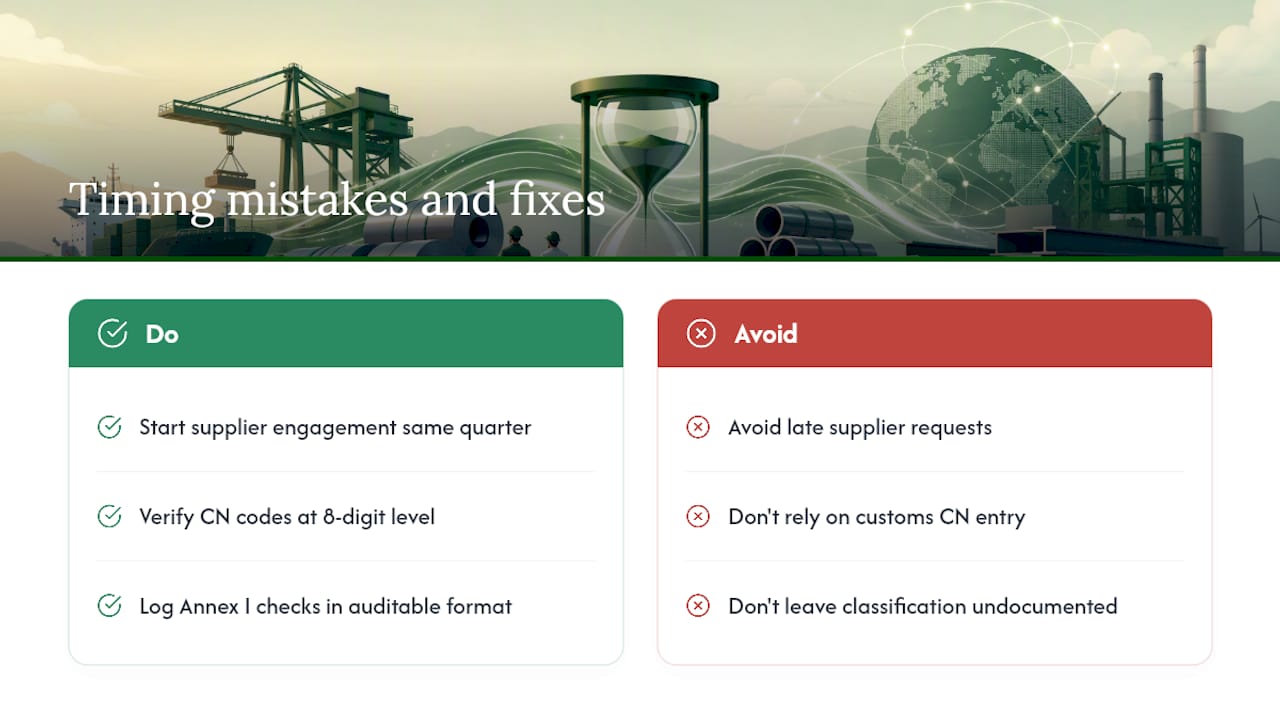
The compliance gap I see most consistently is not a misunderstanding of the regulation. Most compliance officers have read the legislation. The gap is timing, specifically on two fronts.
The first is supplier engagement. Importers routinely assume suppliers will provide monitoring-plan references and production-route data on request, close to the declaration deadline. In practice, non-EU steel producers, particularly those in markets where CBAM is not yet a commercial priority, treat these requests as low-urgency administrative tasks. By the time the importer escalates, the verifier scheduling window has closed or the site visit cannot be completed before the filing date.
The second is CN code documentation. Importers often rely on the CN code from the customs entry without independently verifying it against Annex I at the 8-digit level. When an audit surfaces a misclassification, the importer has no contemporaneous record showing the classification decision was reviewed. That absence of documentation is what turns a correctable error into a penalty exposure.
The practical fix for both: start supplier engagement in the same quarter you confirm your CN code list, and log every Annex I check in a format you can produce to an auditor. Operational preparedness is not separate from cost control. An importer who has verified actuals for their EAF suppliers and clean CN documentation will spend less on certificates and face less audit risk than one who relied on defaults and assumed the customs entry was correct.
CarbonOps turns your steel shipment data into a filed declaration
Filing a CBAM declaration for steel imports means handling CN code mapping, production-route classification, default value application, and registry-format export, all before a hard deadline. CarbonOps does that in four steps with no platform deployment and no onboarding cycle.
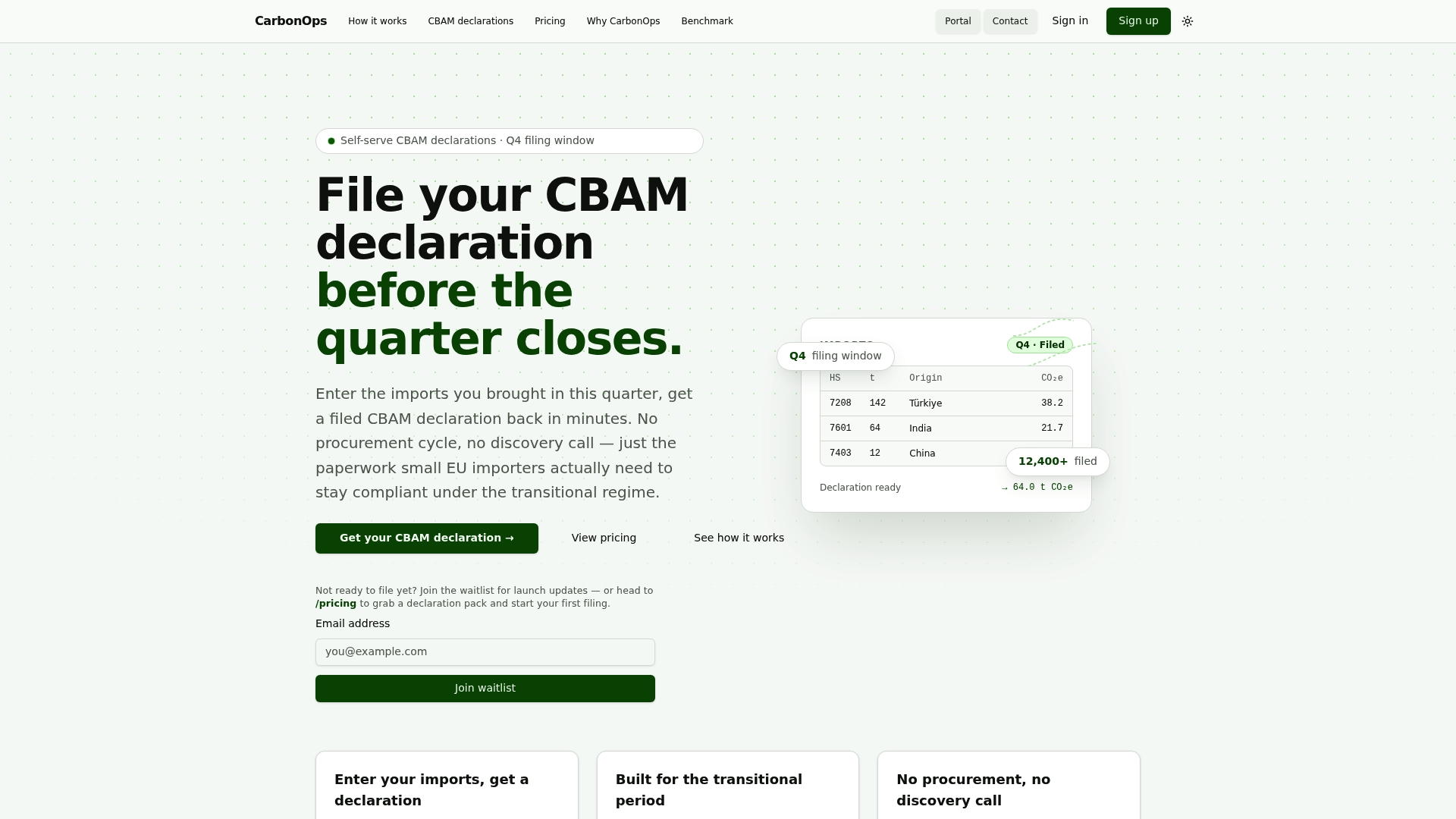
Enter each shipment with its HS/CN code, mass, and country of origin. CarbonOps maps it to the correct CBAM CN code and sector, flags which lines need emissions data, and applies the Commission’s published default values where supplier actuals are missing. Every line resolves to a complete, reviewable figure. The finished declaration exports in the format the EU CBAM Registry expects, with a full audit trail retained for each filing.
Whether you are filing a single declaration or managing a multi-quarter backlog, CarbonOps handles the CN matching and default-value calculation that takes the most time. Start your CBAM declaration and have a filing-ready document without the procurement cycle.
Sources
Use these sources to verify CN codes, benchmark values, and procedural steps directly from authoritative documents.
- CBAM Steel CN Codes 2026: Complete List for Chapters 72 and 73 | CBAM Guide
- EU Commission finalizes CBAM benchmarks, default values ahead of January 2026 launch - EUROMETAL
- Carbon Border Adjustment Mechanism | EUR-Lex