Group CBAM Filing: What US Importers Must Know in 2026

Group CBAM Filing: What US Importers Must Know in 2026
A single group-level CBAM declaration covering every EU subsidiary is not how the regulation works. Administrative centralization is possible, but legal liability stays with the EORI-holding importing entity on each customs declaration. That distinction is the whole game.
Two models let a group centralize the filing work without pretending the legal structure is something it is not:
- Indirect customs representative model: One appointed representative carries out customs obligations and submits a single quarterly CBAM report covering all CBAM goods it declared on behalf of multiple importers.
- Service-provider model: A group entity files on behalf of other group entities, but each importing entity typically remains the authorised declarant and legally liable, and a separate CBAM report is usually required per importing entity.
The immediate next step for most US-headquartered groups is either applying for authorised CBAM declarant status for each EU importing entity or formally appointing an indirect customs representative with the mandate and EORI linkages to file across the group.
Pro Tip: Before choosing a model, map every EU subsidiary’s EORI number against its import volumes. Subsidiaries that import below the annual threshold may not need individual authorisation, which changes the scope of your centralization project entirely.
Key Takeaways
Group CBAM filing is administratively possible through the indirect customs representative or service-provider model, but legal liability remains with the EORI-holding importing entity unless formal representative arrangements are established and documented.
| Point | Details |
|---|---|
| Legal liability stays with the EORI holder | Administrative centralization does not transfer liability; each importing entity remains responsible for its own imports. |
| Two viable centralization models | The indirect customs representative files one quarterly report; the service-provider model requires separate reports per importing entity. |
| September 30, 2027 is a hard deadline | The first annual declaration covering 2026 imports is due September 30, 2027; there is no grace period. |
| Verifier capacity is constrained | Physical site visits are required for the first verification period; book accredited verifiers early for high-emission installations. |
| CarbonOps supports group-managed filings | CarbonOps maps CN codes, applies EU defaults, and exports per-entity declarations with a retained audit trail, no deployment required. |
Table of Contents
- What does CBAM cover, and when does it apply to your imports?
- Who is legally responsible for each CBAM import?
- What are your options for centralizing group CBAM filings?
- How do you prepare a group-managed CBAM declaration?
- What are the verification rules, penalties, and audit requirements?
- How do you appoint and manage an indirect customs representative?
- How CarbonOps maps to the group filing workflow
- What centralized CBAM filing actually looks like in practice
- CarbonOps handles the filing mechanics so your team can focus on the data
- Sources
What does CBAM cover, and when does it apply to your imports?
The Carbon Border Adjustment Mechanism applies to imports of goods in six sectors: cement, iron and steel, aluminum, fertilizers, electricity, and hydrogen. Coverage is determined by CN (Combined Nomenclature) codes, so the first operational task is mapping each product line to its CN code and confirming whether it falls within scope.
Sectors and CN code mapping:
- Cement, clinker, and related products
- Iron, steel, and certain downstream products (pipes, fasteners, and similar)
- Aluminum and aluminum articles
- Fertilizers (urea, ammonia, nitric acid, and mixed fertilizers)
- Electricity imports
- Hydrogen
Key timeline milestones:
- Transitional period (October 2023 through December 2025): Quarterly CBAM reports required; no certificate purchase or surrender obligation; embedded emissions data collected using actual or default values.
- Definitive phase (from January 1, 2026): Authorised CBAM declarant status required to import covered goods; annual CBAM declaration due by September 30 following the year of import; CBAM certificates must be purchased and surrendered at declaration.
- Certificate sales open February 1, 2027, covering 2026 imports.
- First annual declaration deadline: September 30, 2027, covering all 2026 imports.
- Verifier registrations for the first verification cycle are expected to open in advance of that deadline; capacity is already constrained.
Authorization to import CBAM goods in the definitive phase requires registration as an authorised CBAM declarant through the national competent authority in the EU member state where the importing entity is established. Each entity with its own EORI number typically needs its own authorization unless a representative arrangement is in place.
Who is legally responsible for each CBAM import?
The default rule is straightforward: CBAM goods are attributed to the authorised CBAM declarant through the EORI number provided on the customs declaration. Whoever’s EORI appears on that declaration is the entity the CBAM Registry links the import to.
For a US-headquartered group with three EU subsidiaries, each holding its own EORI, that means three separate legal obligations. A parent company filing “on behalf of” subsidiaries does not transfer liability unless a formal representative arrangement is established and documented.
Operational consequences of EORI attribution:
- Incorrect EORI linkage on a customs declaration is difficult to correct after submission. The CBAM Registry flags mismatches, and rectification requires engagement with the national competent authority.
- Each importing subsidiary remains legally liable for its own imports even when a third party handles the filing mechanics.
- Subsidiaries that import covered goods without holding authorised CBAM declarant status face penalties regardless of whether a group entity filed paperwork on their behalf.
Key liability point: Administrative centralization does not transfer legal responsibility. The national Q&A guidance confirms that importing entities remain legally liable for their imports even when a representative or service provider submits the CBAM report.
The pre-submission check that matters most: verify that every EORI in your group’s import records maps correctly to the right legal entity, and confirm that each entity either holds authorised declarant status or has a valid representative arrangement in place before goods clear customs.
What are your options for centralizing group CBAM filings?
Two legally viable models exist. They differ in how liability is allocated and how the CBAM Registry sees the filing.

Indirect customs representative model
An indirect customs representative is appointed by each importing entity and carries out customs obligations on their behalf. Critically, the representative submits one quarterly CBAM report containing all CBAM goods for which it performed customs declarations. This is the closest thing to a consolidated group filing the regulation currently permits.
The representative must have actually performed the customs obligations for the goods covered by the report. Filing a CBAM report disconnected from customs actions is not permitted. That means the representative needs the mandate, the systems access, and the operational capacity to handle customs declarations across all group entities, not just the CBAM paperwork.
Pros: Single registry account for the representative; one quarterly report per period; cleaner audit trail for the central compliance team.
Cons: The representative takes on significant operational and potentially legal exposure; requires formal mandate agreements with each importing entity; customs and CBAM obligations must be bundled together.
Service-provider model
A group entity (often a shared services center or the parent company) acts as a service provider, preparing and submitting CBAM reports on behalf of other group entities. The Commission’s guidance is clear that the underlying importing entity remains the authorised declarant and legally liable, and a separate CBAM report is typically required for each importing entity.
This model gives the group central control over data collection and report preparation while keeping the legal structure transparent. The trade-off is that you do not get a single consolidated report; you get multiple reports prepared centrally.
Pros: Legal liability stays clearly with each importing entity; no need to bundle customs and CBAM mandates; easier to implement without restructuring customs arrangements.
Cons: Multiple CBAM Registry submissions; each importing entity still needs authorised declarant status; intercompany agreements and data governance are non-negotiable.
Decision criteria:
- Volume and complexity: High-volume groups with complex customs arrangements may benefit from the indirect representative model; lower-volume groups often find the service-provider model simpler to implement.
- Number of distinct EORIs: More EORIs generally favor the service-provider model to avoid the operational complexity of bundling customs mandates.
- Internal control: Groups with strong central compliance functions can manage the service-provider model effectively; those with decentralized operations may prefer the representative model for cleaner accountability.
Pro Tip: Draft intercompany agreements before you choose a model. The contractual liability allocation between the service provider and each importing entity is what protects the group if a filing error triggers a penalty. Without it, the exposure is undefined.
How do you prepare a group-managed CBAM declaration?
The preparation workflow runs in a fixed sequence. Skipping steps or running them in parallel creates reconciliation problems that surface at the worst possible time: during verifier review or a registry audit.
- Capture every import shipment with its CN code, net mass, country of origin, and customs declaration reference. This is the foundation; every subsequent step depends on it.
- Map each line to its CBAM CN code and sector. Not every CN code within a broad product category is in scope. Confirm coverage at the eight-digit CN level.
- Record mass in tonnes and MWh for electricity. The unit of measure must match the CBAM Registry’s expected format for each CN code.
- Determine country of origin for each shipment. Origin drives which default emission values apply when supplier-specific data is unavailable.
- Trace the production installation. For actual emission values, you need the installation name, address, and geographic coordinates of the non-EU facility where the goods were produced.
- Collect or calculate embedded emissions. Supplier-specific data requires a verifier-approved methodology. Where supplier data is missing, the Commission’s published default values by CN code and country of origin apply.
- Engage a third-party verifier for actual emission values. For the first verification period covering 2026 imports, the verifier must conduct a physical site visit to the production installation; remote verification is not permitted.
- Submit to the CBAM Registry. Upload via XML or manual UI entry. Confirm that each submission is linked to the correct EORI and authorised declarant account.
Required data elements per shipment:
| Data element | Who typically owns it |
|---|---|
| CN code (8-digit) | Central compliance team |
| Net mass (tonnes) | Importing subsidiary / customs broker |
| Country of origin | Importing subsidiary |
| Production installation name and address | Supplier |
| Installation geographic coordinates | Supplier |
| Supplier-specific embedded emissions (tCO₂e/tonne) | Supplier (verified) |
| EU default emission value (if supplier data unavailable) | Central compliance team |
| Customs declaration reference | Importing subsidiary / customs broker |
| Verifier report reference | Central compliance team |
Verifier readiness checklist:
- Confirm the verifier holds accreditation under the relevant standard for CBAM verification.
- Schedule physical site visits to non-EU production installations well in advance. Verifier capacity for the 2026 cycle is limited, and the September 30, 2027 deadline is final.
- Provide the verifier with installation coordinates, process descriptions, and emissions calculation methodology before the visit.
- Obtain and retain the signed verifier report; it must be attached to or referenced in the annual declaration.
Pro Tip: Stage verifier scheduling by installation priority: start with your highest-emission installations and those in countries where default values are significantly higher than actual emissions. That sequencing protects the group’s certificate cost and gives the verifier time to complete physical visits before the filing window closes.
What are the verification rules, penalties, and audit requirements?
Third-party verification is required when an authorised CBAM declarant uses actual embedded emission values rather than Commission defaults. The verifier must be accredited under the standards set out in the CBAM implementing regulations, and for the first annual declaration covering 2026 imports, a physical site visit to the production installation is mandatory.
Common compliance pitfalls in group or representative-managed filings:
- Mislinked EORI records: a shipment attributed to the wrong importing entity’s EORI account triggers a registry flag and requires manual correction with the national competent authority.
- Incomplete supplier installation details: missing coordinates or an unverifiable installation address blocks the verifier’s ability to complete the physical visit and sign off on actual values.
- Missing or unsigned verifier reports: a declaration referencing actual emission values without an attached verifier report is non-compliant.
- Late certificate surrender: certificates must be surrendered at the time of the annual declaration, not after. Late surrender triggers penalties on top of the certificate cost.
Penalty mechanics: Penalties apply per tonne of CO₂ equivalent for which certificates were not surrendered. The economic cost compounds: the penalty itself plus the obligation to purchase and surrender the missing certificates at market price. For a group with multiple importing entities, a single missed filing by one subsidiary creates a penalty exposure that cannot be offset by another entity’s compliant filing.
Record retention: Supporting documentation for annual declarations must be retained for the period specified in Article 6(6) of the CBAM regulation and must be accessible for audits. For a centralized filing operation, that means maintaining per-entity records, not just consolidated group records. Each importing subsidiary’s shipment data, verifier reports, and customs declaration references must be retrievable separately.
How do you appoint and manage an indirect customs representative?
Appointing a representative is not a one-page form. It is an operational and contractual project that requires careful scoping before any filing begins.
Onboarding steps:
- Define the scope of the mandate: which importing entities, which CN codes, which customs procedures, and which CBAM reporting periods are covered.
- Establish EORI linkages: the representative must be formally linked to each importing entity’s EORI in the relevant customs systems.
- Set up CBAM Registry access: the representative needs an account with the appropriate permissions to file on behalf of each importing entity.
- Agree on data transfer protocols: how shipment data flows from each importing subsidiary to the representative, in what format, and on what timeline.
- Define the verifier engagement process: who contracts the verifier, who provides installation access, and who signs off on the verifier report.
Key contractual clauses:
- Liability allocation: Specify which party bears the penalty exposure for filing errors, missed deadlines, or incorrect emission values.
- Indemnities: Each importing entity should indemnify the representative for liabilities arising from data it provided; the representative should indemnify importing entities for errors in its filing mechanics.
- Audit rights: The importing entity must retain the right to audit the representative’s filing records and CBAM Registry submissions.
- Confidentiality: Supplier emission data and installation details are commercially sensitive; the agreement must restrict use to CBAM compliance purposes.
- Verification cooperation: Specify obligations to facilitate verifier site visits, including access to supplier contacts and installation documentation.
- Termination and transition: Define how filing records, registry access, and verifier relationships transfer if the representative arrangement ends.
Governance checks:
- Who approves verifier engagement and signs the verifier contract?
- Who controls certificate purchases and the treasury flows for certificate costs?
- What is the escalation path if a subsidiary disputes the emission values attributed to its imports?
Representative validation checklist:
- Confirmed EORI linkage in customs systems for each importing entity
- CBAM Registry account active with correct permissions
- Data transfer protocol tested with at least one importing subsidiary
- Liability and indemnity clauses reviewed by legal counsel in each relevant EU jurisdiction
- Verifier engagement process documented and agreed
How CarbonOps maps to the group filing workflow
CarbonOps is built around the same sequence the compliance checklist above follows. The four-step process moves from raw import data to a filing-ready export without requiring platform deployment or a procurement cycle.
The four steps in practice:
- Enter imports: Each shipment is entered with its CN code, net mass, and country of origin. The tool validates and maps supplier data to the CBAM-covered goods it applies to.
- Match CN codes: Each line is matched to its CBAM CN code and sector, confirming which imports are in scope and flagging which ones still need emissions data.
- Apply emissions: Where supplier-specific embedded emissions are missing, CarbonOps applies the Commission’s published default values by CN code and country of origin. Every line resolves to a complete, reviewable figure.
- Export and file: The completed declaration is exported in the format the EU CBAM Registry expects, retained with filing history for the audit trail.
Features that directly address group filing pain points:
- Per-shipment CN code and installation mapping, so each import line is traceable to the correct importing entity and production source.
- Application of EU default values where supplier data is absent, eliminating the gap that most groups hit when suppliers are slow to respond.
- Audit trail and filing history retained per declaration, supporting the per-entity record-keeping that centralized operations must maintain.
- PDF export ready for review and submission, with no additional formatting required.
For groups managing multiple importing entities, CarbonOps supports the service-provider model: the central compliance team prepares declarations for each importing entity’s shipments, exports them separately, and retains the audit trail for each. The tool fits the governance model without requiring a custom integration or a long onboarding process.
What centralized CBAM filing actually looks like in practice
The groups that handle this well share one trait: they treat the CBAM project as a data governance problem first and a filing problem second. The filing itself is the last ten minutes. The preceding six months are spent getting supplier declarations, mapping installations, and confirming EORI linkages.
Three operational shortcuts that consistently reduce audit friction:
- Template supplier declarations: Standardize the format you send to suppliers requesting embedded emissions data. A consistent template reduces back-and-forth and makes it easier to spot missing fields before the verifier engagement begins.
- EORI verification sweeps: Run a full sweep of your group’s EORI numbers against customs declaration records at the start of each filing cycle. Mismatches caught before submission cost an hour to fix; mismatches caught after submission cost weeks.
- Tranche-based verifier scheduling: Book verifiers in tranches by installation priority rather than waiting until all supplier data is in. High-emission installations with slow suppliers are your biggest risk; get the verifier scheduled for those first.
The caveat that matters most: administrative centralization does not replace the need for clear intercompany agreements and indemnities. A group entity that files on behalf of subsidiaries without a documented liability allocation is absorbing undefined exposure. The contracts are not a formality; they are the mechanism that keeps a filing error from becoming a group-level financial event.
CarbonOps handles the filing mechanics so your team can focus on the data
Filing-ready CBAM declarations without a platform deployment or a six-week onboarding process: that is the practical case for CarbonOps. For US-headquartered groups managing multiple EU importing entities, the tool handles the CN code mapping, default value application, and audit-trail retention that the compliance checklist above requires, without requiring a custom integration or a recurring subscription.
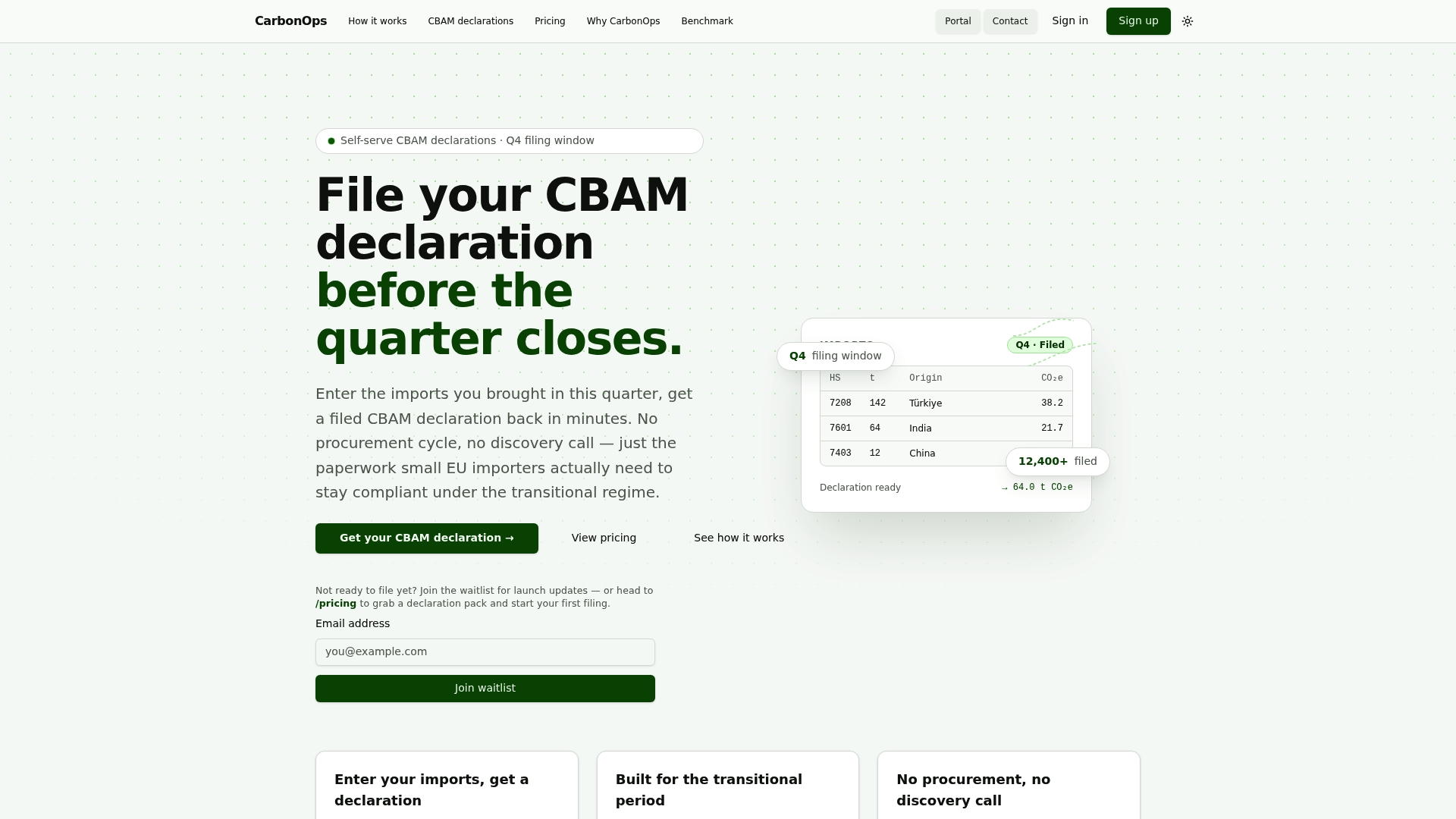
Three specific benefits for group-managed filings: CarbonOps handles per-shipment CN code and installation mapping across multiple importing entities, applies Commission default values where supplier data is missing so no line is left unresolved, and exports each declaration with a retained audit trail that satisfies the per-entity record-keeping obligations described above. Pay per declaration, with no long-term commitment.
The immediate next step: start your first CBAM declaration on CarbonOps with your import data and CN codes in hand. The four-step process takes the filing from raw shipment data to a registry-ready export, and the audit trail stays on file for every declaration you complete.
Sources
The following official documents and practitioner guides support the guidance in this article. Each is worth reading directly for the specific regulatory points noted.
- CBAM Questions and Answers
- Carbon Border Adjustment Mechanism (CBAM) Questions and Answers
- CBAM Declaration 2027: Step-by-Step Filing Guide for September 30 Deadline | CBAM Guide
- CBAM Questions and Answers (national copy)
For national competent authority details, authorization procedures, and jurisdiction-specific requirements, check the official website of the competent authority in each EU member state where your importing entities are established. Requirements and processing timelines vary by member state.
This article is general information, not a substitute for advice from a qualified lawyer. Consult a qualified legal professional about your own circumstances before acting on anything here.