What Are Embedded Emissions? A Clear Definition and Guide

What Are Embedded Emissions? A Clear Definition and Guide
Embedded emissions are the total greenhouse gases released across a product’s entire upstream supply chain, all attributed to that single product or the consumer who buys it. You’ll also see the term written as embodied emissions or embodied carbon, and in most industry usage the three are interchangeable. The distinction matters more than it looks: about 22% of global emissions are embedded in internationally traded goods, meaning a fifth of the planet’s carbon output gets counted somewhere other than where it was actually released.
Key Takeaways
Embedded emissions definition centers on one idea: every greenhouse gas released to make and move a product, converted into kgCO2e and attributed to that product wherever it ends up being used.
| Point | Details |
|---|---|
| Definition | Embedded (or embodied) emissions cover a product’s full upstream supply chain, from raw material extraction to end-of-life. |
| Scale of the issue | About 22% of global emissions travel embedded in internationally traded goods. |
| Measurement basis | LCAs and EPDs convert energy and material data into kgCO2e using GWP factors, where methane counts roughly 28 times heavier than CO2. |
| Policy relevance | CBAM assigns responsibility to importers based on consumption, not just where goods were produced. |
| Practical next step | Tools like CarbonOps fill data gaps with EU default values to turn incomplete supplier data into a filing-ready CBAM declaration. |
Table of Contents
- Embedded Emissions Definition: What Life-Cycle Stages Count
- How Embedded Emissions Are Measured
- Understanding GWP, kgCO2e, and Why Units Matter
- Production vs. Consumption: Where CBAM Fits In
- Why Embedded Emissions Numbers Vary So Much
- Why Getting the Definition Right Actually Matters
- A Practical Route When Supplier Data Falls Short
- Frequently Asked Questions
- Sources
Embedded Emissions Definition: What Life-Cycle Stages Count
A clean embedded emissions definition has to include every stage before the product lands in your hands, and often a few after. That’s the part most people miss: it isn’t just “the factory.”
The stages typically included are:
- Raw material extraction — mining ore, drilling for oil, harvesting timber
- Processing and refining — turning raw inputs into usable materials
- Manufacturing — assembling components into a finished product
- Transport — moving materials and goods between every step above
- Distribution — warehousing and shipping to the point of sale or installation
- Installation and use-phase upstream impacts — energy or materials consumed to put the product into service
- End-of-life processing — disposal, recycling, or demolition
In construction, this framework has a formal name. Life-cycle assessments for buildings use module A1 through A5 to cover everything “upfront,” from material supply through construction, and modules C1 through C4 to cover end-of-life demolition and disposal. The embodied carbon handbook from ABCB notes that upfront embodied carbon, the A1–A5 slice, can account for up to 70% of a building’s total embodied emissions before it’s even occupied.
Concrete and steel are the classic examples: cement production alone generates enormous emissions before a single beam is poured. Electronics work the same way but hide it better, since a smartphone’s biggest carbon cost is usually the mining and chip fabrication that happened long before assembly. The construction industry, for what it’s worth, has gotten further along than most sectors at separating this embodied carbon from the operational carbon a building produces once it’s running.

How Embedded Emissions Are Measured
Every embedded emissions calculation starts with a life-cycle assessment, or LCA. Practitioners follow a few practical steps: define the boundary of what’s included, collect activity data (energy used, materials sourced, distances traveled), convert that data into emissions using recognized factors, then total the result into a single figure. That figure is often called a product carbon footprint.
The standardized output of an LCA is an Environmental Product Declaration, or EPD. An EPD lets you compare the emissions of two similar products, like two brands of insulation, on equal footing. The EPA’s greener products and EPD resources offer tools to locate manufacturer EPDs directly, which is often faster than chasing a supplier for raw numbers.
Here’s where terminology trips people up:
- Scope 1 emissions are direct emissions from a company’s own operations.
- Scope 2 emissions cover purchased electricity, heat, or steam.
- Scope 3 emissions capture everything else in the value chain, including the embedded emissions of purchased goods.
Embedded emissions, in other words, are largely a Scope 3 concept viewed from the product’s perspective rather than the company’s. Boundary choices, and which standard you’re following, whether an ISO 14040 series LCA or the GHG Protocol, will shift the final number even for identical products.
Pro Tip: Before comparing two embedded emissions figures, check whether both followed the same LCA standard and included the same life-cycle modules. A number missing end-of-life data isn’t wrong, but it isn’t the same number as one that includes it.
Understanding GWP, kgCO2e, and Why Units Matter
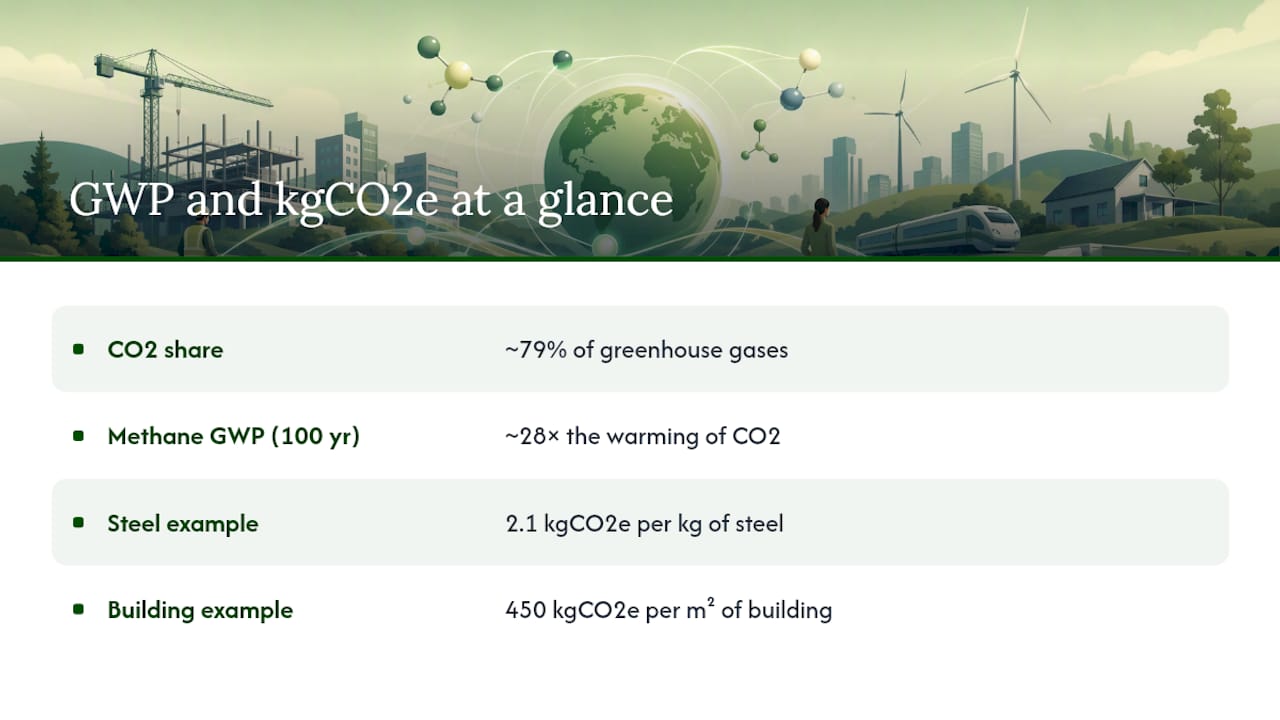
Every embedded emissions figure gets converted into one common currency: kilograms of carbon dioxide equivalent, or kgCO2e. That conversion relies on Global Warming Potential (GWP), a 100-year measure of how much warming a given gas causes relative to CO2.
The reason this matters practically: CO2 makes up roughly 79% of global greenhouse gas emissions, but methane carries a GWP about 28 times higher than CO2 over a 100-year period. A small amount of methane in a supply chain, say from livestock feed or landfill gas, can swing a kgCO2e total dramatically even though the raw tonnage looks tiny. When you see a figure like “2.1 kgCO2e per kilogram of steel” or “450 kgCO2e per square meter of building,” that’s the GWP conversion doing its job: letting you compare a beef supply chain against a battery supply chain using the same yardstick.
Production vs. Consumption: Where CBAM Fits In
Governments have traditionally counted emissions the way the UNFCCC does: by territory, tallying whatever gets emitted inside a country’s borders. That approach has a blind spot. A country that outsources its manufacturing looks cleaner on paper while the emissions just move somewhere else.
Consumption-based accounting flips the lens, assigning emissions to wherever the goods end up being used rather than made. This raises real equity questions, since wealthier importing nations often outsource emissions-heavy production to poorer ones, then claim the lower territorial number. It’s also the logic behind carbon leakage concerns, where companies relocate production to jurisdictions with looser rules rather than actually cutting emissions.
- Production accounting counts emissions where factories operate.
- Consumption accounting, the embedded emissions approach, counts them where products are used.
- The EU’s Carbon Border Adjustment Mechanism (CBAM) is built on this second logic, requiring importers to report the embedded emissions of goods entering the EU.
That’s why CBAM shifts real operational weight onto importers: a company that never operated a blast furnace can still be on the hook for reporting the emissions baked into the steel it imported.
Why Embedded Emissions Numbers Vary So Much
Two suppliers making a nearly identical product can report wildly different embedded emissions, and it’s rarely because one of them is lying. The gap usually comes down to inconsistent boundaries and missing supply-chain data: one LCA includes end-of-life disposal, another stops at the factory gate; one uses supplier-specific energy data, another falls back on generic default values.
Common causes of the mismatch:
- Missing or incomplete supplier data, forcing reliance on industry averages
- Different scope or boundary decisions between LCA studies
- Default emission factors substituted for actual measured inputs
- Inconsistent life-cycle modules included or excluded (some drop C1–C4 entirely)
Pro Tip: When you’re handed an embedded emissions figure, ask three questions before trusting it: what boundary was used, which LCA standard applies, and how old is the underlying data. As a rule of thumb, prefer supplier-specific LCA data first, an EPD second, and a published default factor only when neither is available.
Why Getting the Definition Right Actually Matters
Ambiguity here isn’t academic. When a procurement team can’t agree on what “embedded emissions” includes, supplier negotiations stall and compliance filings get delayed. Importers preparing CBAM declarations feel this directly: validated supplier data and accurate HS/CN code mapping determine whether a filing is defensible or a guess. Getting the definition and the data pinned down early saves weeks later.
A Practical Route When Supplier Data Falls Short
Most importers hit the same wall: supplier-specific embedded emissions data simply isn’t available for every shipment, and chasing it manually eats weeks you don’t have before a filing deadline. CarbonOps is built for exactly that gap.
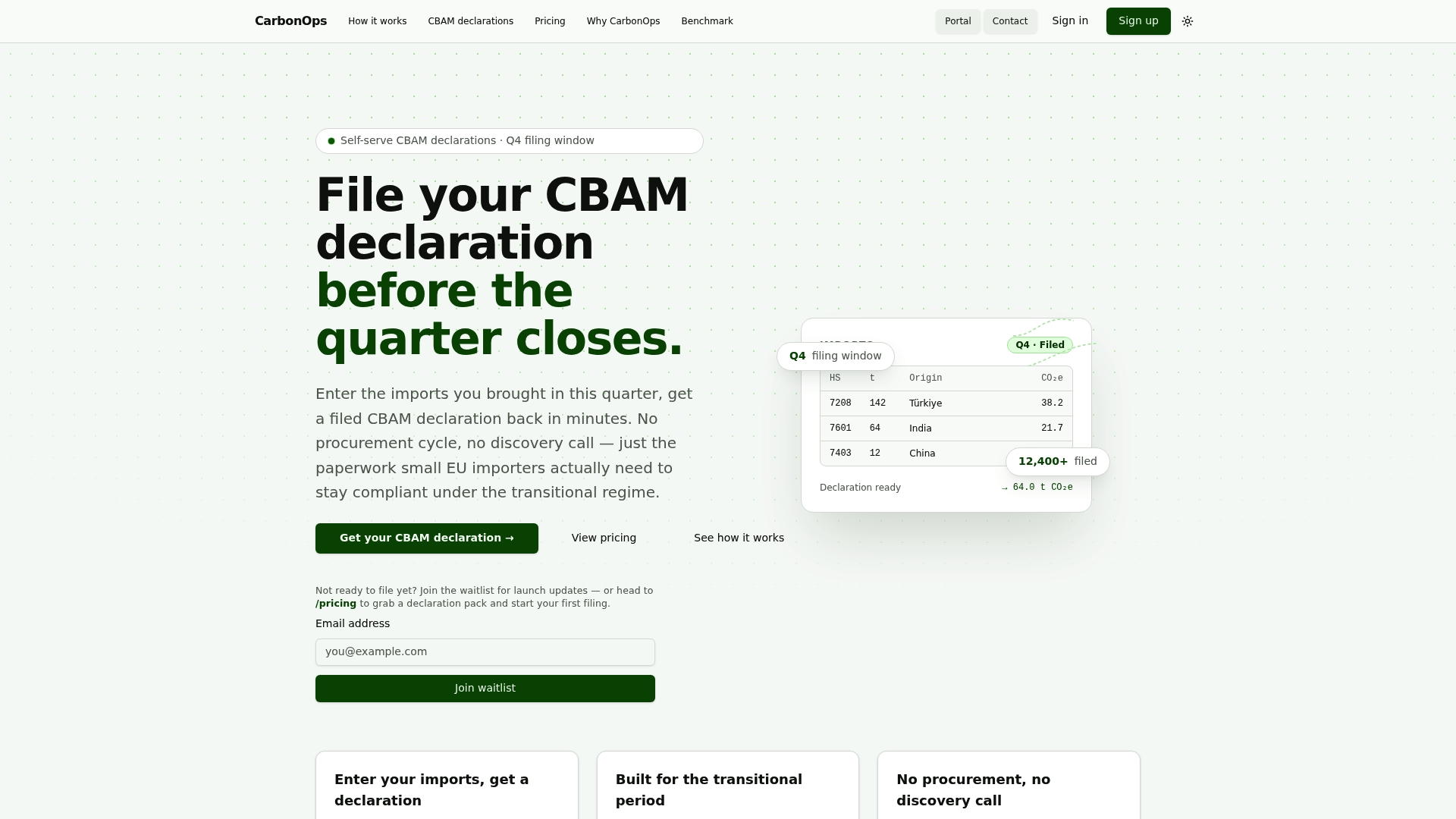
Instead of building a compliance workflow from scratch, you enter each shipment’s HS/CN code, mass, and country of origin, and the system maps it to the correct CBAM sector automatically. Where supplier data is missing, CarbonOps applies the European Commission’s published default values per CN code and country, so every line resolves to a complete figure rather than a stalled one. There’s no platform deployment, no sensor rollout, and no subscription. You pay per declaration, export the completed filing in the format the CBAM Registry expects, and keep the audit trail on file. If you’re staring down a quarterly filing with gaps in your supplier data, that’s the moment to bring your import list to CarbonOps and get a filing-ready declaration back.
Frequently Asked Questions
What is the simplest embedded emissions meaning? It’s the total greenhouse gas output tied to making, moving, and disposing of a product, all credited to that product rather than split across every company that touched it.
Is embedded carbon the same as embodied carbon? Yes. Embedded, embodied, and (less commonly) “upstream” carbon all describe the same concept, though embodied carbon is the term most often used in construction.
How does CBAM use embedded emissions calculation? CBAM requires EU importers to report the embedded emissions of covered goods like steel, cement, and aluminum, using either supplier-specific data or the Commission’s published default values when supplier data is unavailable.
Why do two products with similar specs show different kgCO2e figures? Usually because they were assessed under different boundaries, different LCA standards, or used default emission factors instead of measured supplier data.
Do embedded emissions include end-of-life disposal? They can. Whole-life assessments include end-of-life modules (C1–C4), though many reports focus on upfront emissions (A1–A5) since that portion is easier to measure and often larger.
Sources
Explore the ANU ICEDS study, the ABCB embodied carbon handbook, WRI’s emissions data, and EPA’s EPD tools for deeper technical grounding. For circularity context, see this ESG and recycling guide.
- Embodied carbon handbook (Australian building/infrastructure guidance) | ABCB
- CMore — EPA greener products/EPD resources