CBAM vs ETS: What U.S. Stakeholders Must Know in 2026

CBAM vs ETS: What U.S. Stakeholders Must Know in 2026
CBAM is the import-side mirror of the EU ETS: one prices carbon emissions inside the EU, the other applies an equivalent charge at the border. The EU Emissions Trading System (EU ETS) is a cap-and-trade program governing EU-based industrial installations. The Carbon Border Adjustment Mechanism (CBAM), established under Regulation (EU) 2023/956, extends that carbon cost to imported goods so foreign producers face the same price signal as their EU competitors.
Three things matter immediately for anyone trading with the EU:
- Who pays: Under the EU ETS, regulated EU installations buy allowances. Under CBAM, the EU importer (the “authorised CBAM declarant”) buys and surrenders CBAM certificates.
- How cost is set: CBAM certificate prices are linked directly to the EU ETS auction price, so ETS market volatility flows straight through to import costs.
- When it hits: The definitive CBAM regime started January 1, 2026; the first declaration covering 2026 imports is due September 30, 2027.
Two actions to take now: U.S. exporters should verify whether their goods fall under CBAM’s covered CN codes and begin collecting verified embedded emissions data from their production facilities. EU importers sourcing from the U.S. should confirm their authorised declarant status and assess whether default or actual emission values minimize their certificate liability.
Key Takeaways
CBAM and the EU ETS are legally linked instruments: CBAM certificate prices track ETS auction averages, and CBAM’s applicable rate grows each year as free allowances phase out, making compliance costs a moving target through 2034.
| Point | Details |
|---|---|
| CBAM vs ETS core difference | EU ETS caps EU installations; CBAM charges importers an equivalent price on embedded emissions in covered goods. |
| Certificate price linkage | CBAM certificate prices track EU ETS auction averages directly, so ETS market volatility is an importer’s financial risk. |
| First declaration deadline | The first CBAM declaration covering 2026 imports is due September 30, 2027; authorised declarant status is required above the 50-tonne threshold. |
| Default vs actual values | Commission default values are conservative; verified actual emissions typically reduce certificate liability and are worth the verifier cost. |
| CarbonOps filing workflow | CarbonOps maps CN codes, applies default or supplier emissions values, and exports registry-ready declarations in four steps with no platform deployment. |
Table of Contents
- How do CBAM and EU ETS compare side by side?
- What does the EU Emissions Trading System actually do?
- What is CBAM and what does Regulation (EU) 2023/956 require?
- How do CBAM and EU ETS interact as free allowances phase out?
- Which sectors and products does CBAM cover?
- How are embedded emissions calculated, reported, and verified?
- What does CBAM mean for U.S. exporters and importers?
- A practical four-step filing workflow for CBAM declarations
- The part most compliance teams underestimate
- Filing CBAM declarations without the procurement cycle
- Sources
How do CBAM and EU ETS compare side by side?
| Dimension | EU ETS | CBAM |
|---|---|---|
| Purpose | Reduce emissions from EU installations via a declining cap | Prevent carbon leakage by pricing embedded emissions in imports |
| Mechanism | Cap-and-trade: firms hold allowances for each tonne of CO₂ emitted | Border charge: importers buy CBAM certificates equal to embedded emissions × ETS-linked price |
| Regulated party | EU industrial operators (power, manufacturing, aviation) | Authorised CBAM declarants (EU importers above 50-tonne threshold) |
| Geographic scope | Inside the EU and EEA | Goods imported into the EU from third countries |
| Covered sectors | Power, heavy industry, aviation, maritime (expanding) | Iron & steel, cement, fertilizers, aluminum, electricity, hydrogen |
| Cost link | ETS allowance price set by auction and secondary market | CBAM certificate price = EU ETS auction average (Art. 21 linkage) |
| Reporting & verification | Annual emissions report; accredited verifier sign-off | Annual CBAM declaration; accredited verifier for actual emissions |
| Key deadline | Annual surrender by April 30 each year | First CBAM declaration due September 30, 2027 (covering 2026 imports) |
The price linkage row is the critical one. CBAM certificates are not priced independently; they track the ETS auction average, which means any spike in EU carbon allowance prices raises importer liability in lockstep.
What does the EU Emissions Trading System actually do?
The EU ETS sets a hard cap on the total greenhouse gas emissions allowed from covered installations, then issues allowances up to that cap. Firms that emit less can sell surplus allowances; firms that emit more must buy additional ones. The cap declines each year, making allowances progressively scarcer and more expensive.
Under the EU’s Fit for 55 package, the pace of cap reduction accelerated and free allocation of allowances is being phased out. Free allocation historically shielded energy-intensive industries from the full carbon cost, but that protection is shrinking on a legislated schedule running through 2034. As free allocation falls, the effective carbon cost for EU producers rises, which is precisely why CBAM became necessary: without it, EU manufacturers would face costs their foreign competitors do not.
Sectors currently regulated under the EU ETS include:
- Power generation and district heating
- Iron and steel production
- Cement and lime manufacturing
- Aluminum smelting
- Chemicals and refining
- Commercial aviation within the EEA
- Maritime shipping (phased in from 2024)
The OECD’s 2025 analysis of CBAM and ETS reforms notes that tightening the cap and phasing out free allocation raises ETS prices and creates the competitive gap that CBAM is designed to close. That price signal is the engine of the whole system: higher ETS prices mean higher CBAM certificate costs, which in turn incentivize foreign producers to cut emissions.
ETS price context: EU allowance prices have fluctuated significantly in recent years, reflecting energy market shocks and policy signals. Because CBAM certificate prices track ETS auction averages directly, importers carry ETS market risk even without holding a single ETS allowance.
What is CBAM and what does Regulation (EU) 2023/956 require?
CBAM charges EU importers a certificate cost equal to the embedded emissions in their imported goods multiplied by the ETS-derived certificate price. The legal foundation is Regulation (EU) 2023/956, which defines the mechanism, the authorised declarant obligation, the CBAM registry, and the deductibility rules for carbon prices already paid in the country of origin.
Actual vs. default emission values
Importers can calculate embedded emissions using either actual values (verified by an accredited third-party verifier based on production-level data from the supplier) or default values published by the Commission per CN code and country of origin. Default values are deliberately conservative, meaning they typically represent higher-than-average emission intensities for a given product category. Relying on defaults will, in most cases, increase certificate liability compared to using verified supplier data.
Who must register and when
The 50-tonne annual mass threshold determines whether an importer must become an authorised CBAM declarant. Above that threshold, registration in the CBAM Registry is mandatory before importing covered goods. Failing to obtain authorised status blocks certificate purchase and exposes the importer to penalties.
Key timeline milestones:
- January 1, 2026: Definitive CBAM regime in force; certificate purchase and surrender obligations begin.
- Throughout 2026: Importers track embedded emissions quarterly; CBAM certificates must be held in the registry.
- September 30, 2027: First CBAM declaration due, covering all 2026 imports; certificates surrendered to match declared embedded emissions.
Key compliance fact: Under the consolidated text of Regulation (EU) 2023/956, importers may deduct CBAM certificates when a carbon price has been effectively paid in the country of origin — but only with documented proof and verifier sign-off. This deduction is not automatic and requires proactive documentation from the exporting producer.
How do CBAM and EU ETS interact as free allowances phase out?
CBAM is explicitly designed to track the EU ETS price and to phase in as free allowances phase out. The two mechanisms are legally linked: Article 21 of Regulation (EU) 2023/956 ties the CBAM certificate price to the ETS auction average, and Article 31 governs the adjustment for free allocation.
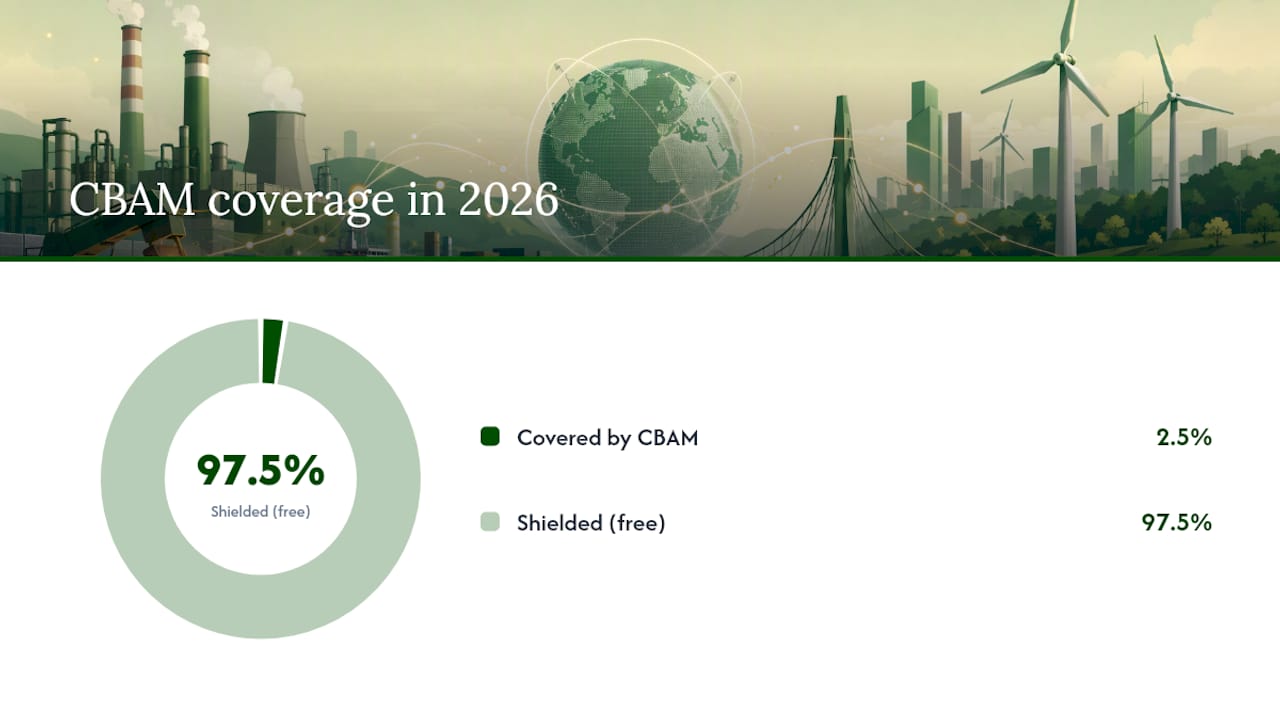
The phase-out runs on a defined schedule. In 2026, the CBAM rate applies to roughly 2.5% of embedded emissions (the share no longer covered by free allocation), with the remaining 97.5% still shielded. That ratio shifts each year through 2034, when free allocation for CBAM-covered sectors is fully eliminated and CBAM applies to 100% of embedded emissions. The practical effect: CBAM compliance costs will grow steadily even if the ETS price stays flat, simply because the applicable percentage increases annually.
Important milestones compliance teams should track:
- Registry access: Authorised declarants must be registered and active in the CBAM Registry before importing in 2026.
- Certificate pricing in 2026: Prices are calculated using a quarterly average of ETS auction prices.
- Certificate pricing from 2027 onward: The mechanism shifts to a weekly linkage with ETS auction prices, creating tighter, more volatile cost signals.
- Annual declaration: Each year’s imports are declared and certificates surrendered by September 30 of the following year.
- Free allocation phase-out checkpoints: The applicable CBAM percentage increases each year per the Annex IV schedule.
Pro Tip: Monitor ETS auction results weekly from 2027 onward to anticipate certificate cost movements. For 2026 planning, a quarterly average smooths volatility, but from 2027 the weekly linkage means a single ETS price spike can materially shift your certificate budget within days.
Interaction principle: As free allowances shrink, CBAM fills the gap. The two instruments are calibrated so that the total carbon cost faced by EU producers and importers of equivalent goods converges over time. That convergence is the policy mechanism, not a side effect.
Which sectors and products does CBAM cover?
CBAM currently covers six sectors: iron and steel, cement, fertilizers, aluminum, electricity, and hydrogen. The initial product list spans approximately 303 energy-intensive products defined by Annex I CN codes, representing a small share of EU imports by value. The selection targets goods where carbon leakage risk is highest and where embedded emissions are measurable at the product level.
Annex I CN codes are the operative boundary. If a product’s CN code appears in Annex I, it is in scope regardless of how it is labeled commercially. Processed or downstream goods that incorporate covered materials but carry different CN codes may fall outside CBAM today, though that boundary can shift as the Commission reviews scope.
Two practical points for U.S. exporters:
- Scope expansion is a real risk. The Commission has authority to add sectors. Building emissions tracking infrastructure now, before scope expands, is cheaper than retrofitting it later.
- Complex goods need careful CN mapping. A fabricated steel component might carry a CN code outside the covered ranges even if its raw material input was covered steel. That distinction matters for both liability and supplier data requests.
How are embedded emissions calculated, reported, and verified?
Embedded emissions under CBAM include direct Scope 1 emissions from the production process and, for certain goods (notably electricity and some complex goods), indirect Scope 2 emissions and upstream Scope 3 inputs as defined by Commission implementing regulations. The starting point is always the production facility, not the shipping or logistics chain.
The compliance process, step by step
- Collect supplier data. Request production-level emissions data from each supplier, ideally in the format specified by Commission guidance. Supplier statements must be verifiable.
- Choose actual or default values. Actual values require an accredited verifier; default values are available from the Commission by CN code and country but carry higher financial exposure.
- Engage an accredited verifier. For actual emissions, a verifier accredited under EU rules must review and sign off on the data before it enters the declaration. The Commission provides e-learning and guidance materials on verification standards and accreditation requirements.
- Submit the CBAM declaration via the CBAM Registry by the applicable deadline (September 30, 2027 for 2026 imports).
- Purchase and surrender certificates. Certificates are bought through the registry at the ETS-linked price and surrendered to match declared embedded emissions.
Pro Tip: Default values are a compliance floor, not a strategy. Because the Commission sets them conservatively, most producers with modern equipment will have actual emissions below the default. Investing in supplier data collection and verifier engagement typically pays back in reduced certificate costs within the first filing cycle.
The deduction mechanism adds another layer. Under Article 9 of the consolidated Regulation (EU) 2023/956, importers can reduce their certificate obligation when a carbon price has been effectively paid in the country of origin. This requires documented proof — typically a government-issued carbon pricing record from the exporting country — and verifier confirmation. For U.S. exporters operating in states with active carbon pricing programs, this deduction could meaningfully reduce the EU importer’s net liability.
What does CBAM mean for U.S. exporters and importers?
U.S. exporters selling iron, steel, aluminum, fertilizers, or other covered goods into the EU face a straightforward commercial reality: if their embedded emissions are high, or if their EU buyer defaults to Commission default values, the importer’s certificate cost rises and that cost will eventually flow back through pricing negotiations. Who absorbs it depends on contract terms and market power, but the cost does not disappear.
Analysis has found that CBAM narrows the value-added loss in covered EU industries from roughly 1.06% to 0.85%, partially offsetting the competitiveness impact of ETS cost increases. For U.S. exporters, the mirror effect is a potential competitiveness disadvantage relative to producers in countries with equivalent carbon pricing, since those producers can claim the deduction under Article 9.
Actions for U.S. exporters and their EU trading partners:
- Identify covered goods. Map your export product list against Annex I CN codes. This is the first and most time-sensitive step.
- Request verified emissions data. Commission guidance and e-learning resources describe the data format suppliers should provide. Starting this process early avoids a last-minute scramble before the 2027 declaration deadline.
- Update sales contracts. Add CBAM-related data-sharing obligations and clarify which party bears certificate costs. Silence in the contract means disputes later.
- Assess margin exposure. Model certificate costs at current ETS price levels and at a range of plausible higher prices, since ETS volatility is the primary financial risk.
- Check for origin-country carbon pricing. If your production facility is subject to a domestic carbon price, document it carefully — it may support a deduction claim for your EU buyer.
Pro Tip: The single highest-value contract clause for CBAM is a supplier data obligation: require the exporter to provide production-level emissions data in the Commission-specified format within 60 days of each shipment. Without that clause, the importer defaults to conservative Commission values and pays more.
A practical four-step filing workflow for CBAM declarations
A repeatable four-step workflow reduces compliance risk and audit friction across every filing cycle.
-
Data intake. Collect each shipment’s HS/CN code, mass, country of origin, and supplier-level embedded emissions data. Use a standardized template aligned to Commission guidance so data is consistent across suppliers and quarters. Validate CN codes against Annex I before proceeding.
-
CN mapping and sector classification. Match each line item to its CBAM CN code and sector. This step identifies which imports are in scope, flags any ambiguous classifications, and determines what emissions data each line still needs. Gaps at this stage mean either sourcing supplier data or applying default values.
-
Emissions calculation and verification. Apply actual supplier emissions where available and verified; apply Commission default values where supplier data is absent. For actual values, engage an accredited verifier before the declaration is finalized. The Commission’s guidance and e-learning resources cover calculation methodologies and verifier accreditation standards in detail.
-
Registry declaration and certificate surrender. Export the completed declaration in the format the CBAM Registry expects, submit by the deadline (September 30, 2027 for 2026 imports), and surrender the corresponding certificates. Retain the filing history and supporting documentation for audit purposes.
Pro Tip: Build the workflow around quarterly data collection even though the declaration is annual. Chasing twelve months of supplier data in August 2027 is a predictable crisis. Quarterly check-ins with suppliers keep data current and give you time to resolve gaps before the filing window.
This four-step structure mirrors the workflow built into CarbonOps, which maps CN codes, applies default or supplier values, and exports registry-ready declarations without requiring platform deployment or a procurement cycle.

The part most compliance teams underestimate
The framing of CBAM as “just another import cost” is the mistake that will cost companies the most. CBAM is a recurring, annually escalating liability tied to a volatile market price. The ETS allowance price is not stable, and from 2027 the weekly linkage means certificate budgets can shift materially within a single quarter. That is a treasury and forecasting problem, not just a compliance checkbox.
What compliance teams consistently underestimate is the data collection lead time. Verified actual emissions from a steel mill or fertilizer plant require the producer to have measurement systems in place, a verifier to review them, and documentation to flow back to the EU importer in a usable format. That chain takes months to establish. Companies that treat the September 2027 deadline as the start date will find themselves defaulting to conservative Commission values and paying more than necessary.
The deduction mechanism under Article 9 is similarly underused. U.S. producers in states with active carbon pricing programs have a legitimate basis to reduce their EU buyer’s certificate obligation, but only if the documentation exists and the verifier accepts it. That is a commercial negotiation point that belongs in the sales conversation, not the compliance queue.
The broader policy logic is worth taking seriously: CBAM is designed to incentivize decarbonization in third countries by making the carbon cost of production visible and financially consequential at the EU border. Companies that invest in cleaner production now are building a durable competitive advantage in EU markets, not just managing a compliance cost.
Filing CBAM declarations without the procurement cycle
The hardest part of CBAM compliance for small and mid-sized importers is not understanding the regulation. It is turning supplier data into a filing-ready declaration without deploying a platform, hiring a consultant, or waiting on a procurement cycle.
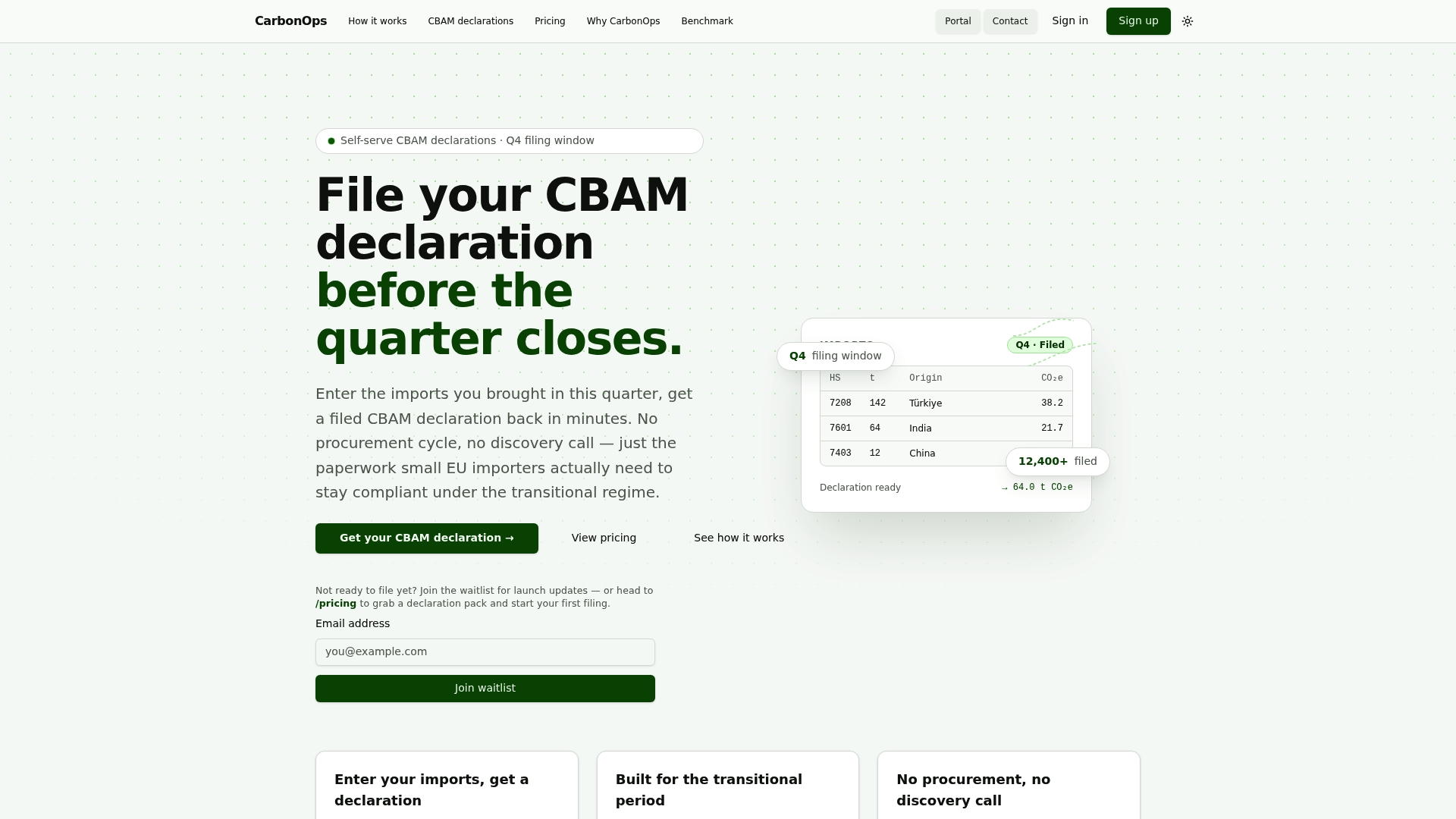
CarbonOps is built for exactly that situation. Enter your shipments with HS/CN codes, mass, and country of origin; the software maps each line to its CBAM CN code and sector, applies Commission default values where supplier emissions are missing, and exports a declaration in the format the EU CBAM Registry expects. Pay per declaration, with no subscription and no onboarding required.
- CN code mapping: Every import line is matched to its Annex I CN code and sector automatically.
- Default and actual emissions: Commission defaults are applied where supplier data is absent; supplier-verified figures slot in where available.
- Audit trail: Filing history and supporting data are retained for every declaration.
- Registry-ready export: The output matches the format the CBAM Registry expects, ready to review and submit.
For compliance officers and accountants handling CBAM filings for small or mid-sized EU importers, start your first declaration at CarbonOps before the 2027 deadline closes in.
Sources
The following official and authoritative resources are the primary references for CBAM and EU ETS compliance:
- EUR-Lex - Regulation (EU) 2023/956 establishing a carbon border adjustment mechanism
- What to expect from the EU Carbon Border Adjustment Mechanism? (OECD, 2025)
- Carbon Border Adjustment Mechanism (CBAM) - European Commission (main page)