CBAM vs Carbon Tax: What Actually Sets Them Apart
CBAM vs Carbon Tax: What Actually Sets Them Apart
CBAM is a certificate-based import charge tied to the EU ETS price. A carbon tax is a government-set domestic levy. They chase similar climate goals through completely different legal and operational channels, and confusing the two leads to bad compliance planning.
For importers, the practical difference lands hard: paying a domestic carbon tax somewhere is a line item. Complying with CBAM means reporting embedded emissions, buying certificates, and proving your numbers hold up under audit.
- CBAM requires certificate purchases tied to weekly EU ETS pricing from 2027, plus detailed reporting and evidence obligations.
- A carbon tax is a flat or scaled government fee, usually covering a much wider slice of the economy than CBAM’s handful of sectors.
- Importers face authorization thresholds, declaration deadlines, and deduction rules that don’t exist in a typical domestic tax filing.
Key Takeaways
CBAM and carbon tax both put a price on emissions, but CBAM does it through import certificates linked to EU ETS pricing while a carbon tax is a direct domestic levy with no certificate market involved.
| Point | Details |
|---|---|
| Different legal mechanisms | CBAM requires certificate purchase and surrender; a carbon tax is a direct government levy with no market link. |
| Narrow but growing scope | CBAM covers steel, cement, aluminum, fertilizers, electricity, and hydrogen, about 3% of EU imports as of early 2025. |
| Definitive regime starts 2026 | The full CBAM regime applies from January 1, 2026, with first declarations due by September 30, 2027. |
| Watch the 50-tonne threshold | Importers exceeding 50 tonnes of covered goods must register as authorized CBAM declarants. |
| Deductions need certified proof | Carbon prices paid abroad only offset CBAM obligations with certified evidence, not informal supplier claims. |
| CarbonOps handles the filing | CarbonOps maps CN codes, applies Commission default emissions values, and exports a registry-ready CBAM declaration. |
Table of Contents
- CBAM vs Carbon Tax: How the EU’s Import Mechanism Actually Works
- What Is a Carbon Tax and How Do Governments Set One?
- CBAM and Carbon Tax Side by Side
- How CBAM Pressures Countries to Adopt Their Own Carbon Pricing
- A Compliance Checklist for Importers Facing CBAM
- Trade Friction, Equity, and Where CBAM Goes Next
- What We Prioritize When Helping Importers Get CBAM-Ready
- Getting Your CBAM Declaration Filed Without the Overhead
- Frequently Asked Questions
- Sources
CBAM vs Carbon Tax: How the EU’s Import Mechanism Actually Works
CBAM is not a tax. It’s a certificate obligation that mirrors what a domestic EU producer already pays under the EU ETS. When you import goods in a covered sector, you calculate the embedded emissions in that shipment, then surrender CBAM certificates priced against the ETS allowance rate. The Commission has structured this pricing deliberately: certificates are pegged to a quarterly average EU ETS price in 2026, shifting to a weekly average from 2027.
The sectors in scope aren’t arbitrary. They’re the most carbon-intensive, most trade-exposed industries where the EU worried about production simply relocating outside its carbon rules:
- Iron and steel
- Cement
- Aluminum
- Fertilizers
- Electricity
- Hydrogen
Together, these goods made up roughly 3% of total EU imports in early 2025, a modest slice by volume but an outsized one by emissions intensity.
The definitive regime starts January 1, 2026. First declarations cover the 2026 calendar year and are due by September 30 of the following year. Any importer bringing in more than 50 tonnes of covered goods annually must register as an authorized CBAM declarant, which brings its own governance and reporting duties. If a carbon price was already paid where the goods were produced, that amount can sometimes be deducted, but only with certified evidence and once the Commission finalizes the implementing rules covering default carbon prices by country.
What Is a Carbon Tax and How Do Governments Set One?
A carbon tax is a direct, government-set levy on the carbon content of fuel or on measured emissions from an industrial source. No certificate market, no EU ETS reference price. A finance ministry or environment agency picks a rate, and that rate applies to whoever falls inside the tax’s defined scope, whether that’s a power plant, a refinery, or a household heating bill.
Design choices vary widely from one jurisdiction to the next:
- Scope: some taxes hit only fossil fuel combustion; others reach industrial process emissions too.
- Rate path: a fixed number set once, or an escalator that climbs on a schedule to give industry time to adjust.
- Exemptions and rebates: many governments carve out energy-intensive, trade-exposed sectors to protect competitiveness, or rebate revenue back to households.
Where the money goes differs by country. Some governments fold it into general revenue. Others earmark it for green infrastructure or return it as a per-household dividend. Liability sits with the domestic entity emitting the carbon, not with a foreign supplier or an importer, which is the core operational split from CBAM.
CBAM and Carbon Tax Side by Side
Once you line up the two mechanisms on the same dimensions, the split stops being abstract.
| Dimension | CBAM | Carbon Tax |
|---|---|---|
| Mechanism | Certificate purchase and surrender | Direct government levy |
| Coverage | Selected import sectors (steel, cement, aluminum, fertilizers, electricity, hydrogen) | Economy-wide or sector-specific, domestic |
| Who pays | Authorized CBAM declarant (importer) | Domestic emitter or fuel supplier |
| Revenue destination | EU budget, via certificate sales | National treasury or earmarked funds |
| Price reference | EU ETS allowance price (quarterly, then weekly average) | Government-set rate, fixed or escalating |
| Primary objective | Prevent carbon leakage, equalize import costs | Cut domestic emissions, raise revenue |
Pro Tip: Don’t assume a carbon tax paid abroad automatically offsets your CBAM certificate obligation. The deduction only applies with certified proof of an “effectively paid” carbon price, and the Commission’s implementing rules on this are still being finalized.
The administrative burden diverges sharply too. A carbon tax return is closer to standard tax compliance. A CBAM declaration means monitoring, reporting, and verification work modeled on the EU ETS MRV framework, with documentation retained for audit long after filing.
How CBAM Pressures Countries to Adopt Their Own Carbon Pricing
CBAM’s most interesting side effect isn’t inside the EU. It’s what it does to exporting countries’ incentives.
- If a country outside the EU has no domestic carbon price, its exporters absorb the full CBAM certificate cost with no offset available.
- If that same country introduces its own carbon tax, exporters may qualify for a deduction, and the government captures revenue that would otherwise flow into EU certificate sales.
- Economic modeling on border measures and domestic pricing suggests this dynamic can shift trade flows and partially offset carbon leakage when the two policies operate together rather than in isolation.
That’s the quiet logic behind CBAM’s design. It doesn’t just tax imports. It nudges trading partners toward pricing carbon themselves, since Brookings’ analysis frames CBAM as trade-focused leakage prevention rather than a domestic emissions tool. Whether a country takes that bait depends on how it weighs new revenue against the diplomatic friction of matching EU carbon pricing.
A Compliance Checklist for Importers Facing CBAM
Getting ahead of CBAM obligations comes down to four sequential steps, and skipping the order creates rework later.
- Classify your goods. Cross-check every CN code against CBAM’s Annex I list and quantify the embedded emissions tied to each shipment. Miss a code and you’ll misdeclare, or worse, discover the obligation after the deadline.
- Collect emissions evidence. Push suppliers for certified, shipment-level emissions data. Where that data doesn’t exist, you’ll fall back on the Commission’s published default values per CN code and country, but document the gap either way.
- Check the 50-tonne threshold. Once your covered imports cross that line, register as an authorized CBAM declarant and set up internal governance for ongoing reporting, not a one-off filing.
- Build an audit-ready filing process. Certificate prices move with the EU ETS, so plan cashflow for purchases rather than treating them as a fixed cost. Retain every piece of supporting documentation, since certified proof is required for any origin-country carbon price deduction.
Pro Tip: Treat CBAM certificate purchases like a variable cost tied to a commodity market, not a fixed compliance fee. Locking in certificates only when a deadline forces your hand means buying at whatever the ETS price happens to be that week.
Trade Friction, Equity, and Where CBAM Goes Next
CBAM’s biggest open question is whether it survives sustained legal and diplomatic pressure without triggering a formal trade dispute.
- The mechanism was built to be non-discriminatory and evidence-based specifically to hold up under WTO scrutiny, though that compatibility remains a live debate rather than a settled matter.
- Downstream industries that use CBAM-covered inputs, and sectors not yet covered at all, may feel cost pressure without getting any of the leakage protection the named sectors get.
- Export-dependent developing economies face a real distributional question: OECD analysis flags complex downstream effects that still need monitoring as the mechanism matures.
- Other jurisdictions are watching closely, and any move toward similar border measures elsewhere will reshape who actually captures carbon-pricing revenue globally.
What We Prioritize When Helping Importers Get CBAM-Ready
Supplier engagement comes first. Certified emissions evidence, not informal attestations, is what keeps you from double-paying and lets you claim deductions you’re actually entitled to. Get ready early, because scrambling to buy certificates against a volatile ETS price is the expensive way to learn this lesson.
Getting Your CBAM Declaration Filed Without the Overhead
Most of the friction in CBAM compliance isn’t the regulation itself, it’s the manual work of matching shipments to CN codes and chasing supplier data that may never arrive. CarbonOps turns a batch of import records into a filing-ready declaration without requiring a procurement cycle or a platform rollout.
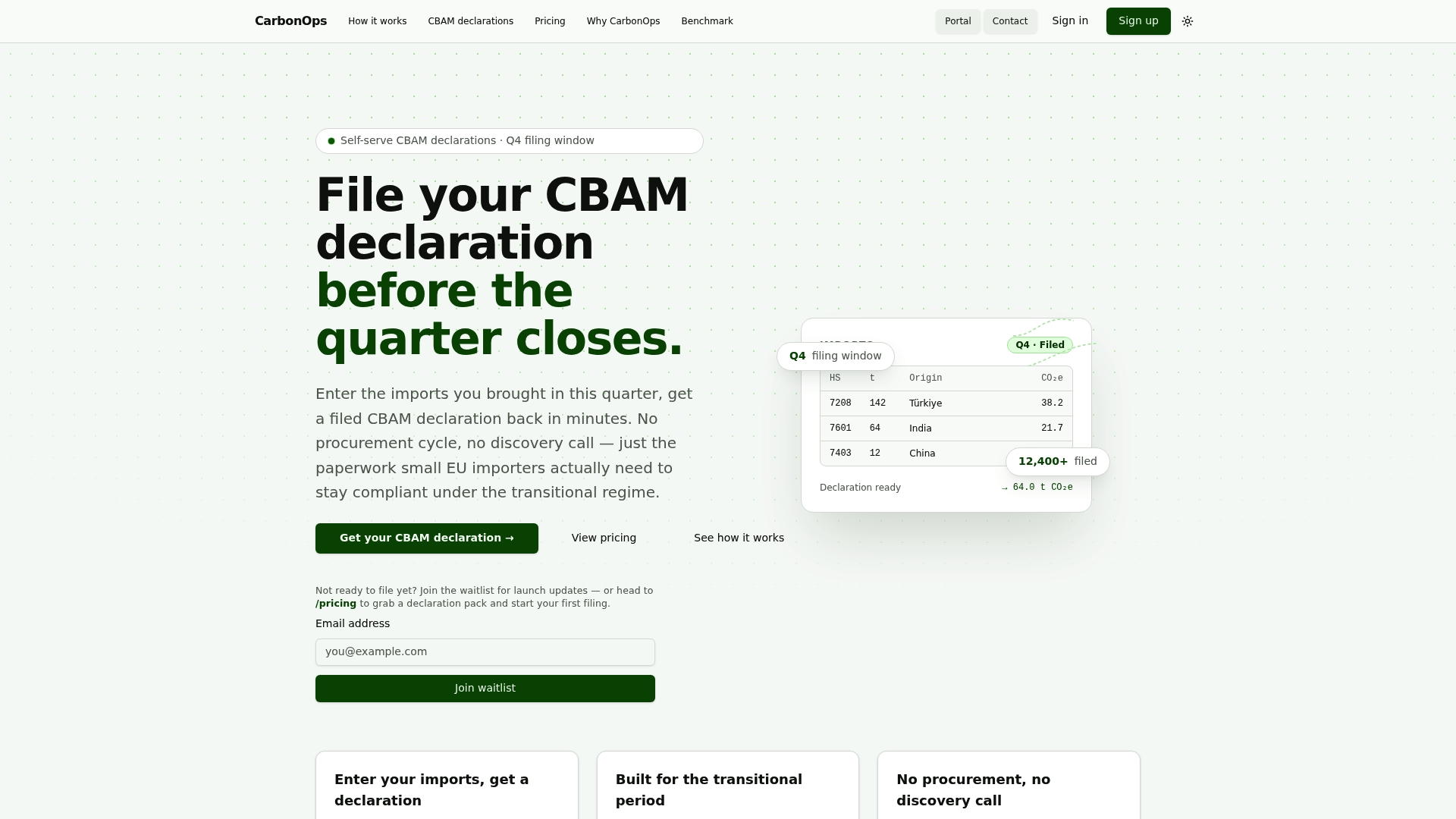
You enter each shipment with its HS/CN code, mass, and country of origin, and CarbonOps validates and maps that data to the CBAM goods it applies to. Every line gets matched to its CBAM sector automatically, so you see at a glance which imports are in scope and what’s still missing. Where supplier-specific embedded emissions aren’t available, CarbonOps applies the Commission’s published default values per CN code and country, so no line stays incomplete. The finished declaration exports in the format the EU CBAM Registry expects, retained with your filing history for the audit trail. If your import volumes cross the 50-tonne threshold and you need a declaration that holds up under review, that’s the gap CarbonOps was built to close.
Frequently Asked Questions
Is CBAM a tax? No. CBAM is a certificate-based obligation tied to the EU ETS allowance price, legally distinct from a tax even though it functions like one economically for importers.
What’s the core difference between CBAM and a carbon tax? CBAM targets imports in specific carbon-intensive sectors and prices them against a market-linked certificate system. A carbon tax is a government-set rate applied economy-wide or sector-wide to domestic emitters.
Which sectors does CBAM currently cover? Iron and steel, cement, aluminum, fertilizers, electricity, and hydrogen, representing about 3% of total EU imports.
When does the definitive CBAM regime start? January 1, 2026, with certificate purchases beginning in 2027 and the first annual declarations due by September 30 of the following year.
Can I deduct a carbon price I already paid in the country of origin? Yes, but only with certified evidence, and the Commission’s detailed implementing rules on this are still being finalized.
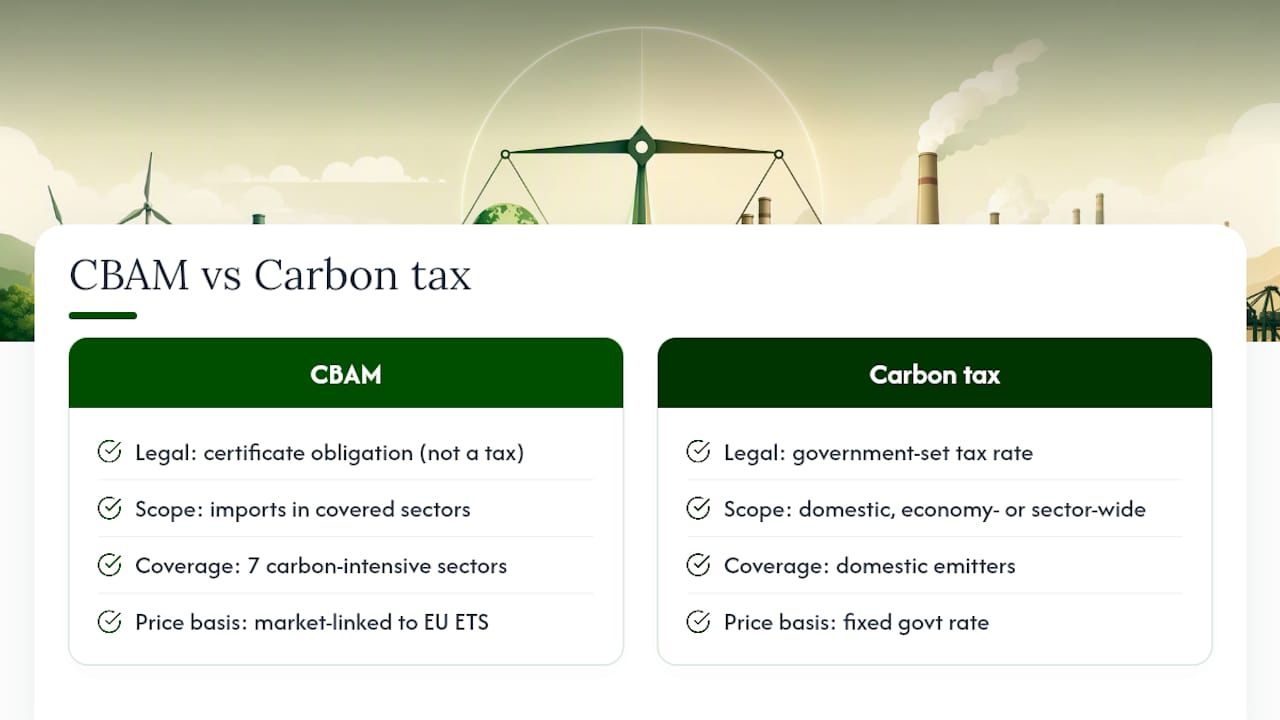
Does a carbon tax reduce emissions more effectively than CBAM? They’re built for different jobs. A carbon tax targets domestic emissions reduction directly, while CBAM exists to prevent carbon leakage and align import costs with domestic carbon pricing, not to replace domestic policy.
Sources
- CBAM definitive regime - Taxation and Customs Union - European Commission
- EU Carbon Border Adjustment Mechanism: What is it, how does it work and what are the effects? - OECD
- What is a carbon border adjustment mechanism? - Brookings
- Research on interactions between border measures and domestic carbon pricing - Journal/working paper