CBAM Precursors List: A Sector-by-Sector Compliance Guide

CBAM Precursors List: A Sector-by-Sector Compliance Guide
In CBAM, precursors are input materials, often CBAM goods in their own right, whose embedded emissions must flow into the final good’s SEEg. Cement clinker feeding into cement, ammonia feeding into fertilizer blends, hot-rolled coil feeding into steel tubes: each carries an emissions footprint that doesn’t disappear just because the material got processed further downstream.
Here’s the part that trips up a lot of import teams: you don’t always have to report precursor data as a separate line item, but you always have to fold its emissions into the final good’s total. The EU’s implementation guidance is explicit on this in Section 6.1.4 and Annex II. Optional reporting rows do not mean optional emissions.
Your first move, before anything else, is straightforward:
- Map every imported line to its CBAM CN code and sector.
- Flag any input material that is itself a CBAM good or a known precursor.
- Send a data request to that supplier immediately, since verification reports take time to produce.
Table of Contents
- What Counts as a CBAM Precursor, Sector by Sector
- How Precursor Emissions Flow Into the SEEg Calculation
- What to Request From Precursor Suppliers
- A Practical Checklist for Filing Precursor Data
- Why Most Compliance Teams Underestimate Precursor Risk
- Sources
What Counts as a CBAM Precursor, Sector by Sector
A precursor, in CBAM terms, is any material consumed in making a covered good whose own production emitted greenhouse gases that need counting. Regulation (EU) 2023/956 sets the six sectors in scope: cement, iron and steel, aluminum, fertilizers, hydrogen, and electricity. Each has its own cast of precursor materials, and knowing them by name saves you from misclassifying a shipment.
1. Cement precursors
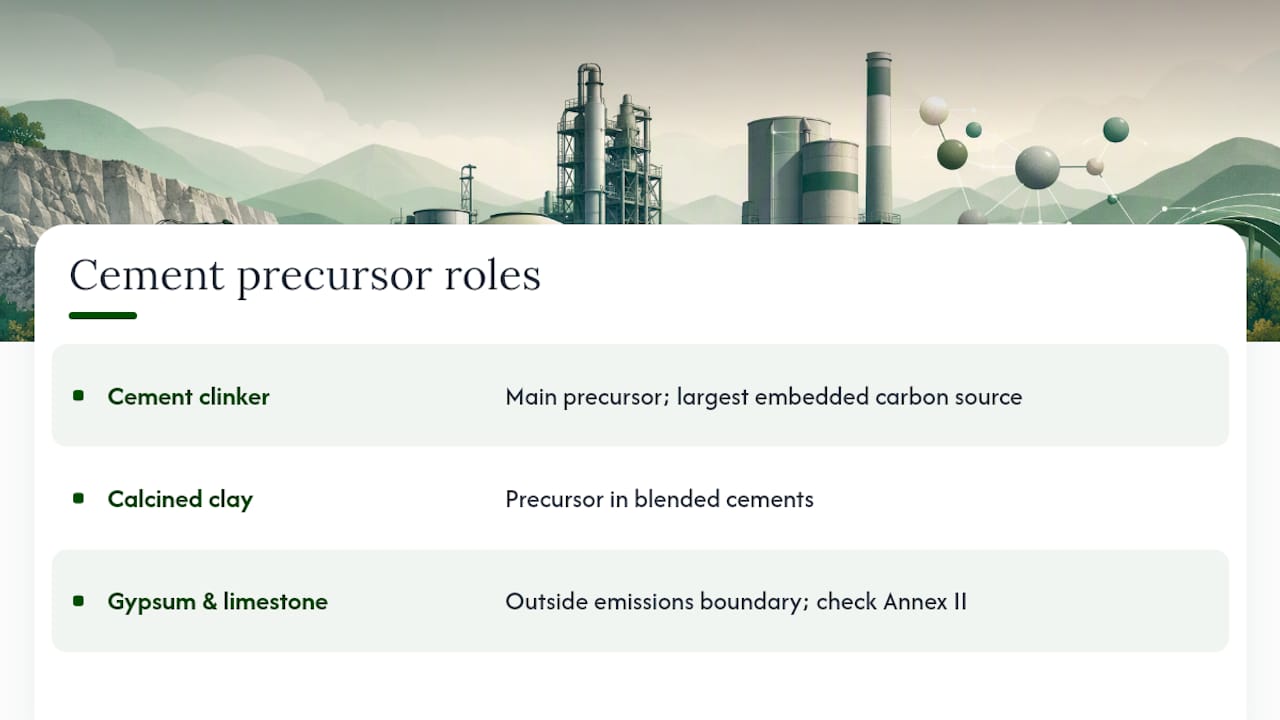
Cement clinker (CN 2523 10 00) is the backbone precursor here. It’s the intermediate product from burning limestone and clay in a kiln, and it accounts for most of cement’s embedded carbon. Calcined clay (CN 2507 00 80) shows up as a precursor too, particularly in blended cements using supplementary materials. Raw gypsum and limestone additions generally sit outside the emissions boundary because their processing emissions are minimal, but always check the current Annex II listing before assuming a constituent is excluded.
2. Iron and steel precursors
This sector has the longest precursor chain of the six. Hot-rolled coil feeds into tubes, pipes, and cold-rolled products. Coke and sintered ore feed into pig iron. Ferro-alloys feed into alloyed steel grades. Each has its own CN code family, and the detailed TAXUD guidance provides production-route tables (Table 5-2) to help you match a specific input to the right precursor category. Get this wrong and you’ll either overcount or undercount emissions for the finished good.
3. Aluminum precursors
Alumina and baked anodes are the two precursors that matter most for primary aluminum. Alumina refining is itself energy-intensive, and baked anode production adds another emissions layer before the metal ever gets smelted. If your imported good is a downstream aluminum product like extrusions or cast parts, both precursors need to be accounted for in the cascade.
4. Fertilizer precursors
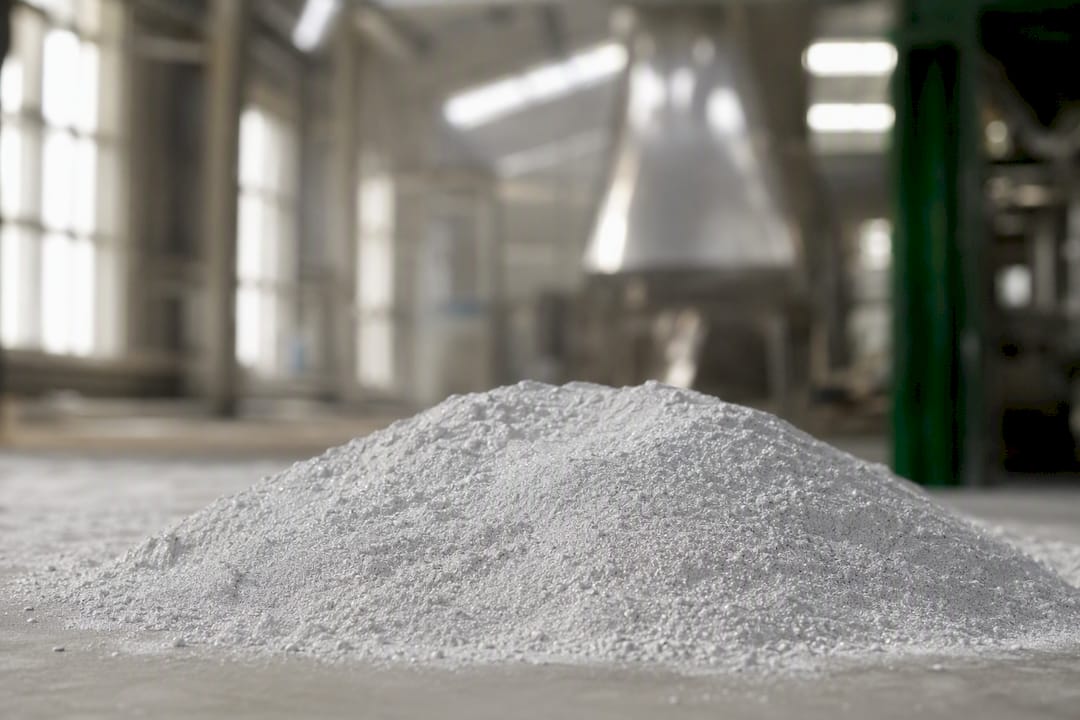
Ammonia and nitric acid are the workhorses. Most NPK blends and nitrogen fertilizers trace their emissions footprint back to ammonia synthesis, which is one of the most energy-intensive industrial processes in the world. Nitric acid production adds nitrous oxide emissions on top of that. If a supplier can’t isolate ammonia-specific emissions data, expect a heavier reliance on default values here.
5. Hydrogen and electricity: a special case
Electricity only counts as a standalone CBAM good when it’s the actual imported commodity crossing the border. In every other case, electricity consumption shows up as an indirect emissions input to whatever good was manufactured using it, not as a separate precursor line. Hydrogen, by contrast, is squarely a covered good and frequently a precursor to ammonia production, so trace it carefully if you’re importing nitrogen fertilizers made with low-carbon hydrogen feedstock.
How Precursor Emissions Flow Into the SEEg Calculation
The SEEg formula (specific embedded emissions of goods) works out to roughly (AttrEmg + EEInpMat) divided by ALg. AttrEmg is the direct and indirect emissions attributable to the production process itself. EEInpMat is the embedded emissions carried in by precursor materials. ALg is the activity level, meaning the quantity of the good actually produced during the reporting period. Divide the sum by that quantity and you get emissions per unit, the figure that ends up on your declaration.
Whether a precursor’s emissions get included or excluded from that calculation depends on its Annex II listing and the specific production route declared. Some constituents, as Sandbag’s analysis points out, sit outside CBAM’s current scope because they receive free allowances under the EU ETS, and that carve-out has real consequences: excluding materials like coke, sintered ore, or alumina from full accounting can understate a steel or aluminum good’s true footprint.
A few rules govern how the numbers actually get built:
- Use supplier-specific actual data when it’s available and verified; fall back to Commission default values only when it isn’t.
- Production periods must align between the precursor supplier’s data and your own reporting period, or you’ll need to average across overlapping periods.
- Precursors sourced from the EU or from a territory covered by the EU ETS can be zero-rated, since their emissions are already priced.
Statistic worth flagging: analysis from Sandbag found that excluding certain free-allowance precursors can reduce CBAM’s coverage of true embedded emissions in steel and aluminum supply chains, a gap compliance teams should factor into how conservatively they estimate when supplier data runs thin.
What to Request From Precursor Suppliers
Getting usable data out of a supplier before your filing deadline requires asking for the right fields the first time, not after three follow-up emails. The Commission’s 2026 quick guide for non-EU operators lays out the parameters that matter most:
- Installation identifier for the facility that produced the precursor.
- Reporting period covered by the emissions figures.
- Direct and indirect embedded emissions, reported separately.
- Production route used (this determines which default values apply if data is missing).
- Quantity of precursor actually consumed in your specific order.
- CN code for the precursor itself.
- Carbon price already paid in the country of production, if any, since that can offset your CBAM certificate obligation.
Verification matters just as much as the numbers themselves. You need an accredited verifier’s positive report covering the exact production period in question, and if electricity is involved through a power purchase agreement or shared grid installation, you need evidence tying that specific electricity to the precursor’s production.
Pro Tip: Build one standardized request template and send it to every precursor supplier the same way. Suppliers who see a consistent, professional ask respond faster than those getting an improvised email chain, and consistency makes your own audit trail far easier to defend later.
When a supplier simply can’t produce verified data in time, document that gap and record which default value you substituted, along with the reasoning. The Commission plans to expand the CBAM Registry in 2027 so operators can share verified emissions data directly, and encouraging your suppliers to register voluntarily now will make every future filing easier.
A Practical Checklist for Filing Precursor Data
Turn all of the above into four steps your team can actually execute and track:
- Map imports. Assign CN codes to every shipment and flag lines that are likely precursors based on the sector tables above.
- Request supplier data. Send your standardized template and collect verification reports covering the correct production period.
- Apply values and cascade. Use actual supplier figures where verified, defaults where not, and run the cascade into your SEEg calculation.
- Export and retain. Format the finished declaration for the CBAM Registry and keep the full audit trail, including which values were actual and which were default.
Tools like CarbonOps handle steps three and four automatically, matching each import line to its CN code and applying published default values wherever supplier data is incomplete.
| Point | Details |
|---|---|
| Precursor emissions are mandatory | Reporting the precursor line is optional, but its embedded emissions must appear in the final good’s SEEg. |
| Sector precursors differ sharply | Cement, steel, aluminum, and fertilizers each rely on distinct precursor materials with their own CN codes. |
| Supplier data beats defaults | Verified installation-level data produces a more accurate SEEg than falling back on Commission default values. |
| Documentation protects you in audits | Recording why a default value was used, and which one, is as important as the number itself. |
Why Most Compliance Teams Underestimate Precursor Risk
The conventional advice on CBAM precursors treats them as a footnote, something to handle once the main goods calculation is done. That gets the priority backwards. For sectors like steel and aluminum, precursor emissions often make up the bulk of the embedded emissions figure, not a marginal add-on. If your team is spending most of its time perfecting the final good’s direct emissions calculation and treating supplier data collection for coke, sintered ore, or alumina as an afterthought, you’re optimizing the smaller number.
The bigger gap I see is process, not knowledge. Compliance officers generally understand that precursor emissions cascade into SEEg. What they lack is a repeatable system for chasing down supplier data before the filing deadline creates pressure to default everything. Start supplier outreach the moment you map a shipment to a CBAM good, not after you’ve confirmed you actually need the figure. That single sequencing change does more for filing accuracy than any formula memorization ever will.
— Jake Stevens
Sources
- Guidance document on CBAM implementation (importers) — TAXUD
- Regulation (EU) 2023/956 establishing CBAM
- Precursors: the products that will eat away at the CBAM’s effectiveness — Sandbag