CBAM Downstream Products: What EU Importers Must Do Now

CBAM Downstream Products: What EU Importers Must Do Now
The EU plans to bring steel- and aluminium-intensive downstream goods under CBAM starting January 1, 2028. That means bolts, structural metalwork, vehicle body parts, radiators, pumps, and hundreds of similar components could soon require embedded-emissions declarations at the EU border. The proposal is still moving through trilogue, but the direction is clear and the compliance clock is running.

Three institutional positions are on the table. The European Commission’s proposal COM(2025)989 covers roughly 180 downstream product codes. The Council widened that to approximately 200 products in its general approach adopted June 12, 2026. The European Parliament’s ENVI committee went further still, backing an estimated 457 downstream products in a July 6, 2026 vote. All three positions share one date: January 1, 2028.
If you import steel- or aluminium-intensive goods into the EU, here is where to start right now:
- Map your SKU list against CN codes and flag any product where steel or aluminium accounts for a significant share of mass or embedded emissions.
- Request supplier emissions data for your highest-risk components before supplier lead times become a bottleneck.
- Identify which shipments would require a declaration under even the narrowest (Commission) scope, then stress-test against the broader ENVI position.
- Assign internal ownership for CBAM compliance across procurement, logistics, and finance before the legislative text is finalized.
Timeline to watch: January 1, 2028 is the proposed effective date across all three institutional positions. Trilogue has not yet started as of mid-2026, so the final product list remains unsettled. Plan for the broadest plausible scope.
Pro Tip: Don’t wait for the final consolidated CN annex. Build your triage list now using the Commission’s ~180-product baseline as the floor and the ENVI committee’s ~457-product position as the ceiling. Any SKU that falls in that range is a compliance risk worth tracking today.
Table of Contents
- Which downstream products are proposed for CBAM coverage?
- Where does the downstream extension stand in the EU legislative process?
- Why is the EU extending CBAM to downstream steel and aluminium goods?
- How did regulators decide which products to include?
- Which sectors face the biggest exposure?
- What compliance steps do importers need to take?
- How to assess whether your products are covered
- What should compliance teams watch for next?
- Key takeaways on CBAM downstream products
- The downstream extension is necessary, but the admin burden risk is real
- Climastry CarbonOps handles your downstream CBAM declarations from day one
- Useful sources for monitoring the downstream CBAM extension
Which downstream products are proposed for CBAM coverage?
The proposal targets goods where steel or aluminium makes up the dominant share of mass and embedded emissions. That focus is deliberate: these products are technically tractable for emissions accounting in a way that downstream cement or fertilizer goods are not. The current extension under Article 30(3) of Regulation (EU) 2023/956 explicitly limits this phase to metals-sector downstream goods.
The main product categories under discussion across all three institutional positions include:
- Fasteners and fixings: bolts, screws, nuts, rivets, washers
- Structural and industrial metalwork: sheet piling, towers, lattice masts, bridges, doors, windows, and frames
- Vehicle and machinery components: vehicle body parts, axles, suspension components, pumps, compressors, valves
- Containers and pressure equipment: tanks, casks, drums, gas cylinders, heat exchangers, radiators
- Metal furniture and fittings: shelving, racking, metal furniture frames
- Selected household appliances and certain medical devices: where steel or aluminium content is dominant
The table below shows how the three positions compare in scope, with representative examples per category:
| Institution | Approx. products | Representative examples | Notes |
|---|---|---|---|
| European Commission | ~180 | Bolts, sheet piling, radiators, pumps, vehicle body parts | Baseline; industrial focus |
| Council (ECOFIN) | ~200 | Adds pre-consumer scrap as precursor; broader structural metalwork | Includes annual list review mandate |
| ENVI Committee (Parliament) | ~457 | Broader household appliances, more consumer-adjacent categories | Widest scope; trilogue starting point for Parliament |
Analysis of candidate goods finds that a large majority of the products under discussion are industrial supply-chain components with high metal content, typically with a high share of steel or aluminium intensity across those categories. That concentration is not accidental. Regulators chose products where the embedded CBAM input is measurable, verifiable, and large enough to matter for carbon accounting.
Five concrete products every importer should check against their SKU list: bolts and fasteners (CN chapter 73), sheet piling and structural sections (CN 7301–7308), radiators and heat exchangers (CN 7322), vehicle body parts and stampings (CN 8708), and industrial pumps and compressors (CN 8413–8414).
Pro Tip: If a product’s bill of materials shows steel or aluminium at more than 50% of total mass, treat it as a high-risk SKU regardless of which institutional position ultimately prevails in trilogue.
Where does the downstream extension stand in the EU legislative process?
The proposal is real but not yet law. Understanding the difference between a Commission proposal, a Council general approach, and a Parliament committee position matters for calibrating how much certainty to build into your compliance planning.
Here is the sequence of key legislative checkpoints:
- December 17, 2025: — Commission publishes COM(2025)989, proposing ~180 downstream product codes with a January 1, 2028 start date.
The gap between the Council’s and Parliament’s product lists is the central negotiating tension. Trilogue outcomes routinely land somewhere between the two positions, meaning the final list could cover a broad range of products within those boundaries. No compliance team should plan around a single number.
Practical implication: A regulation that needs to be published, transposed into national guidance, and supported by Commission implementing acts before January 1, 2028 leaves roughly 12–18 months of effective preparation time once a final text is agreed. That window is shorter than it looks.
Pro Tip: Subscribe to the European Commission’s CBAM taxation and customs page for official updates. Set a calendar alert for the Parliament plenary session following the ENVI committee vote — that is when the Parliament’s formal negotiating mandate becomes public.
Why is the EU extending CBAM to downstream steel and aluminium goods?
The short answer: circumvention. Once CBAM applies to raw steel and aluminium, a straightforward workaround is to process those materials into downstream goods outside the EU, then import the finished components instead of the raw metal. The downstream extension closes that gap.
The policy drivers, in order of weight:
- Circumvention prevention: Importers could avoid CBAM costs by shifting from raw-material imports to component imports. Extending coverage removes that arbitrage.
- Carbon leakage risk: As EU carbon prices rise under the EU Emissions Trading System (EU ETS), the incentive to relocate production of metal-intensive components to lower-carbon-cost countries grows. The extension addresses that risk directly.
- EU competitiveness: EU manufacturers of downstream metal goods already face EU ETS costs on their steel and aluminium inputs. Without CBAM coverage on imports, foreign competitors face no equivalent cost, distorting competition.
- Technical feasibility: Steel- and aluminium-intensive goods are tractable for embedded-emissions accounting because the primary input share is large and measurable. This is why the extension covers metals and not downstream cement or fertilizer goods in this phase.
The German Environment Agency (Umweltbundesamt) has detailed five technical prioritization criteria for downstream inclusion: share of CBAM inputs in the product, emissions relevance, carbon-leakage risk, administrative burden, and circumvention avoidance. These criteria explain why a bolt or a vehicle body panel qualifies while a lightly metal-trimmed consumer product does not.
The approximately 94% industrial supply-chain concentration among candidate downstream goods reflects this logic. Regulators are not trying to cover every product that contains a bolt. They are targeting the products where the embedded carbon cost of steel or aluminium inputs is large enough to create a real leakage or circumvention incentive.
How did regulators decide which products to include?
The German Environment Agency’s framework gives compliance teams a replicable scoring approach. Five criteria determine whether a downstream product belongs on the list:
- Share of CBAM inputs: What percentage of the product’s mass or embedded emissions comes from steel or aluminium? Higher share means higher priority.
- Emissions relevance: Does the embedded carbon from CBAM inputs represent a material portion of the product’s total lifecycle emissions? Products where steel or aluminium dominates the carbon footprint rank higher.
- Carbon-leakage risk: Is there a credible risk that production would shift to non-EU countries to avoid CBAM costs? Trade intensity and production mobility matter here.
- Administrative burden: Can the emissions be calculated and verified without disproportionate cost? Products with complex multi-material compositions or opaque supply chains score lower.
- Circumvention risk: Could the product be used as a vehicle to import CBAM-covered materials in processed form, bypassing the raw-material levy? Products that are essentially processed steel or aluminium with minimal value-added transformation score highest.
To apply this framework to your own SKU list, work through these questions for each product group:
- Does steel or aluminium account for more than 50% of total product mass?
- Is the embedded carbon from those inputs more than 30% of the product’s estimated total emissions?
- Is the product manufactured in countries with lower carbon pricing than the EU?
- Can your supplier provide a production route statement and material composition certificate?
- Is the product structurally similar to a raw CBAM good with minor processing (e.g., cut-to-length sections, stamped blanks)?
Products that score “yes” on three or more of these questions should be treated as high-risk for downstream CBAM coverage.
Pro Tip: When evaluating mid-weight components like brackets, flanges, or structural fittings, weigh trade intensity against cost-push. A product with thin margins and high import volumes from carbon-intensive origins is a circumvention risk even if its absolute emissions are modest. That combination is exactly what regulators are targeting.
Which sectors face the biggest exposure?
Automotive is the highest-risk sector by volume and complexity. Vehicle body parts, chassis components, axles, and suspension systems are all candidate downstream products. An automotive importer or OEM sourcing stampings, castings, or structural assemblies from non-EU suppliers will likely face declaration obligations across a large portion of their component portfolio.
Construction and structural metalwork follows closely. Sheet piling, prefabricated structural sections, metal doors and windows, towers, and lattice masts are all in scope across the institutional positions. Construction supply chains that source fabricated metalwork from Turkey, India, or Southeast Asia face direct exposure.

| Sector | Typical downstream products | Likely policy exposure |
|---|---|---|
| Automotive | Body panels, axles, suspension parts, fasteners | High |
| Construction | Sheet piling, structural sections, doors, windows | High |
| Heavy machinery | Pumps, compressors, valves, gearboxes | High |
| Industrial equipment | Heat exchangers, pressure vessels, tanks | High |
| Household appliances | Radiators, certain white goods frames | Medium |
| Medical devices | Selected metal-intensive devices | Medium (ENVI position) |
Exposure also depends on where you sit in the value chain:
- Raw-material importers already file CBAM declarations. The downstream extension does not change their obligations directly, but it changes what their customers need from them (supplier emissions data).
- Component importers are the primary new declarants under the downstream extension. If you import bolts, structural sections, or vehicle parts, you become responsible for the declaration.
- OEMs and contract manufacturers importing sub-assemblies or finished components face the broadest SKU exposure and the most complex emissions-accounting requirements.
- Distributors importing on their own account are declarants; those importing on behalf of EU buyers need to clarify contractual responsibility for the declaration.
The ~94% industrial supply-chain concentration among candidate products means the downstream extension is fundamentally a B2B compliance event, not a consumer-goods issue. If your imports are industrial components destined for further manufacturing or construction, assume you are in scope until the final text proves otherwise.
What compliance steps do importers need to take?
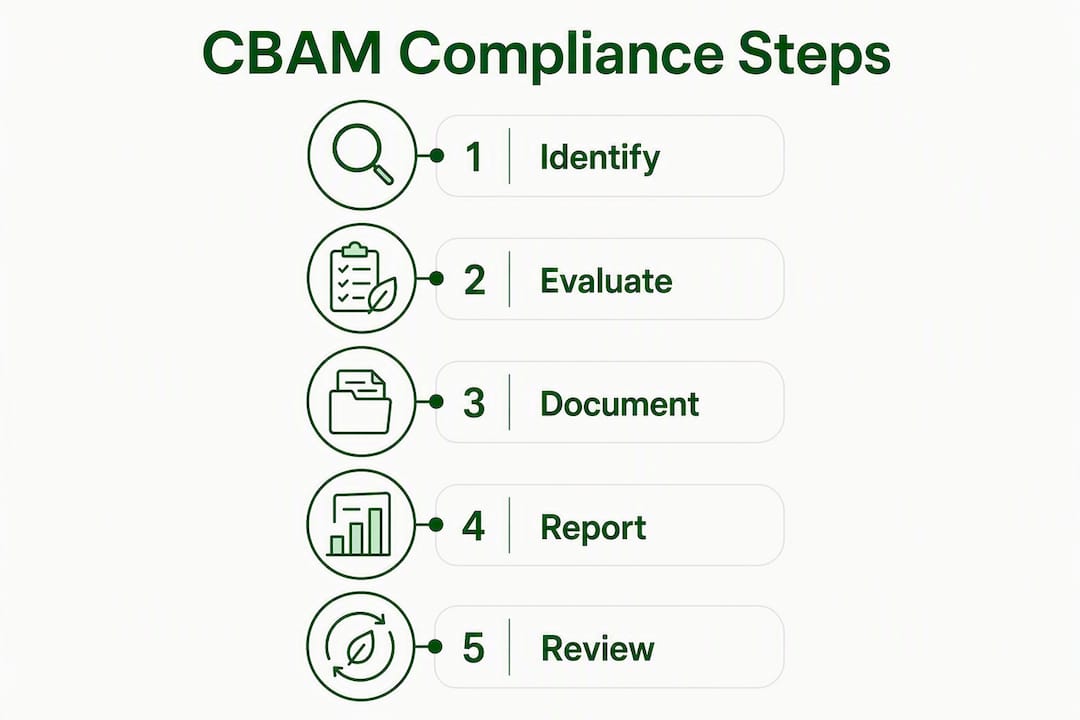
Importers of newly covered downstream goods will become declarants. That means quarterly reporting during any transitional phase, then definitive obligations tied to EU ETS alignment once the regulation is fully in force. The data requirements are similar to current CBAM: CN code, mass, country of origin, and embedded emissions per unit, either from supplier-specific data or EU default values.
Here is the operational checklist:
- Extract your full SKU/CN code list from commercial invoices and customs declarations. Flag every code that falls within the candidate product categories.
- Request supplier emissions data for high-risk SKUs. Ask for production route statements, material composition certificates, and where available, Environmental Product Declarations (EPDs).
- Map precursor inputs. For each downstream product, identify the steel or aluminium inputs used in production and their origin. The Council’s text adds pre-consumer scrap as a recognized precursor, so document scrap content where relevant.
- Estimate embedded emissions using supplier data where available. Where it is not, apply EU default values per CN code as a placeholder.
- Update commercial invoice templates to capture the data fields CBAM declarations require (supplier installation, production route, embedded emissions per tonne).
- Assess IT system readiness. Can your ERP or trade compliance system handle CN-level emissions data fields and quarterly aggregation?
- Train procurement and logistics staff on what data to request from suppliers and how to handle missing or incomplete supplier responses.
The administrative burden is real, particularly for SMEs importing a wide range of metal components in small volumes. Practical mitigation tactics include batching declarations by product category, using EU default values for low-volume or low-value SKUs to reduce supplier data requests, and prioritizing supplier engagement for the top 20% of SKUs by import value or volume.
Pro Tip: EU default values are not a penalty — they are a legitimate fallback built into the regulation. For SMEs with dozens of small-volume metal component lines, applying defaults to the long tail of SKUs and investing supplier-engagement effort only in high-volume, high-emissions lines is a defensible and efficient approach.
One accounting edge case to resolve early: the Council’s general approach includes pre-consumer scrap as a precursor in emissions accounting, while post-consumer scrap remains outside the current proposals. If your suppliers use significant scrap content in production, clarify which category applies and document it before your first declaration.
How to assess whether your products are covered
Start here: map your SKUs to CN codes, score each against the five selection criteria, then calculate embedded emissions using supplier data or EU defaults. That three-step sequence produces a defensible coverage assessment and the inputs for a provisional declaration.
The detailed workflow:
- Extract your SKU/CN list. Pull every CN code you import from your customs declarations or ERP system. Cross-reference against the Commission’s ~180-product baseline list as the minimum scope.
- Identify CBAM input share. For each CN code, estimate what percentage of product mass comes from steel or aluminium. Use bill-of-materials data or mass-weighted assumptions where exact data is unavailable. Document your assumptions.
- Request supplier primary emissions data. Ask suppliers for production route descriptions, material composition statements, and specific embedded emissions figures (tonnes CO₂e per tonne of product). Give suppliers a structured data request template so responses are consistent.
- Apply EU default values where supplier data is missing. The EU publishes default embedded emissions values per CN code. These are conservative (typically higher than actual supplier emissions) but they make the declaration complete and reviewable.
- Calculate per-SKU embedded emissions. Multiply the embedded emissions factor (supplier-specific or default) by the imported mass per shipment. This gives you the embedded emissions figure for the declaration.
- Aggregate by shipment for a provisional declaration. Sum per-SKU embedded emissions across all products in a shipment or reporting period. This is the figure that goes into the transitional CBAM declaration.
Documents to collect for each high-risk product line:
- Supplier production route statement (electric arc furnace vs. blast furnace matters for emissions intensity)
- Material composition certificate (steel/aluminium content by mass)
- Batch or lot data linking production records to specific shipments
- Purchase invoices with CN codes and net mass
- Transport mode records (relevant for indirect emissions where applicable)
| Document | Purpose | Priority |
|---|---|---|
| Production route statement | Determines emissions factor | High |
| Material composition certificate | Confirms CBAM input share | High |
| Embedded emissions declaration | Supplier-specific emissions figure | High |
| Purchase invoice with CN code | Links product to declaration | High |
| Batch/lot data | Audit trail for specific shipments | Medium |
| Transport records | Indirect emissions (where required) | Low/Medium |
For tooling, a well-structured spreadsheet covering CN code, mass, emissions factor, and source (supplier vs. default) handles most SME needs in early preparation. As volume grows, purpose-built software that handles CN/HS mapping, supplier data intake, and EU default fallback becomes worth the investment. Climastry’s CarbonOps platform handles all four steps in that workflow without requiring platform deployment or a procurement cycle.
Pro Tip: Build your audit trail from day one. Keep a versioned log of supplier data requests, responses, and the default values applied where responses were missing. When a customs authority reviews your declaration, the audit trail is what turns a defensible estimate into a compliant filing.
What should compliance teams watch for next?
The most consequential near-term event is the European Parliament plenary vote, which gives Parliament its formal mandate for trilogue. After that, trilogue negotiations begin, and the final product list takes shape. Here is what to monitor:
- Trilogue negotiation updates: — Commission, Council, and Parliament publish press releases after each trilogue round. The key variable is where the final product list lands between ~200 and ~457 items.
Recommended monitoring cadence and calendar actions:
Key takeaways on CBAM downstream products
The EU’s downstream CBAM extension targets steel- and aluminium-intensive industrial components with a proposed January 1, 2028 start date, and importers who act now on SKU mapping and supplier data will be materially better positioned than those who wait for the final text.
| Point | Details |
|---|---|
| Proposed start date | January 1, 2028 is the target across all three institutional positions; trilogue is pending as of mid-2026. |
| Product scope range | The final list will fall between the Commission’s ~180-product baseline and the ENVI committee’s ~457-product ceiling, with the Council’s ~200-product position as the likely lower bound for trilogue. |
| Highest-risk sectors | Automotive, construction, heavy machinery, and industrial equipment face the broadest SKU exposure. |
| Five selection criteria | Input share, emissions relevance, leakage risk, administrative burden, and circumvention risk determine product inclusion. |
| Immediate action | Map SKUs to CN codes now, request supplier emissions data for high-risk lines, and run a dry-run declaration in Q4 2026. |
| Climastry CarbonOps | Handles CN/HS mapping, supplier data intake, EU default fallback, and PDF-ready declarations with no platform deployment. |
The downstream extension is necessary, but the admin burden risk is real
The policy logic behind extending CBAM to downstream steel and aluminium goods is sound. Without it, the original CBAM creates an obvious arbitrage: process your steel into bolts or body panels outside the EU, then import the finished components instead of the raw metal. The extension closes that gap. Anyone who argues otherwise is essentially arguing for a policy with a built-in workaround.
What concerns me more is the administrative burden risk, particularly for SMEs. The gap between the Council’s position and the ENVI committee’s position represents a significant increase in SKUs, supplier data requests, and declaration line items for importers, which could challenge those with limited staff or systems. A regulation that is technically correct but operationally crushing for mid-sized importers risks pushing compliance toward the largest players and leaving smaller firms either non-compliant or exiting the market.
The five-criteria framework from the German Environment Agency is the right filter. Products that score high on circumvention risk and input share deserve to be in scope. Products that score high mainly on administrative burden should be scrutinized carefully in trilogue. The ENVI committee’s broader position may reflect legitimate climate ambition, but the final negotiated text needs to hold the line on technical feasibility and proportionality.
My practical advice for senior compliance and procurement leaders: don’t wait for the final list to start building your data infrastructure. Invest in supplier data for your core components now. Pilot a declaration workflow on your current CBAM-covered goods if you have them, or on your highest-risk downstream SKUs if you don’t. And create a cross-functional CBAM task force that includes procurement (supplier data), legal (declaration responsibility), logistics (CN code accuracy), and IT (systems readiness) before the legislative text is finalized. The teams that treat this as a data and process problem now will spend far less time in crisis mode in 2027.
Climastry CarbonOps handles your downstream CBAM declarations from day one
Filing a CBAM declaration for a downstream steel component is not fundamentally different from filing one for raw steel. The inputs are the same: CN code, mass, country of origin, embedded emissions. What changes is the volume of SKUs and the complexity of supplier data requests. That is exactly where most compliance teams hit a wall.
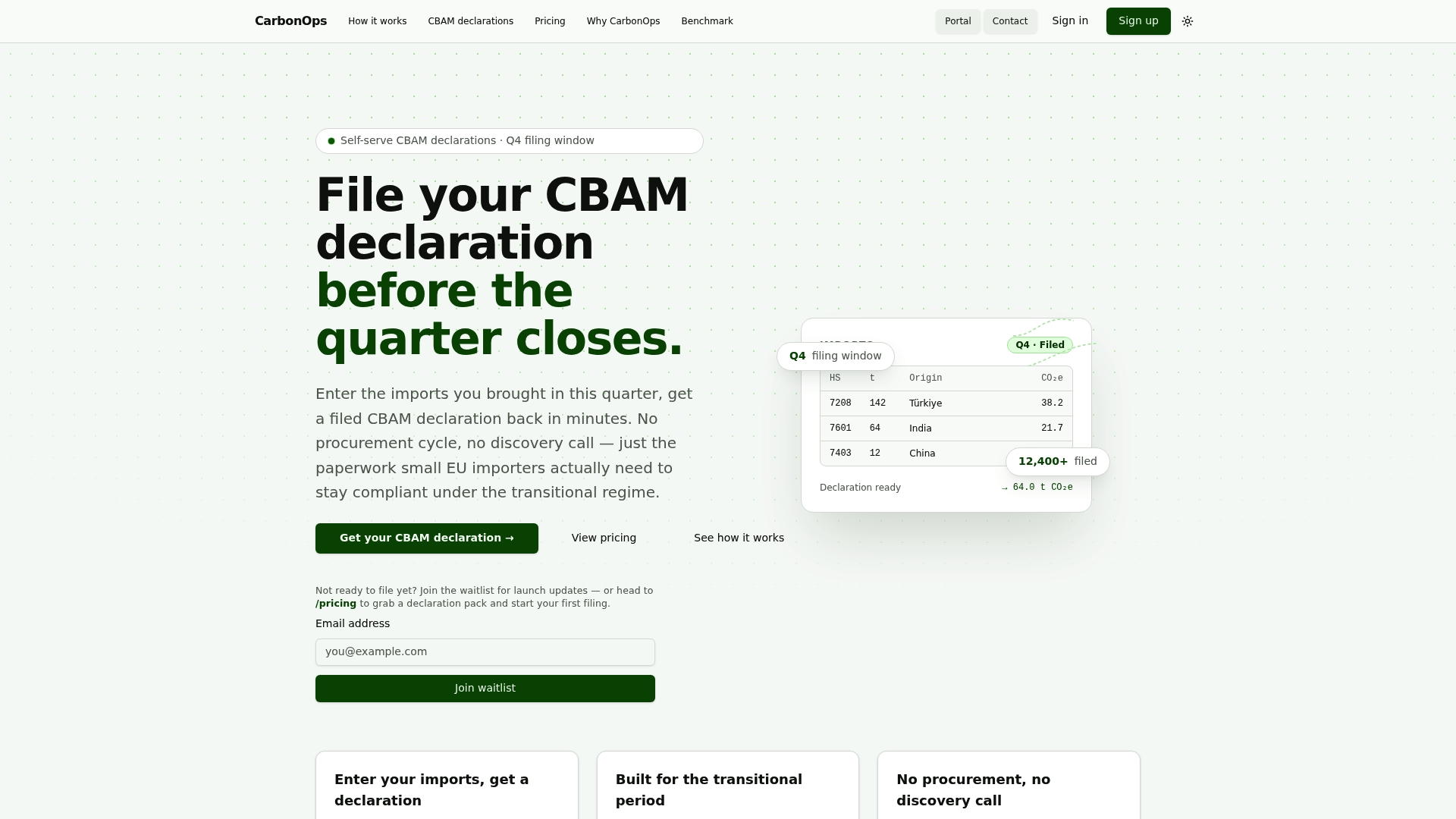
Climastry’s CarbonOps platform was built for this. Enter each shipment with its HS code, mass, and origin. The platform validates supplier data, applies EU default values where supplier figures are missing, and exports a completed declaration in the format the EU transitional CBAM registry expects. No platform deployment. No onboarding cycle. No subscription. You pay per declaration, get the filing back, and keep the audit trail.
For importers preparing for the downstream extension, that means you can run a dry-run declaration on your highest-risk SKUs today, before the final regulation is published. When the consolidated CN annex drops, you update your product list and file. The workflow does not change.
Start your first declaration at climastry.com and see how long it actually takes.
Useful sources for monitoring the downstream CBAM extension
The official sources below are the authoritative references for tracking legislative progress, product scope, and compliance guidance. Monitor them directly rather than relying on secondary summaries.
| Source | What to watch | Monitoring priority |
|---|---|---|
| European Commission press release on downstream CBAM | Official scope statement, Commission position, press updates | High |
| Commission CBAM taxation and customs page | Implementing regulations, default values, guidance documents, CN annexes | High |
| European Parliament EPRS briefing on downstream extension_EN.pdf) | Parliament analysis, product mix data, institutional position summaries | High |
| Commission impact assessment | Policy rationale, Article 30(3) basis, technical feasibility analysis | Medium |
| Umweltbundesamt: Inclusion of downstream products in CBAM | Five prioritization criteria, technical scoring framework | Medium |
| Commission guidance for installation operators outside the EU | CN code lookup methodology, embedded emissions calculation guidance | Medium |
Key monitoring actions:
- Check national customs authority websites — (for example, the German Zollverwaltung or French Douanes) for member-state implementation guidance, which often precedes Commission-level guidance on operational details.
Recommended cadence: weekly checks during active trilogue rounds, monthly otherwise. Set a calendar reminder for the first week of each month to review the Commission’s CBAM page for new guidance or implementing acts.