Importers: File CBAM Definitive Regime Declarations in Four Steps

Importers: File CBAM Definitive Regime Declarations in Four Steps
The CBAM definitive regime took effect on January 1, 2026, replacing the transitional reporting-only phase with real financial obligations. If you import cement, iron and steel, aluminum, fertilizers, electricity, or hydrogen into the EU and cross the 50-tonne annual threshold, you now need authorized declarant status, a Registry account, and supplier emissions data. Your immediate priorities: confirm your authorization status, request CBAM Registry access, and start collecting embedded emissions figures from suppliers now, not in September.
TL;DR:
- Importers exceeding 50 tonnes annually for cement, steel, aluminum, or fertilizers, or importing hydrogen or electricity, must obtain authorized declarant status before shipments.
- Verification of supplier emissions data is optional but can significantly lower costs compared to default values, which are usually more conservative.
- Certificates are priced based on EU ETS auction averages, fluctuating weekly from 2027, and require purchase to match embedded emissions for each shipment.
- Compliance involves detailed shipment records, verified or default emissions data, proof of domestic carbon payments, and six-year retention of documentation.
- Non-compliance risks include penalties, suspension of import authorization, and paying higher costs due to reliance on default emissions data.
Table of Contents
- What Does the CBAM Definitive Regime Actually Cover?
- Do You Need to Apply for Authorized CBAM Declarant Status?
- How Does the CBAM Registry and Annual Declaration Work?
- When Do You Need Verified Emissions Instead of Default Values?
- How Are CBAM Certificate Prices Calculated?
- Which Sectors and Goods Fall Under CBAM Right Now?
- Where Should You Go for Authoritative CBAM Guidance?
- A Four-Step Workflow to Turn Shipment Data Into a Filing-Ready Declaration
- What Happens If You Don’t Comply With CBAM?
- How Does the Phase-In Period Change Your Obligations Through 2034?
- What Documentation Do You Need to Prepare a CBAM Declaration?
- How Is the CBAM Price Actually Calculated?
- How Does CBAM Interact With the EU ETS and Other Climate Policies?
- Why the Real Compliance Risk Isn’t the Deadline, It’s the Data
- Turn Your Import Data Into a Filed CBAM Declaration Without a Platform Rollout
- Sources
What Does the CBAM Definitive Regime Actually Cover?
The CBAM definitive regime replaces the transitional period’s simple quarterly reporting with binding financial obligations: certificate purchases, verified emissions data, and annual declarations. It applies to six sectors initially, with full coverage phasing in through 2034 as the European Commission tightens default values and expands scope.
The mechanism mirrors the EU Emissions Trading System by design. As EU manufacturers lose free carbon allowances under ETS reform, CBAM steps in to apply an equivalent carbon cost to imported goods so domestic producers don’t simply get undercut by carbon-intensive imports from countries without a comparable price on emissions.
One detail trips up a lot of importers: the reporting period isn’t always the year you imported the goods. The default is the calendar year of import, but if you can document the actual production year for a shipment, that year governs which default values or verified figures apply. For goods sitting in transit or storage for months, that distinction can shift your entire emissions calculation.
Do You Need to Apply for Authorized CBAM Declarant Status?
The threshold is simple on paper: if your imports of CBAM-covered goods exceed a specified annual quantity threshold requiring authorized declarant status, you must apply for authorized declarant status before you can keep importing. Hydrogen and electricity importers don’t get a threshold at all. Authorization is mandatory from the first kilogram.
Run this quick test: total up your annual imports across cement, iron and steel, aluminum, and fertilizer by mass. If the sum tips past 50 tonnes, or if you import any hydrogen or electricity, you’re in scope. The application goes through your National Competent Authority, either directly if you’re the importer of record or through your indirect customs representative if a third party handles customs clearance on your behalf.
Before you apply, gather:
- Your EORI number and proof of establishment in the EU (or your representative’s)
- A list of the CN codes and expected annual volumes for goods you plan to import
- Financial guarantees or solvency documentation, which some National Competent Authorities require for new applicants
- Contact details for whoever will manage your CBAM Registry account day to day
Processing times vary by member state, and a backlog is common right after enforcement deadlines. Apply well before you need to file your first shipment, not the week before a declaration is due. Waiting on authorization while shipments pile up at customs is not a position you want to be in.
How Does the CBAM Registry and Annual Declaration Work?
The CBAM Registry is where every authorized declarant files, tracks certificates, and manages their compliance history. Once you’re authorized, your National Competent Authority grants you access, and you’ll set up user roles for whoever handles data entry versus final submission.
The annual declaration follows a predictable rhythm:
- Collect data all year. Track every CBAM-covered shipment with its CN code, quantity, country of origin, and embedded emissions figure.
- Reconcile by early September. Cross-check quantities against customs records and confirm which lines use verified data versus default values.
- File by September 30. The declaration for calendar year 2026 imports is due September 30, 2027, and every year follows the same pattern: prior-year data, filed the following fall.
- Retain everything for six years. Guidance No.1 sets this retention period for monitoring records, verification reports, and supporting documentation.
Your declaration needs to show quantities and origin per shipment, embedded emissions (verified or default), any free-allocation adjustment relevant to the EU sector equivalent, and documentation of carbon prices already paid abroad. Organize shipment lines by HS/CN code from day one. Retrofitting six months of scattered invoices into a clean declaration in August is a miserable way to spend a summer.
When Do You Need Verified Emissions Instead of Default Values?
Every authorized declarant needs a monitoring plan that documents how emissions data gets collected, calculated, and checked before it reaches a declaration. Guidance No.1 lays out how that plan should align with the Commission’s Methodology Act, covering everything from data sources to quality checks.
You have two paths for the emissions figure itself: use the Commission’s published default values per CN code and country, or use verified actual emissions from your supplier. Default values are faster but usually higher, since they’re built to be conservative. Verified figures take more upfront work but often mean lower certificate costs, particularly for efficient producers.
That verification has to come from an accredited party. Verifiers need accreditation from an EU National Accreditation Body covering your specific industrial sector, and there aren’t unlimited verifiers to go around.
- Confirm your monitoring plan covers every CN code you import, not just your highest-volume lines.
- Contract a verifier in the first quarter of your reporting year, not the third.
- Keep every monitoring record, invoice, and verification report for at least six years.
Pro Tip: Book your verifier before you need them. Accreditation constraints mean the sector-qualified verifier pool is smaller than it looks, and a scheduling gap in September can delay your entire declaration.
How Are CBAM Certificate Prices Calculated?
CBAM certificate prices track the EU ETS auction average, which means your import costs move with a market you don’t control. In 2026, that price gets set quarterly; from 2027 onward, it updates weekly, so the certificate price you pay in March could look very different by November.
Certificates for imports from the first year go on sale starting early 2027, and you surrender them annually by September 30 alongside your declaration. But you can’t wait until then to buy: starting February 2027, a quarterly purchase rule kicks in requiring you to hold certificates covering at least 50% of your year-to-date embedded emissions at each checkpoint.
- Buy certificates progressively through the year to smooth out price volatility
- Document any carbon price already paid in the country of origin, since that amount can be deducted from your certificate obligation
- Keep proof of payment records tied to each shipment for the deduction to hold up
Industry analysis for metals buyers frames this correctly: CBAM isn’t a flat administrative fee, it’s a market exposure tied to EUA price swings, and treating it like a fixed cost line is how budgets get blown.
Which Sectors and Goods Fall Under CBAM Right Now?
Six sectors carry CBAM obligations under the definitive regime: cement, iron and steel, aluminum, fertilizers, electricity, and hydrogen. Each has its own CN code list and its own quirks.
- Iron and steel requires attention to precursor inputs. If your finished product incorporates semi-finished steel, embedded emissions from that precursor carry through your calculation.
- Aluminum often involves indirect emissions from electricity used in smelting, which needs separate documentation from direct process emissions.
- Fertilizers frequently trip up importers blending multiple nitrogen sources into one shipment line.
- Electricity and hydrogen have no minimum threshold and simpler goods definitions, but stricter monitoring expectations.
The Commission’s sector-specific guidance (Guidance No.5a through 5f) includes worked examples for each category, and they’re worth reading before your first declaration rather than after a rejected one.
Where Should You Go for Authoritative CBAM Guidance?
Three sources matter more than anything else you’ll find searching around: Regulation (EU) 2023/956 itself, the implementing acts that carry legal force, and the Guidance No.1 through No.5 series the Commission publishes to clarify how those rules apply in practice.
The distinction matters: implementing acts are binding law. Guidance documents explain interpretation and method but aren’t themselves law, so where they seem to conflict with the Regulation, the Regulation wins. Follow your National Competent Authority’s own bulletins and the Commission’s newsroom for updates, since sector guidance and default value tables get revised as more verified data comes in across the EU.
A Four-Step Workflow to Turn Shipment Data Into a Filing-Ready Declaration
Most of the compliance burden isn’t legal complexity, it’s data organization. A workable process looks like this:
- Log every import with its HS/CN code, mass, and country of origin, validated against customs records.
- Match each line to its CBAM sector to confirm scope and flag which shipments still need emissions data.
- Apply emissions figures — verified supplier data where you have it, default values per CN code and country where you don’t.
- Export in Registry format, retain the audit trail, and submit before September 30.
Pro Tip: Build your verifier touchpoint into step three, not as an afterthought. A line waiting on verification is a line that can stall your whole declaration in the final week.
This is essentially the process CarbonOps automates for self-serve filers, and whether you build it in a spreadsheet or use software, the logic doesn’t change.
What Happens If You Don’t Comply With CBAM?
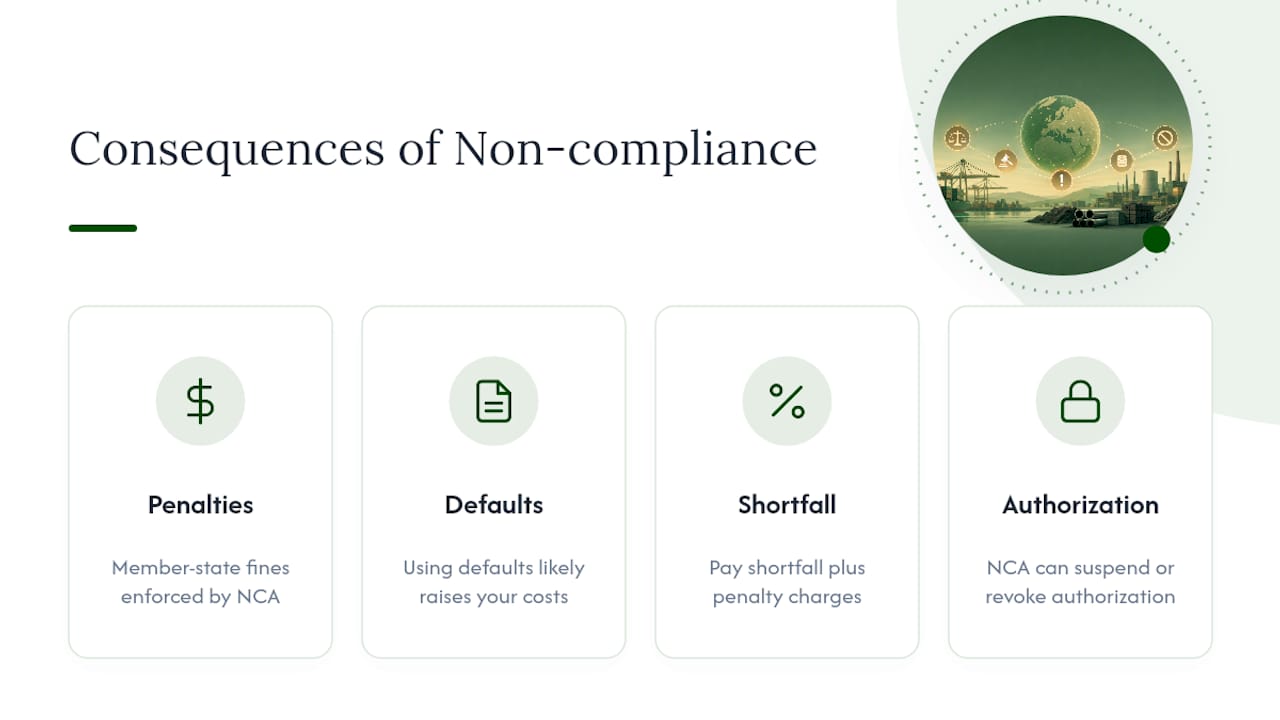
Non-compliance carries real financial and operational risk, not just paperwork friction. Failing to hold authorized declarant status while importing above the 50-tonne threshold, or while importing any hydrogen or electricity, exposes you to penalties set at the member-state level and enforced through your National Competent Authority.
Missing the September 30 declaration deadline, filing incomplete data, or failing to surrender enough certificates by year-end each trigger separate consequences. Underlying all of this is a simple mechanic: if you don’t surrender enough certificates to cover your declared embedded emissions, national authorities can pursue you for the shortfall plus penalty charges, similar to how EU ETS enforcement works domestically.
There’s also a quieter risk that doesn’t show up in a penalty schedule. If you rely entirely on default values because you never collected supplier-specific data, you likely pay more than a competitor who did the legwork. Analysis for metals buyers makes this point directly: default values are built conservative, and importers who never move past them absorb a cost their supply chain didn’t have to carry.
Beyond financial penalties, repeated non-compliance can affect your authorized declarant status itself. A National Competent Authority can suspend or revoke authorization for persistent failures, which means you can’t legally continue importing CBAM goods until you resolve it. For a business with EU imports as a core supply line, that’s not a fine you absorb and move on from. It’s an operational halt.
How Does the Phase-In Period Change Your Obligations Through 2034?
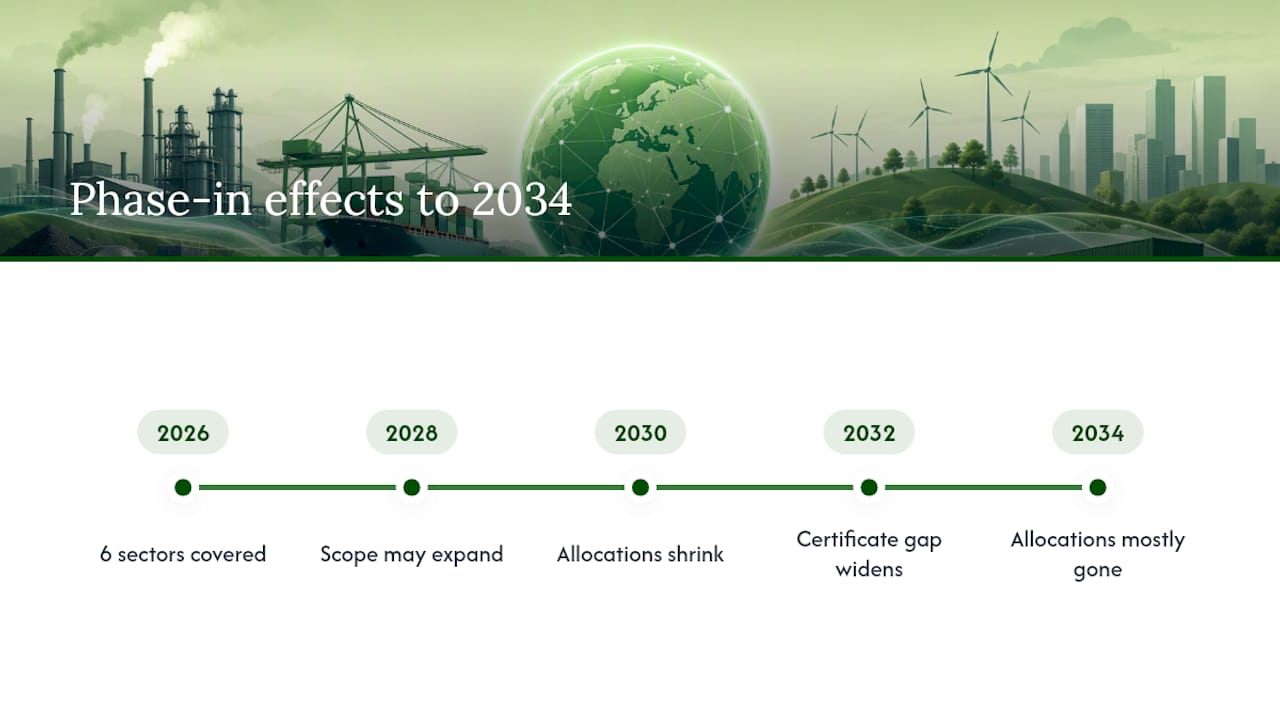
The definitive regime didn’t arrive as a single switch flipped on January 1, 2026. It phases in gradually through 2034, and what changes year to year is mostly the scope of goods covered and the shrinking of free allocations under the parallel EU ETS reform.
For imports in 2026 and the years immediately after, you’re working with the six sectors initially defined: cement, iron and steel, aluminum, fertilizers, electricity, and hydrogen. The Commission has signaled it will expand CBAM’s scope over time to cover more downstream products and potentially additional sectors, but nothing beyond the current six is locked in yet for the near term.
The bigger transition to watch is on the EU side, not the import side. As EU manufacturers in CBAM-covered sectors lose free ETS allowances progressively through 2034, the certificate price gap between doing nothing and complying properly widens. Early years carry a lower certificate cost simply because free allocation still cushions EU producers; later years won’t offer that same cushion, which means the earlier you build a verified-emissions capability with suppliers, the more resilient your cost base looks as allocation shrinks.
Practically, that means don’t treat your 2026 compliance setup as a one-time project. Build your data collection and supplier relationships assuming the cost pressure only increases as the phase-in matures. Importers who wait until scope expansion forces their hand will be doing this same authorization and data-collection scramble again in a few years, under worse time pressure.
What Documentation Do You Need to Prepare a CBAM Declaration?
The single biggest predictor of a smooth declaration season is whether you organized your documentation as shipments happened, rather than reconstructing it in August. Four categories of data feed every declaration.
Shipment-level records come first: HS/CN code, mass in tonnes, country of origin, and the customs entry reference for each import. These need to reconcile cleanly against your customs declarations, since discrepancies here are the fastest way to trigger a National Competent Authority query.
Emissions data is the technical core. For each shipment line, you need either a verified emissions figure from a verifier accredited under EU rules or a documented default value pulled from the Commission’s published tables for that CN code and country of origin. Mixing both across a single declaration is normal, most importers do, but each line needs to clearly show which method applies.
Supporting evidence for deductions matters if you’re claiming a reduction for carbon prices already paid in the country of origin. That requires proof of payment tied to the specific production batch, not a general statement that “some carbon tax applies” in the exporting country.
Monitoring plan documentation ties it together, showing how your data collection method aligns with the Methodology Act referenced in Guidance No.1. Keep all of it for six years. That’s not a suggestion, it’s the retention floor set in the guidance itself.
How Is the CBAM Price Actually Calculated?
The CBAM certificate price isn’t set independently. It’s pegged to the average auction price of EU ETS allowances, recalculated quarterly through 2026 and weekly starting in 2027. Your cost per shipment comes from multiplying your embedded emissions figure (in tonnes of CO2 equivalent) by that certificate price, then subtracting any documented carbon price already paid at origin.
This has a direct consequence for budgeting: your CBAM cost isn’t a fixed line item, it moves with the EU carbon market. A shipment declared in a quarter with a higher EU ETS average costs more in certificates than the identical shipment declared when prices are lower, even if nothing about the goods themselves changed.
The practical impact on import costs scales with two variables you can influence and one you can’t. You can influence your embedded emissions figure, verified data from an efficient supplier usually beats a conservative default value, and you can influence your deduction documentation for carbon already paid abroad. You cannot influence the EU ETS market price itself. Industry analysis frames this correctly as a market-risk exposure rather than a static tariff, which means importers who treat CBAM like a hedgeable cost, buying certificates progressively rather than in one lump purchase near a deadline, tend to manage the price swings better than those who wait.
How Does CBAM Interact With the EU ETS and Other Climate Policies?
CBAM was built as the import-side mirror of the EU Emissions Trading System, not a standalone tax. The connection runs in both directions, and understanding it clarifies why several CBAM rules exist at all.
On the price side, CBAM certificates cost whatever the EU ETS auction average says they cost. There’s no separate CBAM pricing mechanism, which means EU ETS reform decisions directly move CBAM costs for every importer, even those who’ve never heard of the domestic scheme.
On the allocation side, EU manufacturers in CBAM-covered sectors currently still receive some free ETS allowances, a legacy protection against competitiveness loss. As the ETS reform phases those allowances down through 2034, CBAM’s certificate requirement for importers effectively steps in to fill the gap, so imported goods face a comparable carbon cost to what domestic EU production faces once its free allocation shrinks. That’s the entire logic of the “adjustment” in Carbon Border Adjustment Mechanism.
It also interacts with the Methodology Act underpinning EU ETS monitoring standards, since CBAM’s own monitoring plan requirements borrow heavily from established ETS methodology rather than inventing a parallel system from scratch. For compliance teams already familiar with ETS reporting inside the EU, CBAM’s monitoring logic will feel familiar, even though the declarant obligations sit on the import side of the border rather than the production side.
Why the Real Compliance Risk Isn’t the Deadline, It’s the Data
The conventional advice on CBAM treats it like a filing problem: get authorized, know your deadlines, submit on time. That’s necessary but it misses where importers actually get hurt. The real risk sits upstream, in whether you have verified emissions data from suppliers or you’re stuck defaulting to the Commission’s conservative published values on every line.
Default values exist for a reason and they’re not a trap. But they’re built conservative by design, and every importer leaning on them exclusively is paying a premium relative to competitors who invested in supplier data early. That premium compounds as ETS free allocation shrinks toward 2034 and certificate prices carry more weight in your landed cost.
What I’d prioritize first, before worrying about verifier accreditation or Registry account permissions, is a straight conversation with your top suppliers about whether they can produce verifiable emissions figures at all. If they can’t yet, that’s the gap to close over the next two reporting cycles, not the deadline right in front of you. The paperwork mechanics of CBAM are genuinely learnable in a week. Building a supply chain that hands you real numbers instead of defaults takes longer, and it’s the difference that shows up on your margin, not your compliance checklist.
— Jake Stevens
Turn Your Import Data Into a Filed CBAM Declaration Without a Platform Rollout
Everything covered above, the thresholds, the Registry mechanics, the emissions math, adds up to a lot of manual reconciliation if you’re building it in spreadsheets from scratch. CarbonOps exists for exactly that gap: enter your shipments with HS/CN code, mass, and origin, and the software matches each line to its CBAM sector, applies verified or default emissions values, and exports a declaration in the format the CBAM Registry expects.
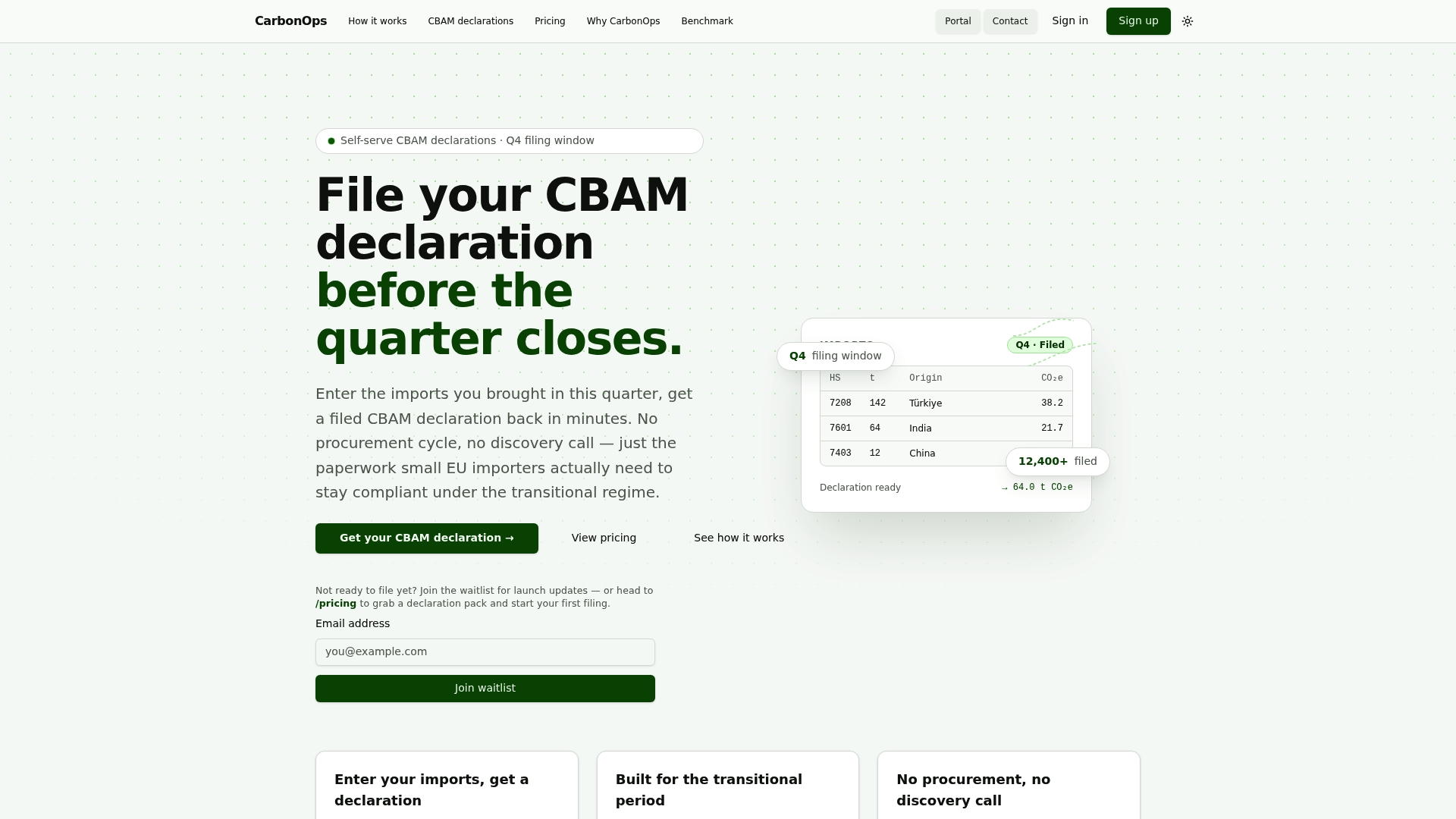
There’s no procurement cycle, no platform deployment, no sensor rollout. You bring the supplier data you already have; CarbonOps handles the CN code matching, the default-value fallback where supplier figures are missing, and the audit trail retention your six-year record-keeping obligation requires. It’s built for importers and the accountants or compliance officers handling filings on their behalf, priced per declaration rather than as a subscription, so a business filing one quarter’s shipments isn’t paying for a platform built around continuous enterprise use. If your first declaration is coming up, start your filing with CarbonOps and see what’s still missing before September 30 arrives.