CBAM Covered Products: The Sectors and Codes That Define Scope

CBAM Covered Products: The Sectors and Codes That Define Scope
CBAM covers goods from six sectors: cement, iron and steel, aluminum, fertilizers, hydrogen, and electricity. But the sector name on a shipping label doesn’t determine your obligation. The Annex I CN codes written into the CBAM Regulation do. If your product’s 8-digit CN code appears on that list, it’s a covered good, no matter what industry you think you’re in.
Your first move isn’t reading policy summaries. It’s pulling your import ledger and checking every CN code against Annex I.
- Cross-reference each SKU’s CN code against Annex I, not just the sector description on your invoice.
- Flag any shipment tied to cement, iron and steel, aluminum, fertilizers, hydrogen, or electricity for a closer look.
- Start requesting supplier emissions data now, since verification and reporting both depend on it.
Key Takeaways
CBAM scope is determined by Annex I CN codes across six sectors, and importers must verify emissions data before default values apply.
| Point | Details |
|---|---|
| Six sectors, one legal test | Cement, iron and steel, aluminum, fertilizers, hydrogen, and electricity are covered, but Annex I CN codes decide actual scope. |
| Functional units vary by sector | Cement uses clinker tonnes, fertilizers use kilograms of nitrogen, and electricity uses kilowatt-hours for emissions reporting. |
| De minimis has limits | The 50-tonne annual threshold excludes electricity and hydrogen entirely, regardless of import volume. |
| Definitive regime raises the stakes | Since January 1, 2026, importers need authorized declarant status and must submit through the CBAM Registry. |
| Verified data beats defaults | Supplier-verified emissions, confirmed by accredited verifiers, typically produce more favorable figures than Commission defaults. |
Table of Contents
- What Products Fall Under CBAM Product Categories?
- How Do You Confirm a Product Is Covered Under CBAM?
- What Changes Under the Definitive CBAM Regime?
- Are There Exemptions From CBAM Reporting?
- How Do You Turn CBAM Rules Into a Working Process?
- Where to Verify Official CBAM Details
- The Real Lesson From CBAM’s First Compliance Cycles
- Sources
What Products Fall Under CBAM Product Categories?
Each of the six sectors covers a different mix of raw materials, precursors, and finished goods. Knowing the general shape of each category helps you scan your import list faster, but the actual determination still comes down to CN codes.
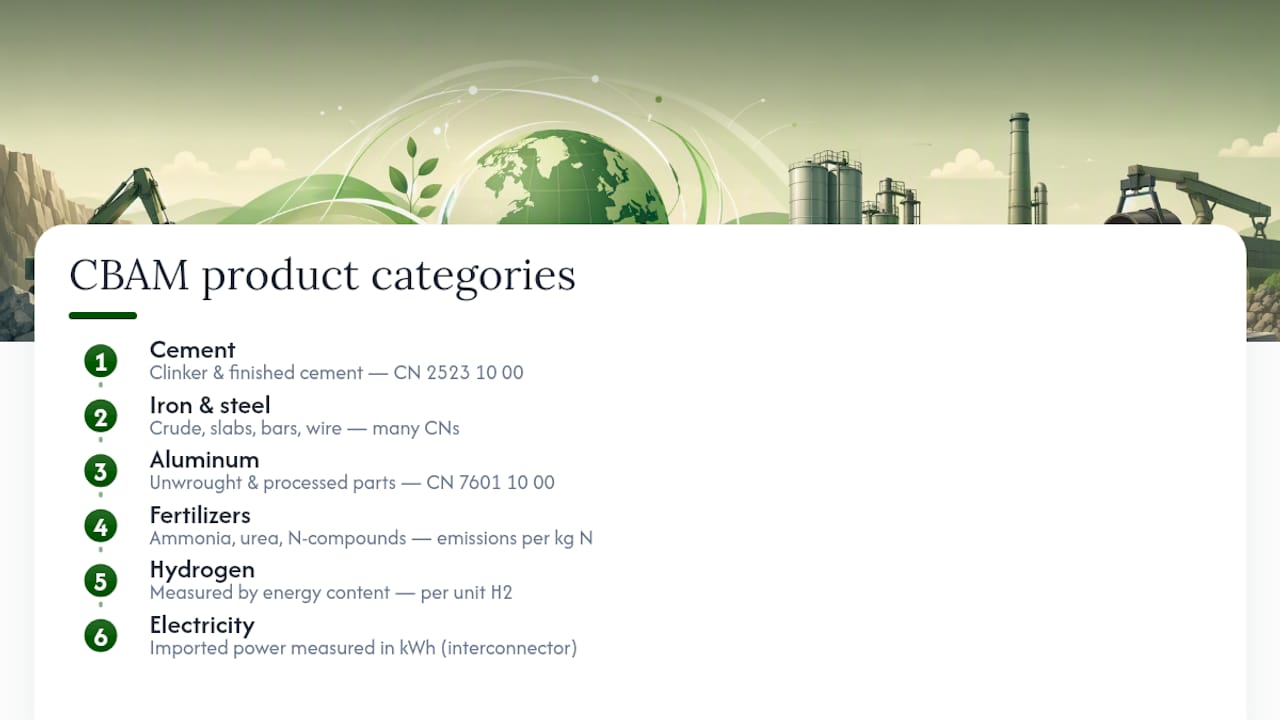
Cement covers clinker (the intermediate product baked in kilns before grinding) and finished cement itself. Clinker matters because it’s the functional unit used to calculate embedded emissions, even when the imported product is finished cement.
Iron and steel is the broadest category by volume. It includes crude steel, semi-finished products like slabs and billets, and a long list of downstream goods such as bars, wire, tubes, and certain fasteners. A single mill’s output can span dozens of CN codes.
Aluminum covers unwrought aluminum along with a range of processed aluminum products, from bars and sheets to certain finished parts.

Fertilizers center on ammonia, urea, and nitrogen-based compounds. Because nitrogen content drives the environmental impact, emissions here get reported per kilogram of nitrogen rather than per tonne of product.
Hydrogen is measured by energy content, typically reported per unit of hydrogen produced rather than by shipment weight.
Electricity is the outlier: there’s no physical shipment, only imported power measured in kilowatt-hours across an interconnector.
A few concrete examples show how this plays out at the code level. Portland cement clinker falls under CN 2523 10 00. Unwrought, non-alloy aluminum sits under CN 7601 10 00. Anhydrous ammonia is classified under CN 2814 10 00. Each of these appears explicitly in Annex I, and the Commission’s Q&A guidance walks through how related codes get grouped by production route.
Relying on a product’s general category instead of checking the CN code is one of the most common sources of scope errors. A finished good can look like it belongs to an exempt category while its actual CN code sits squarely inside Annex I.
How Do You Confirm a Product Is Covered Under CBAM?
Checking scope is a four-step exercise, and skipping steps is where most compliance gaps start.
- Find your 8-digit CN code. This is the same code your customs broker already uses for TARIC classification. Match it directly against the Annex I list rather than relying on a product description or HS heading alone.
- Apply the correct functional unit. Embedded emissions aren’t always calculated per tonne of finished product. Cement uses tonnes of clinker, fertilizers use kilograms of nitrogen, and electricity uses kilowatt-hours. Using the wrong unit produces a wrong emissions figure even if your CN code is right.
- Classify the good. Determine whether you’re importing a simple good, a complex good made from multiple CBAM-relevant inputs, or a precursor like clinker that feeds into another covered product. This affects whether aggregation rules under Guidance No. 3 apply.
- Handle multi-component goods separately. When a single shipment contains parts with different CN codes, report embedded emissions per component rather than blending them into one estimate. Guidance No. 3 also permits grouping CN codes that differ only in size or shape, such as steel coils of varying thickness, into one production process for monitoring purposes.
Pro Tip: Build a standing CN-code reference sheet for your recurring suppliers. Classification rarely changes shipment to shipment, so mapping it once saves you from re-verifying scope every quarter.
What Changes Under the Definitive CBAM Regime?
Since January 1, 2026, CBAM has moved from a reporting exercise into a financial and customs obligation. Importers now need authorized declarant status before bringing covered goods into the EU, and the mechanism folds directly into customs clearance rather than sitting alongside it.
Here’s what that means operationally:
- You must hold authorized CBAM declarant status, applied for through the CBAM Registry, before importing covered goods.
- Declarations get submitted through the Registry, with the first annual certificate surrender for 2026 imports expected in 2027.
- Emissions data should reflect actual, verified figures from your supplier wherever possible. Accredited verifiers confirm those numbers before you submit them.
- When verified data isn’t available, you fall back to the Commission’s published default values, which are typically less favorable than a supplier’s actual emissions performance.
- Your declaration must include embedded emissions, the country and installation of production, any carbon price already paid at origin, and adjustments for free allocation under the EU ETS.
That last point matters more than it looks. CBAM is designed to mirror the EU ETS carbon price, so any carbon cost your supplier already paid in production reduces what you owe. Skip that reporting step and you overpay.
Are There Exemptions From CBAM Reporting?
Most importers do get some breathing room, but it’s narrower than it sounds. The single de minimis threshold is 50 tonnes net mass per importer per calendar year, aggregated across your covered CN codes.
- Electricity and hydrogen are excluded from this exemption entirely, regardless of volume.
- Goods originating in countries with a carbon price linked to the EU ETS, including Norway, Iceland, Liechtenstein, and Switzerland, fall outside CBAM’s scope.
- Electricity imports have their own market-coupling exemption conditions, detailed in Annex III and the sector guidance rather than the main regulation text.
If you’re close to the 50-tonne line, don’t assume you’re safe. The threshold applies across your entire import volume for the year, not per shipment.
How Do You Turn CBAM Rules Into a Working Process?
Reading the regulation is one thing. Running a compliance process against it every quarter is another. A working checklist looks like this:
- Inventory every import by CN code and flag anything matching Annex I.
- Record net mass and country of origin for each flagged shipment.
- Request verified embedded emissions data from suppliers, or verifier reports if they already have one.
- Book an accredited verifier well before your filing deadline.
- Document any carbon price your supplier already paid in the production jurisdiction.
CarbonOps builds directly around that sequence rather than replacing it. You enter each shipment with its CN code, mass, and origin, and the system matches it against covered CN codes and sectors automatically. Where supplier-verified emissions aren’t ready yet, it applies the Commission’s published default values so every line still resolves to a complete figure. The output exports in the format the CBAM Registry expects, ready for review and filing.
Pro Tip: Start verifier outreach and supplier data requests at least one full quarter before your filing deadline. Verifier capacity tightens fast as deadlines approach, and a missing verified figure forces you onto default values that are usually less favorable.
Where to Verify Official CBAM Details
Consult the Commission’s CBAM landing page, sector-specific guidance pages, and the consolidated Regulation text for code-level detail. Annex I remains the definitive scope reference.
The Real Lesson From CBAM’s First Compliance Cycles
Most CBAM confusion doesn’t come from the sector list. It comes from importers trusting product descriptions instead of CN codes. A company selling “aluminum parts” assumes coverage or exemption based on how the product is marketed, then discovers months later that the actual 8-digit code tells a different story entirely.
The conventional advice, “check which sector you’re in,” undersells the work. Sector awareness gets you to the right chapter of Annex I. It doesn’t get you to the right line item. That only comes from matching codes directly, and building the discipline to do it for every SKU, every supplier, every quarter.
If there’s one place to spend disproportionate effort, it’s supplier data collection. Default values exist as a fallback, not a strategy. Importers who wait until a filing deadline to chase verified emissions data end up boxed into less favorable defaults simply because verifier calendars filled up. Start that conversation with suppliers now, not when the registry deadline is three weeks out.
Sources
- Consolidated text: Regulation (EU) 2023/956 — EUR-Lex
- CBAM Questions and Answers (European Commission)